
- Buy Crypto
- Markets
 Futures
- Spot
- Copy Trade
 Earn
Earn- More
Crypto Market Update: Potential Trend Reversal Ahead, Capitalizing on Short-Term Funding for Investment Opportunities

Original Article Title: "Crypto Market May See Trend Reversal, Capturing Investment Opportunities from Short-Term Fundamentals"
Original Article Author: Alfred, Trend Research
1. Macro Improvement and Gradual Recovery of Crypto Market
1. Signs of Tariff Easing
The short-term direct emotional impact and risk-off trades brought about by Trump's tariff policy have eased, and the current market volatility has decreased. On Tuesday, April 22nd, local time, Trump made a speech in public, acknowledging that the current U.S. tariffs on Chinese imports are too high and are expected to be significantly reduced. This marks a moderation in Trump's signature tariff policy stance.
2. Expectation of Interest Rate Cuts
The current CME interest rate futures imply rate cuts starting in June, with a total of three cuts within the year. This may inject new liquidity into the market.

3. Gradual Implementation of Crypto-Friendly Policies
Since Trump took office, the crypto market has become a key industry for his development, aiming to create a new "dollar hegemony" system. (1) On March 6, 2025, Trump signed an executive order officially establishing the "Strategic Bitcoin Reserve" and "U.S. Digital Asset Reserve." The plan is currently advancing, while dozens of states in the U.S. are advancing Bitcoin state reserve bills. If Arizona passes the final third reading, it will be submitted for the governor's signature.
(2) Currently, the U.S. is advancing two stablecoin bills, namely the "GENIUS Act" (Guiding and Establishing National Innovation in Stablecoin Act) and the "STABLE Act" (Stablecoin Transparency and Accountability For Economies Act). Both proposals have been introduced in their respective committees and have received approval. It is widely expected in the industry that the final bills may be passed and implemented in the second half of 2025, depending on the coordination speed between the two houses and the president's attitude.
(3) On April 22nd, Paul Atkins, nominated by Trump, officially replaced Gary Gensler as the SEC chairman. Atkins is seen as a regulator friendly to the crypto industry and is expected to reduce enforcement actions against crypto companies, promoting industry innovation.
4. BTC Shifts from Bearish to Bullish
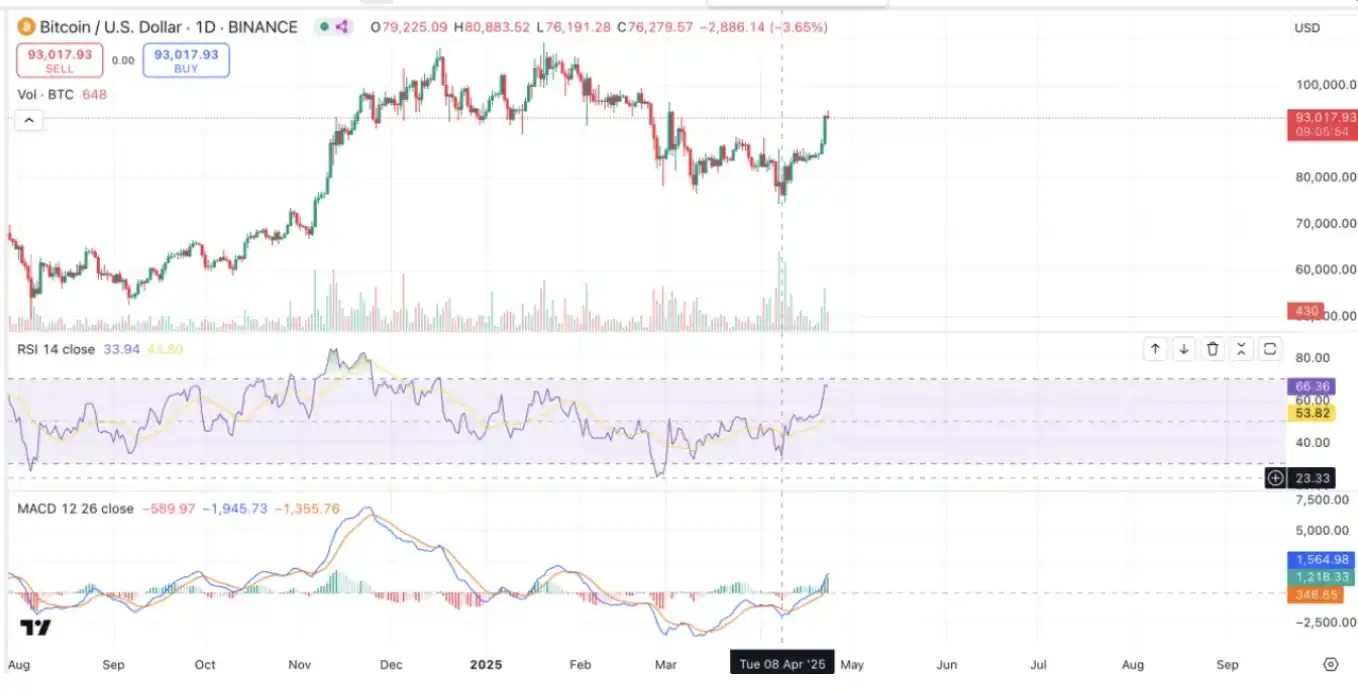
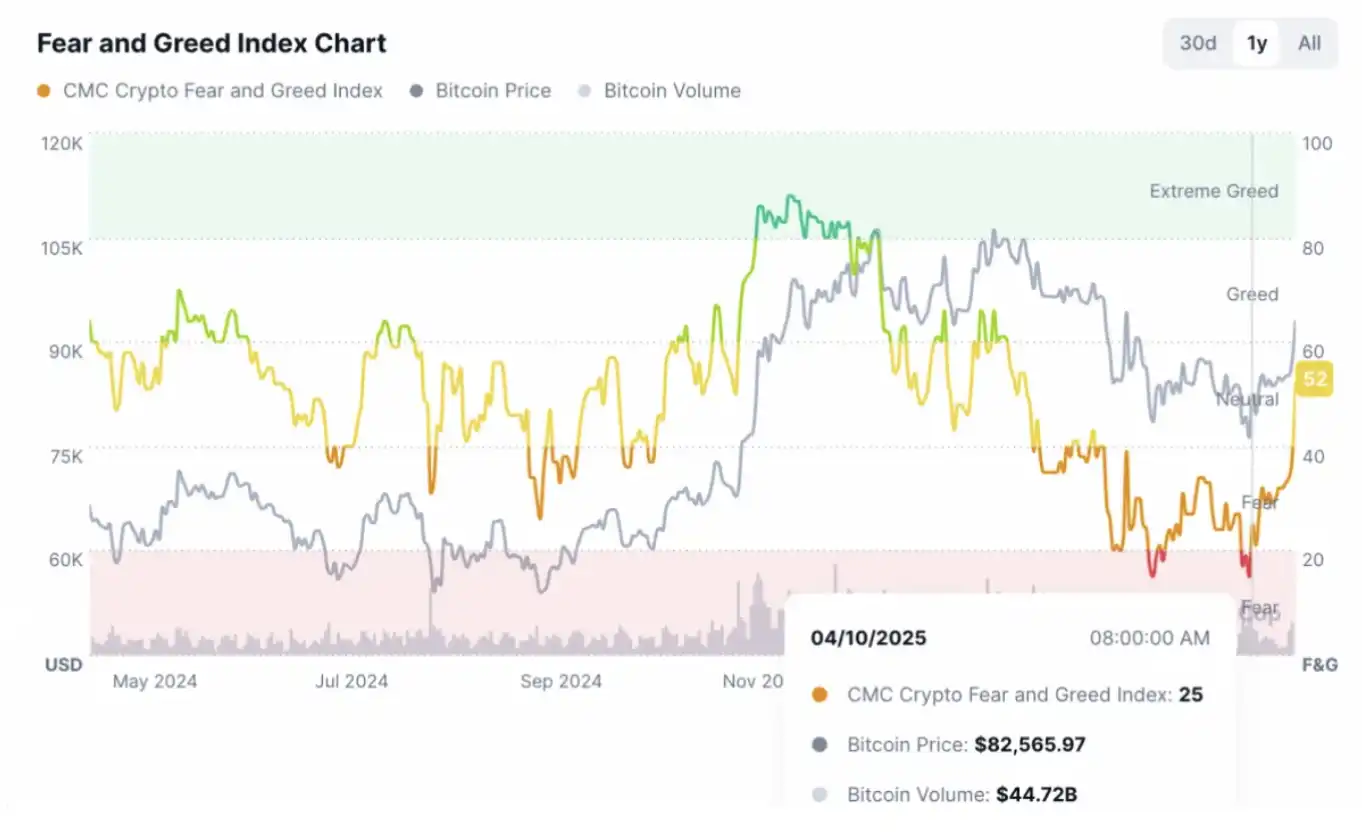
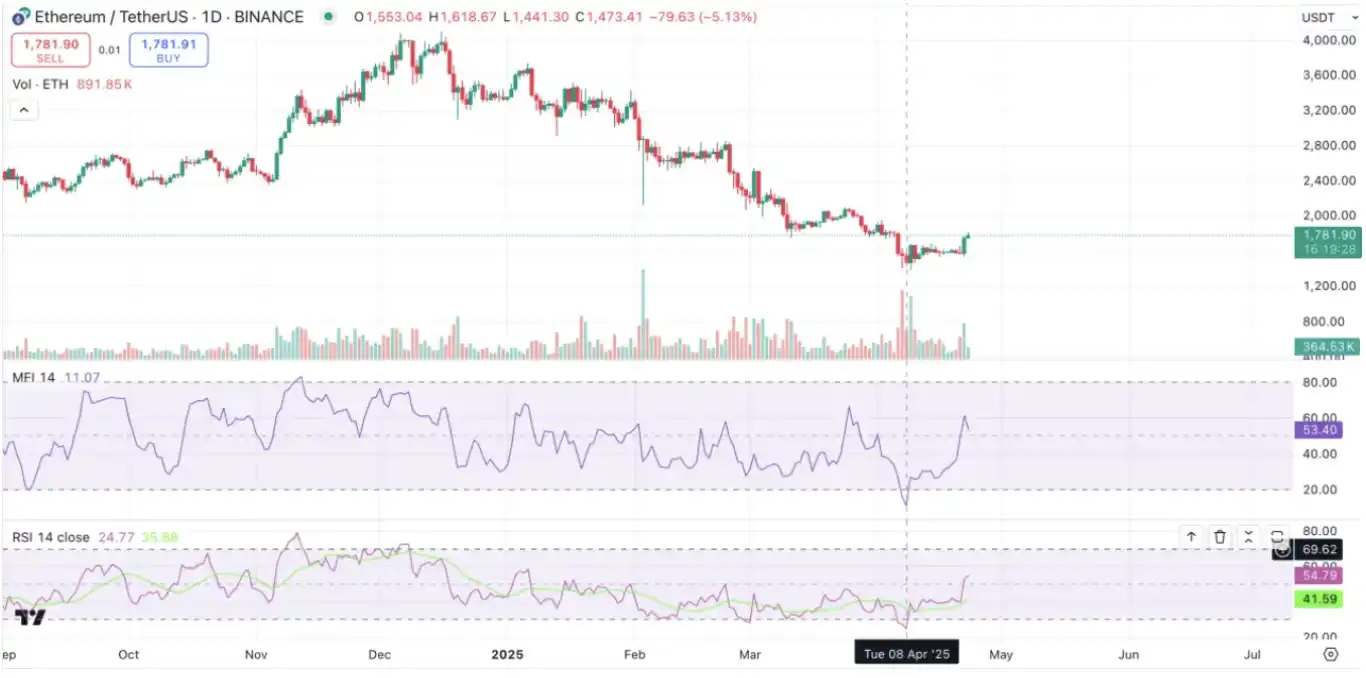
Since mid-March, BTC has performed better than the U.S. stock market, demonstrating a hedge-like property similar to gold. Around April 8th, BTC showed a bullish divergence in both RSI and MACD, combined with sentiment indicators reaching extreme fear levels, forming a recent bottom. As of now, both the MACD fast line and slow line have crossed above the zero axis, indicating a shift in market trend from bearish to bullish.
2. Trend Reversal of ETH or Leading Shitcoin
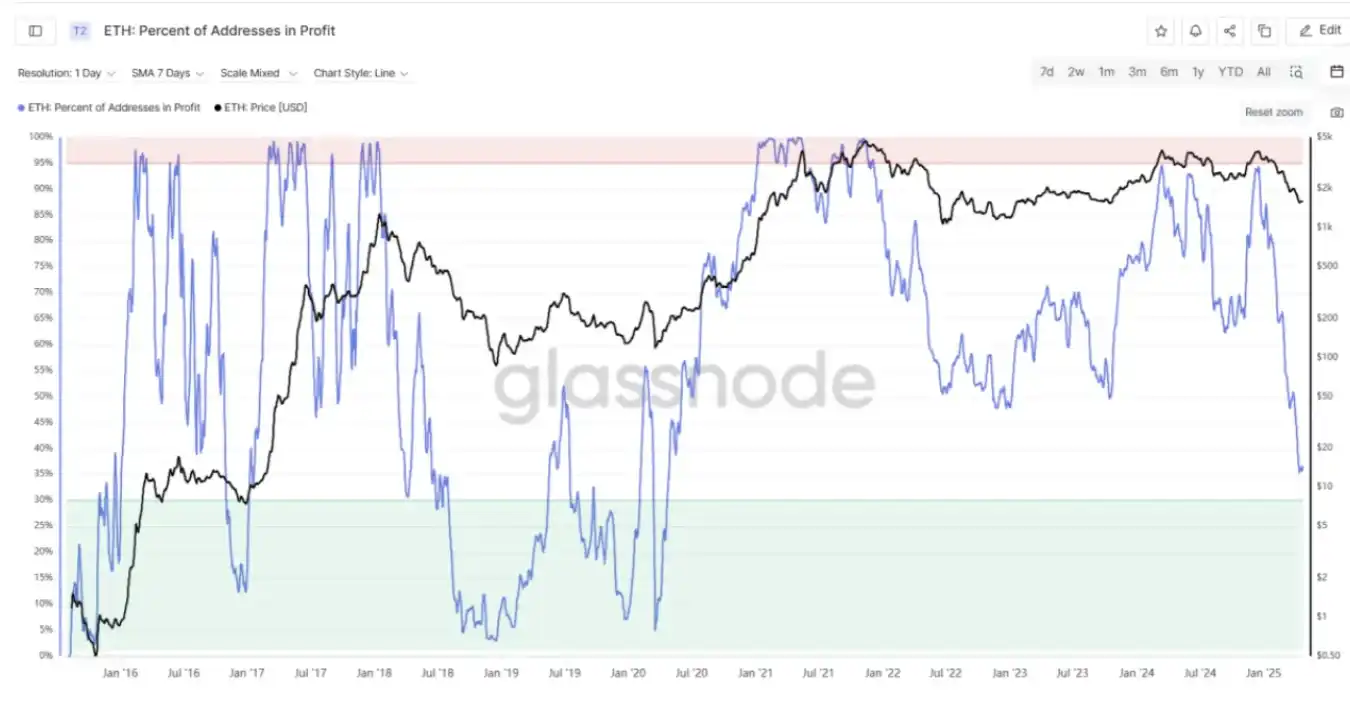
1. On-chain Data: ETH has experienced a prolonged 5-month decline from December 2024 to the present, with the number of profitable addresses dropping to a lower level seen in the bear market, continuously oversold. Currently, along with the overall crypto market recovery, ETH has entered a critical support-resistance swap range.
(1) Profitable Address Data
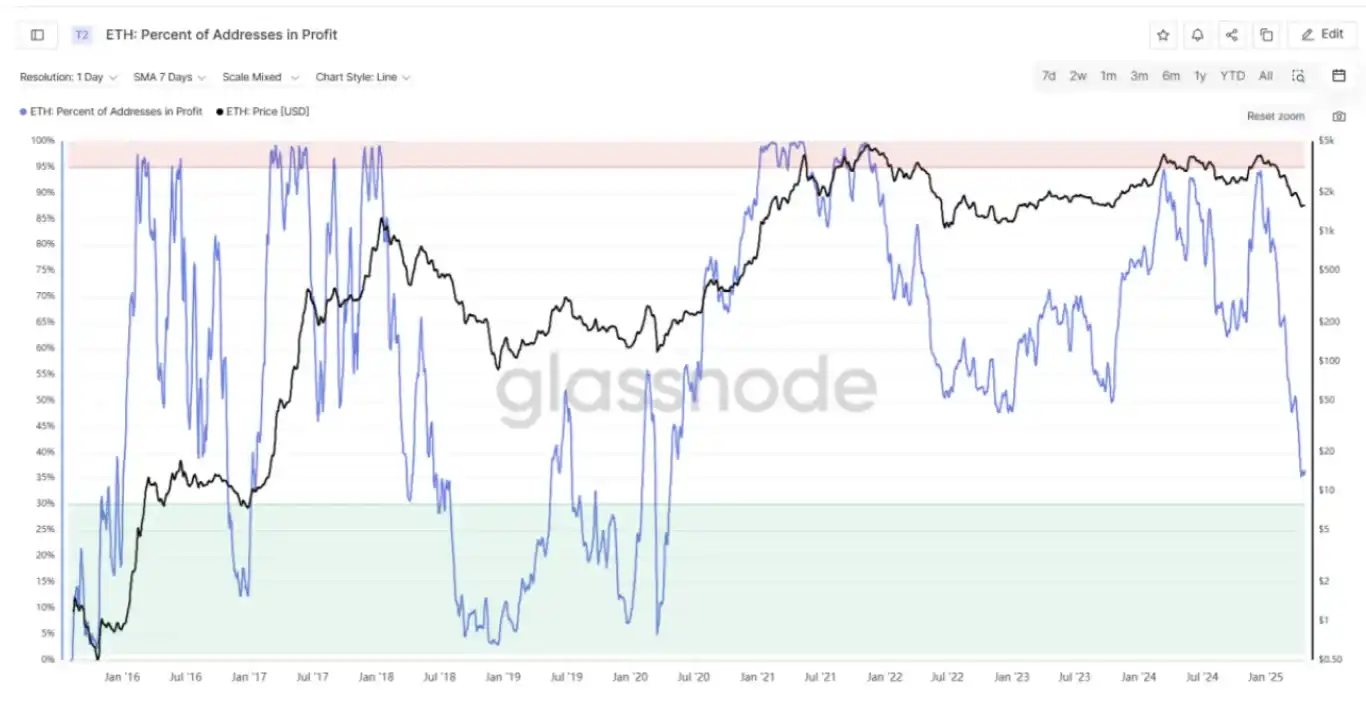
The number of profitable addresses has plummeted, from nearly 95% profitability at the end of last December to only around 35% of addresses still in profit. This level is even lower than during the 2022 bear market.
(2) MVRV Ratio
The MVRV ratio has dropped to 0.8, with the market value now lower than the realized value, clearly entering an oversold state, comparable to the bear market phases of 2022 and 2019.
(3) Cost Basis Distribution
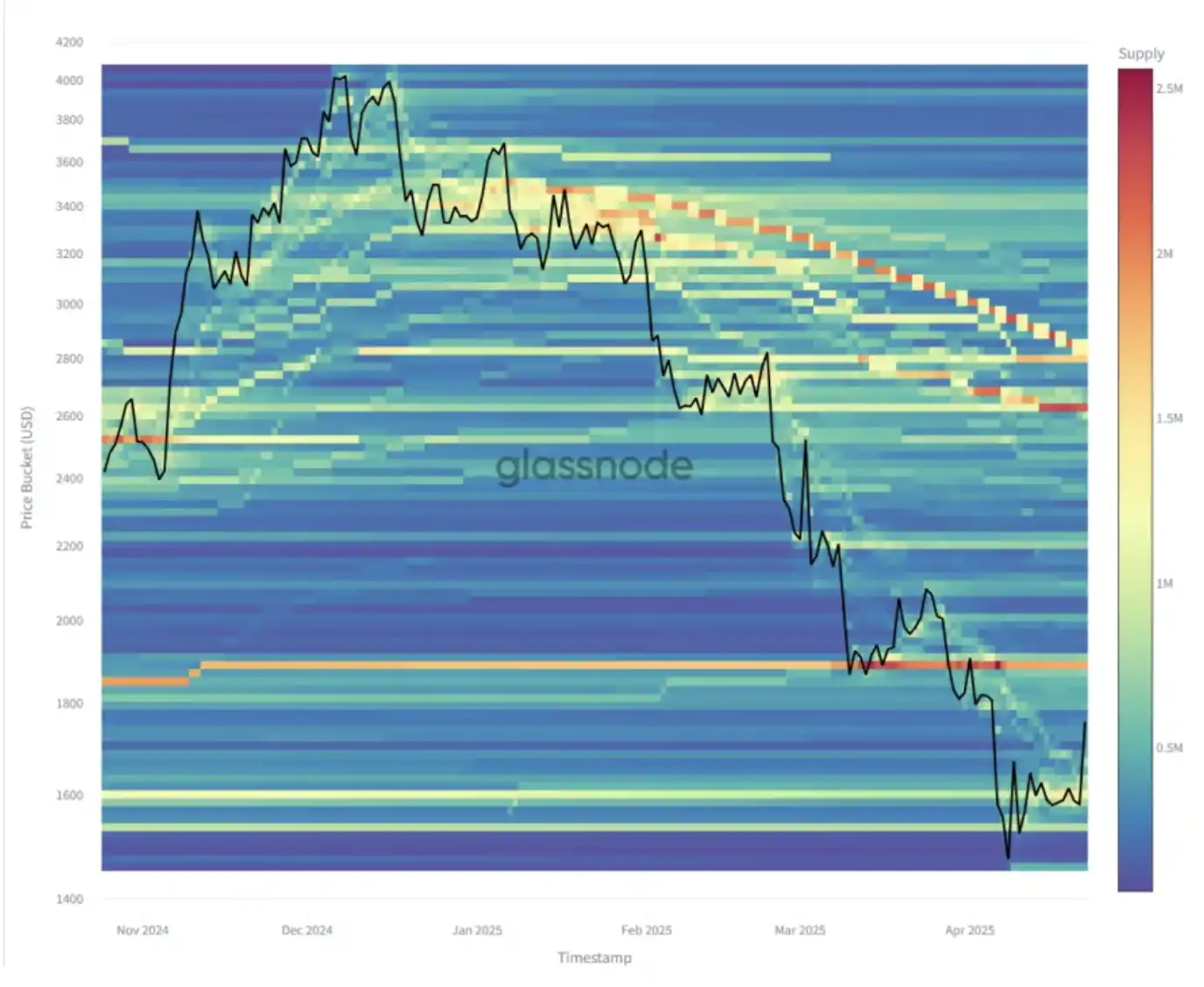
The redder the color, the more chip exchanges are happening. The four active trading regions are: $3200–$3400, $2600–$2800, $1850, and $1650.
In the $3200–$3400 region, over time, holders have not been able to hold steadfastly but instead have sold off (color changing from orange, yellow to green). In the $2600–$2800 region, accumulation time is short, but currently, holders appear to still be holding without significant sell-offs. The $1850 region represents long-term holders who have held since November 2024 without major changes. The $1650 level is an accumulation zone formed to find a new bottom after this drop.
Looking at the cost basis distribution, there is a significant accumulation zone of chips near $1850 held by long-term holders. It is necessary to observe whether a pressure-support swap will form around $1850, creating a new support level.
2. Contract Data Analysis: As the second-largest cryptocurrency by market capitalization, ETH has a massive contract market size, with the contract market size of trading platforms being several times or even tens of times larger than their wallet balances. Currently, the contract market has experienced a certain degree of synchronous rise driven by spot funds.
(1) Contract Position Change
The current total ETH contract position is $21.821 billion, with a market capitalization of $216.9 billion and an OI/MC around 10%. This indicator is around 3.5% for BTC, 7.3% for SOL, and 0.9% for BNB among major cryptocurrencies, showing that ETH has greater liquidity and significance in the contract space.
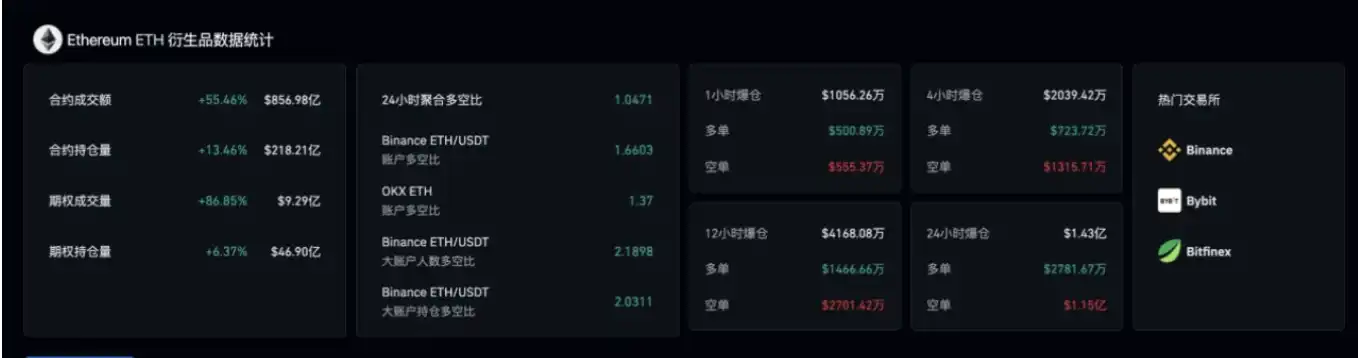
The current total Binance ETH-USDT contract position is 1.789 million ETH, making it the largest ETH contract trading pair in terms of position size.
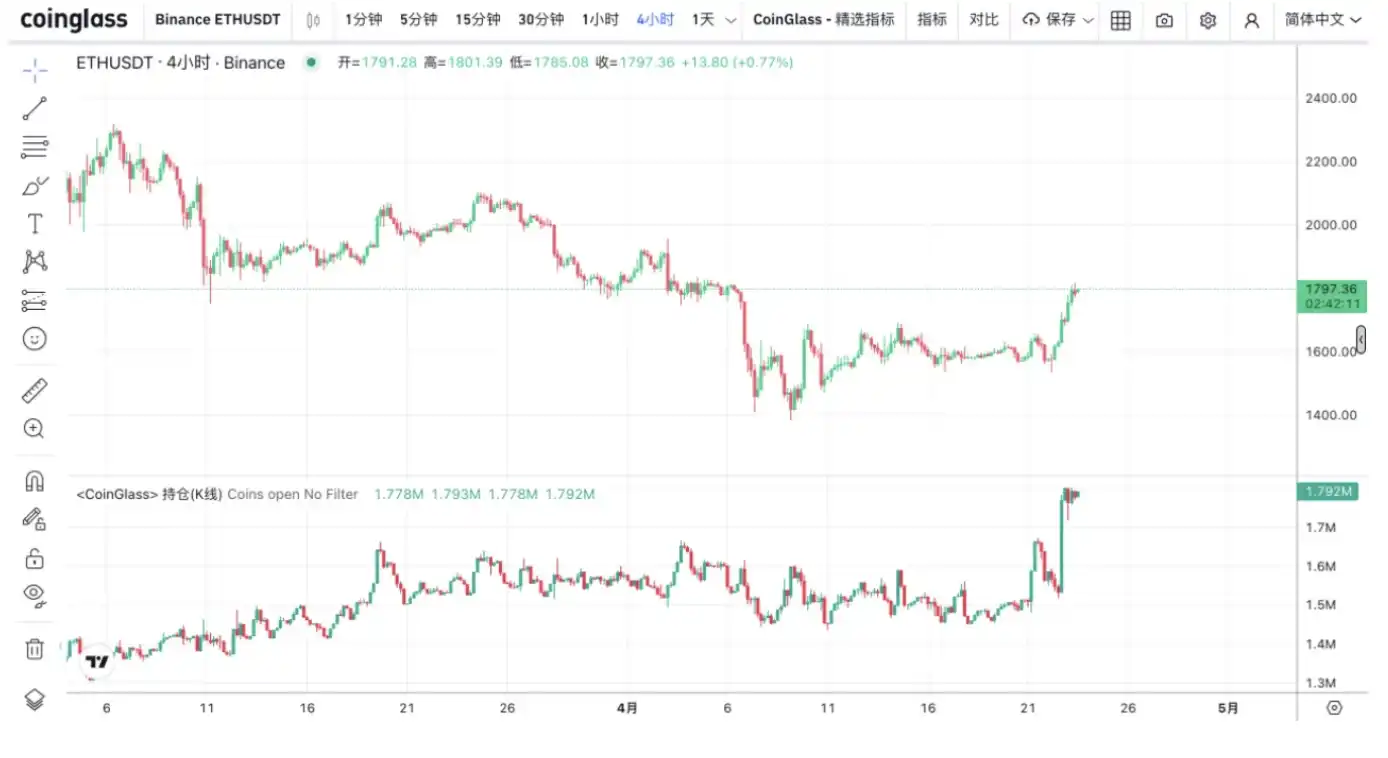
Based on the chart below, since April 11, ETH has tested the resistance level around 1650 three times, with the contract position and price demonstrating a positive correlation. On the night of April 22, a significant rise in the ETH contract position drove the price breakthrough to $1695, followed by the contract position remaining in a range-bound manner while the price continued to surge to $1800. This rally was driven by leveraged and spot funds simultaneously.
(2) Exchange Balance Situation
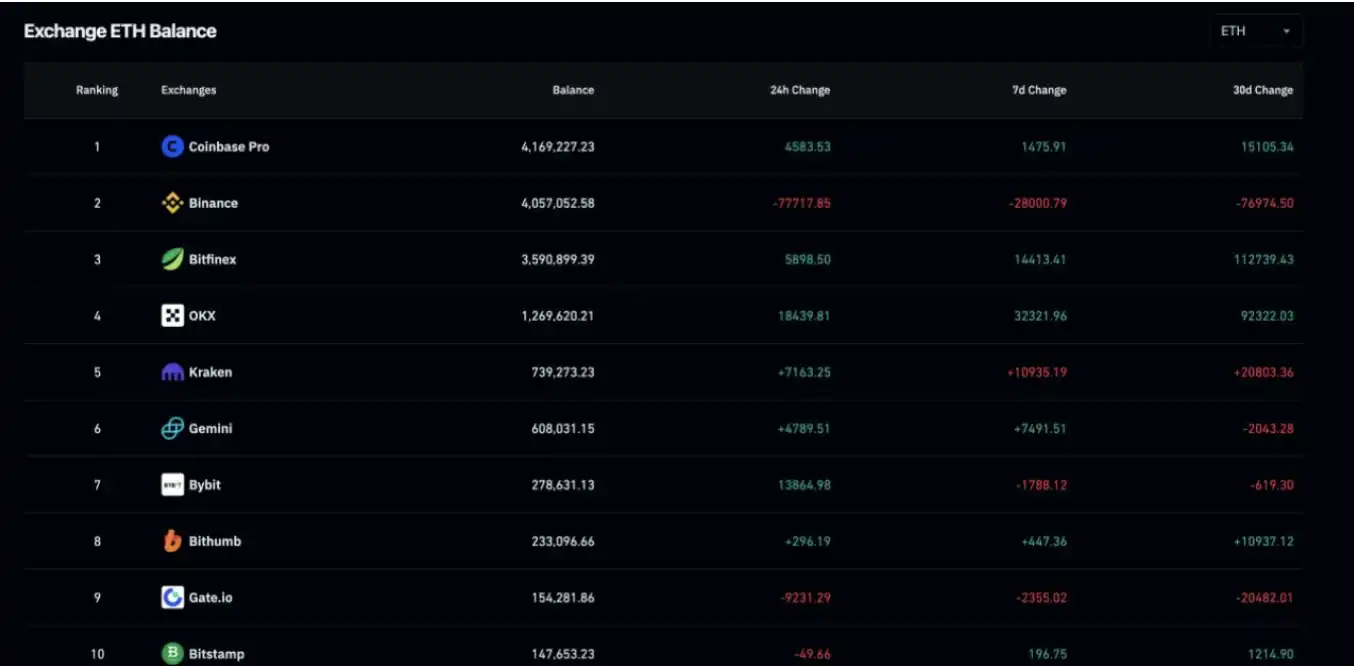
There is a significant gap between the ETH balance in exchange wallets and the corresponding contract volume held by the exchange. The Bybit exchange wallet balance is 276,300 ETH, while the exchange's contract position is 1.147 million ETH, meaning that Bybit has opened positions worth 1.147 million ETH based on a balance of 276,300 ETH, a leverage ratio of 4.15. The Gate wallet balance is 154,000 ETH, and the exchange's contract position is 1.9052 million ETH, resulting in a leverage ratio of 12.3. The Binance wallet balance is 4.057 million ETH, while the exchange's contract position is 2.3926 million ETH, indicating a leverage ratio of 0.6. These data represent the best practices among various exchanges. In many exchanges currently, the contract position in ETH is several times that of the spot reserve balance, and the high derivative scale has increased fund efficiency while providing significant liquidation profit space for both long and short positions.
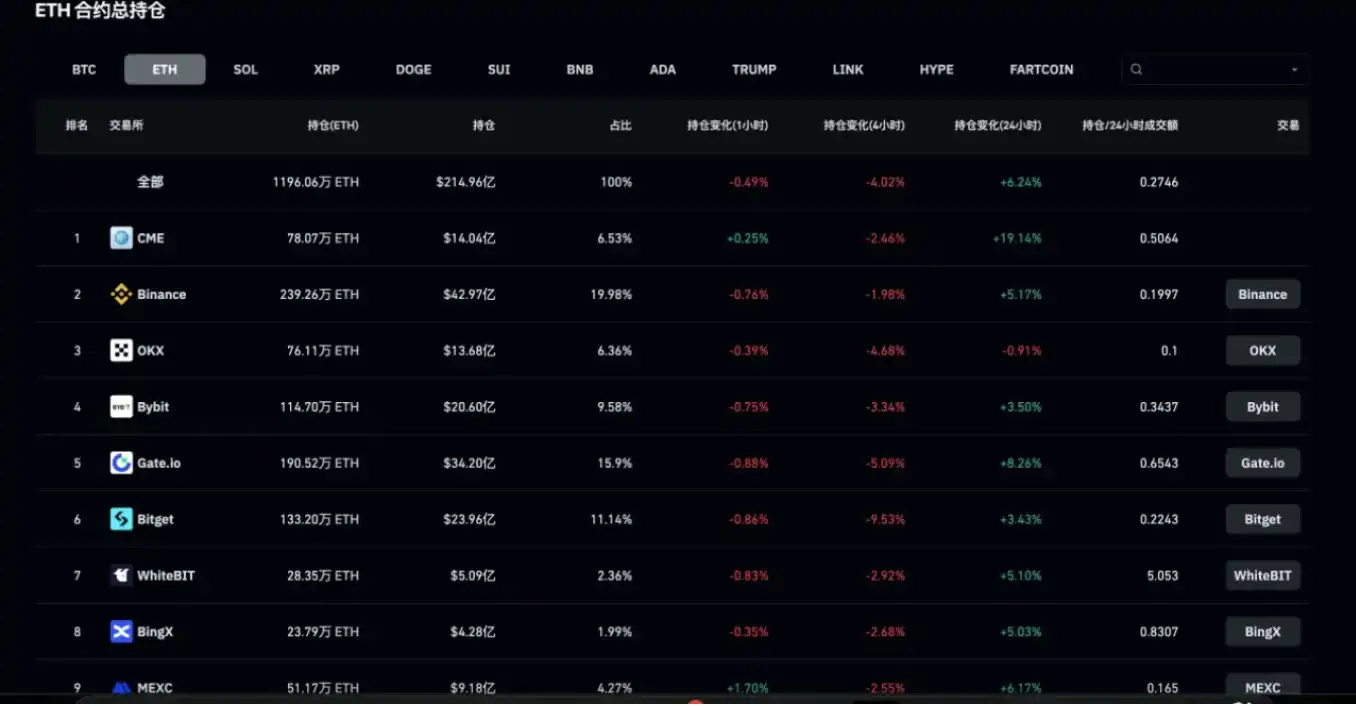
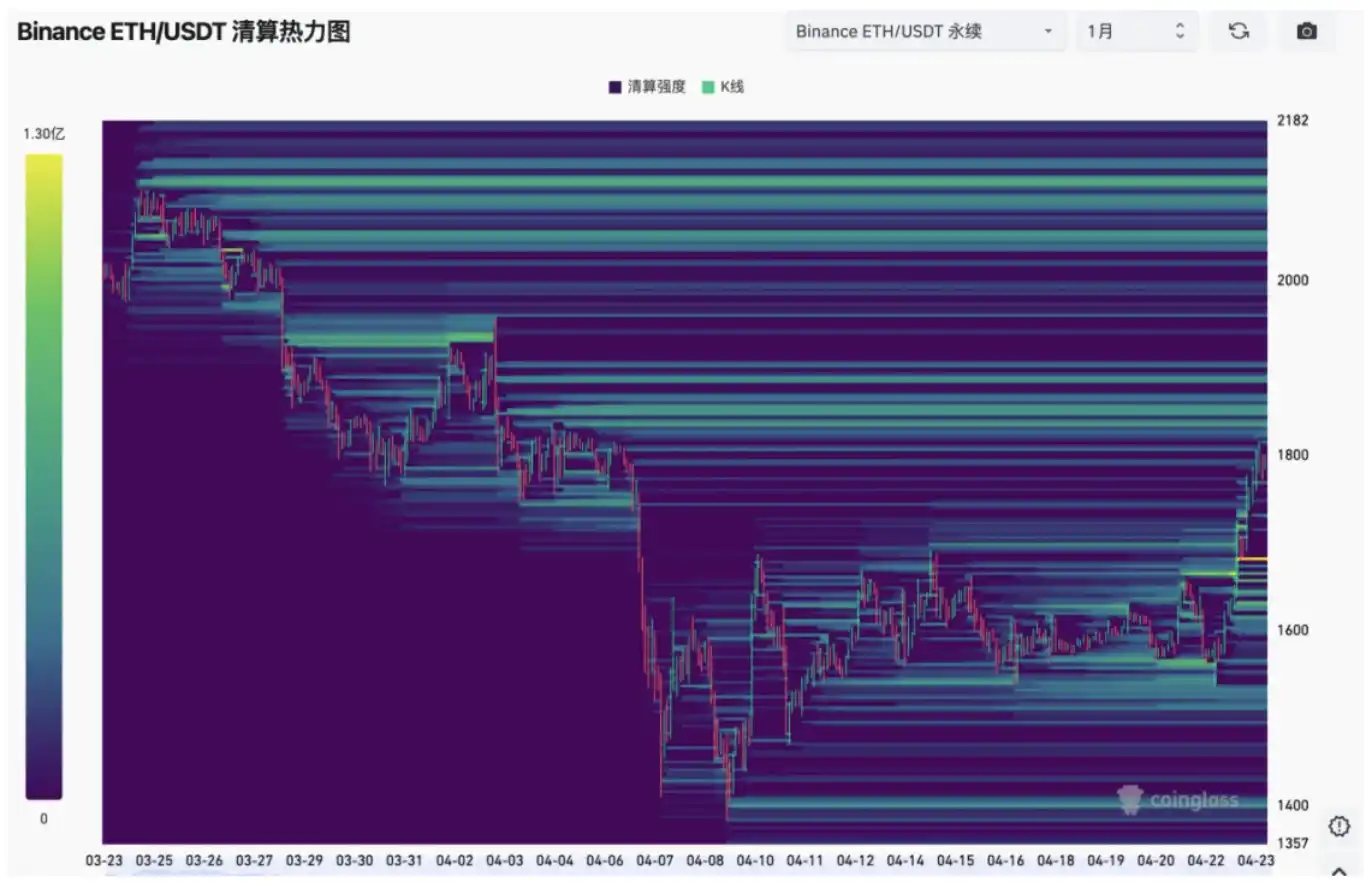
(3) Monthly Liquidation Data
Binance's short liquidations are concentrated below $1900, high-leverage short liquidations are concentrated from the current price to $1847, and long liquidation contract prices are concentrated at $1682.
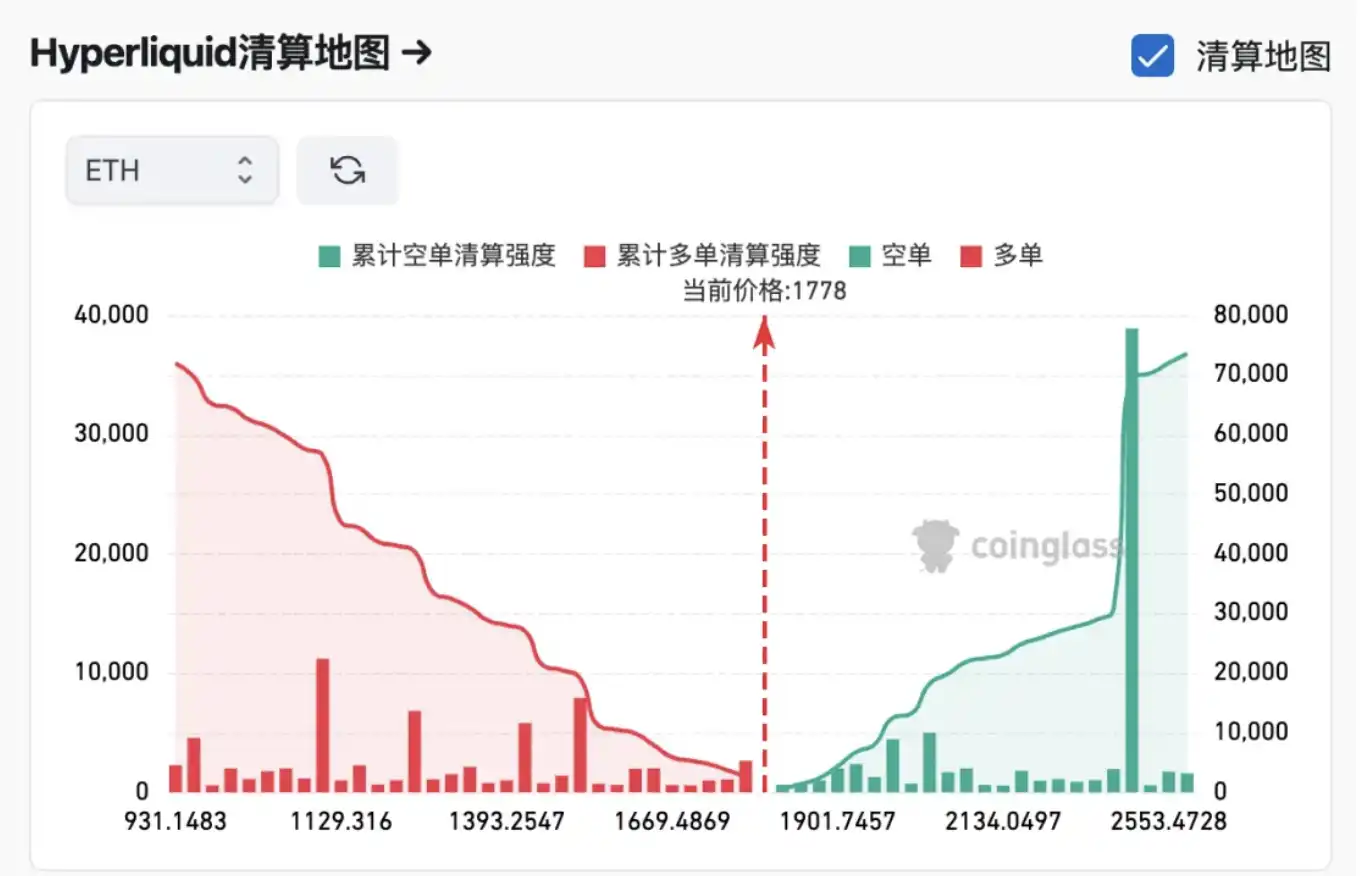
The majority of liquidations on Hyperliquid were concentrated around $2478, followed by $1896 and $1931 for short positions. On the other hand, the liquidation prices for long positions were more scattered, ranging from $1765, $1471, $1426 to as low as $1099.
3. Technical Analysis: Several technical indicators for ETH have recently shown signs of a bottoming pattern, indicating the possibility of a bullish reversal. The current price is testing the upper boundary of a descending channel and horizontal resistance, with a breakout and confirmation on a pullback potentially signaling a buying opportunity.
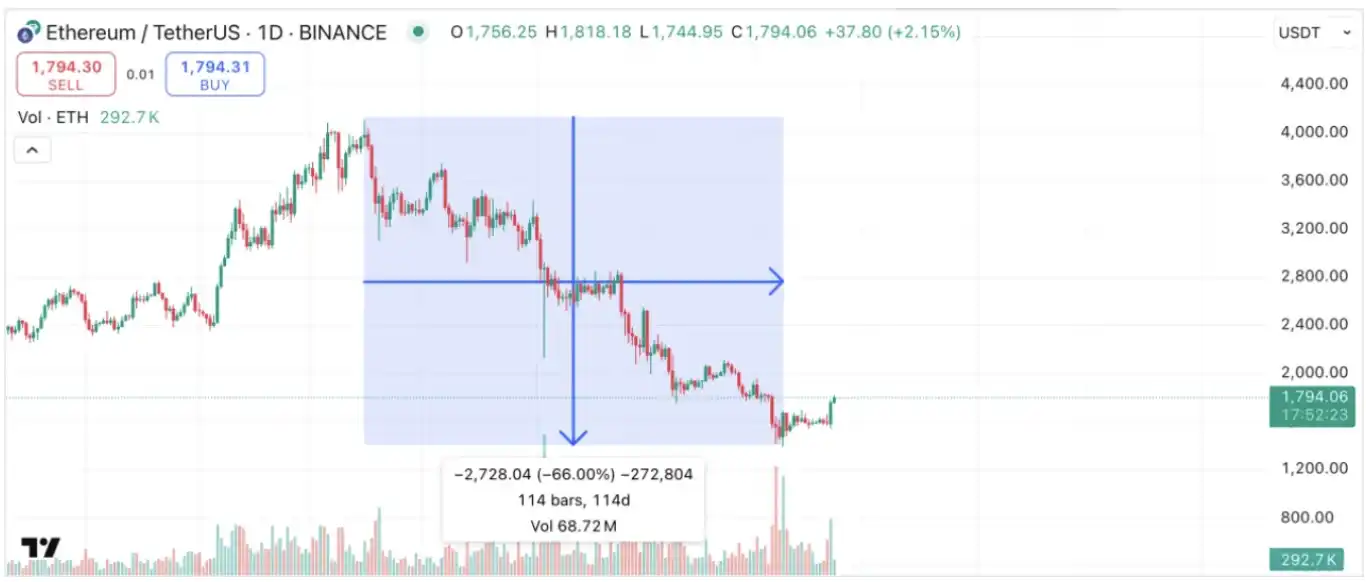
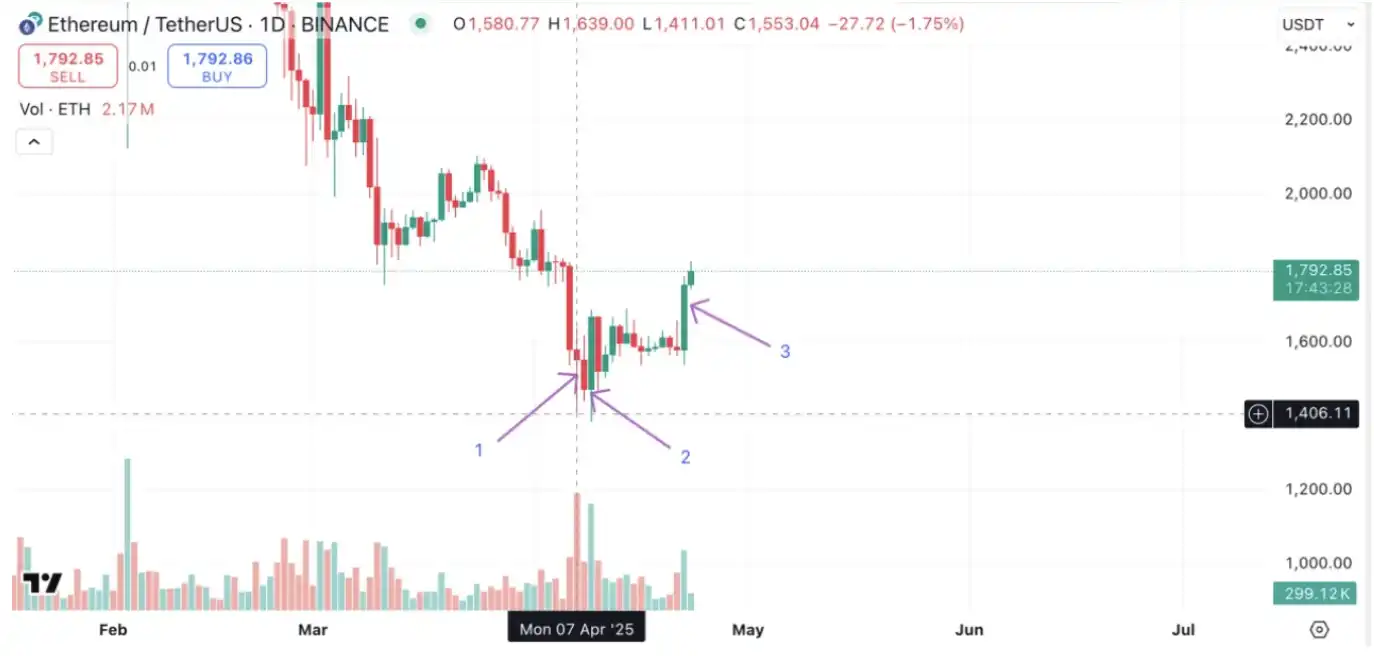
Over the past four months, ETH has been in a downtrend, experiencing a 66% price drop from a high of $4100 to a low of $1385. Recently, there has been a noticeable bullish defense on the chart, with a rebound of around 30% from the low point to the vicinity of $1800 as of April 23rd.
(1)Candlestick Patterns
In the chart below, the first candlestick (1) shows a spring pattern as per the Wyckoff theory, with the highest volume in two months. This candle has a long lower shadow and a narrow real body, indicating a mismatch between effort and result, reflecting potential buying power from institutional investors at this level. In a downtrend, the appearance of a Spring may signal a trend reversal and is one of the signals of a shift from bearish to bullish sentiment.
Candlesticks 2 and 3 exhibit a Bullish Engulfing pattern, signaling a bullish reversal. This pattern consists of two candlesticks where the first is bearish and the second is bullish, completely engulfing the real body of the previous candlestick. It typically occurs in a downtrend and is seen as a potential signal for a trend reversal to the upside.
(2)Moving Averages
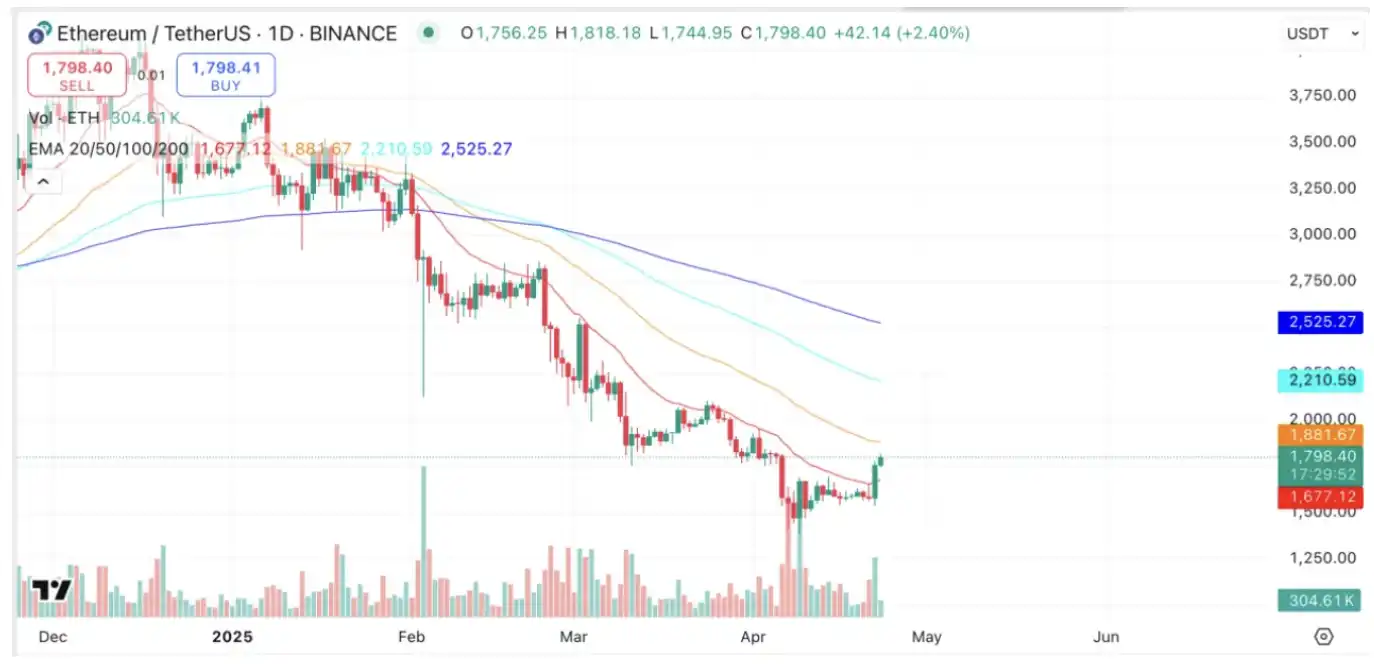
ETH has been trading below the 20-day EMA (red line) for a long period. Yesterday, there was a strong breakout above the EMA20, suggesting a possible trend reversal. Further confirmation can be sought by observing whether the candlesticks in the next 2-3 days can stay above the EMA20.
(3)MACD&Momemtum
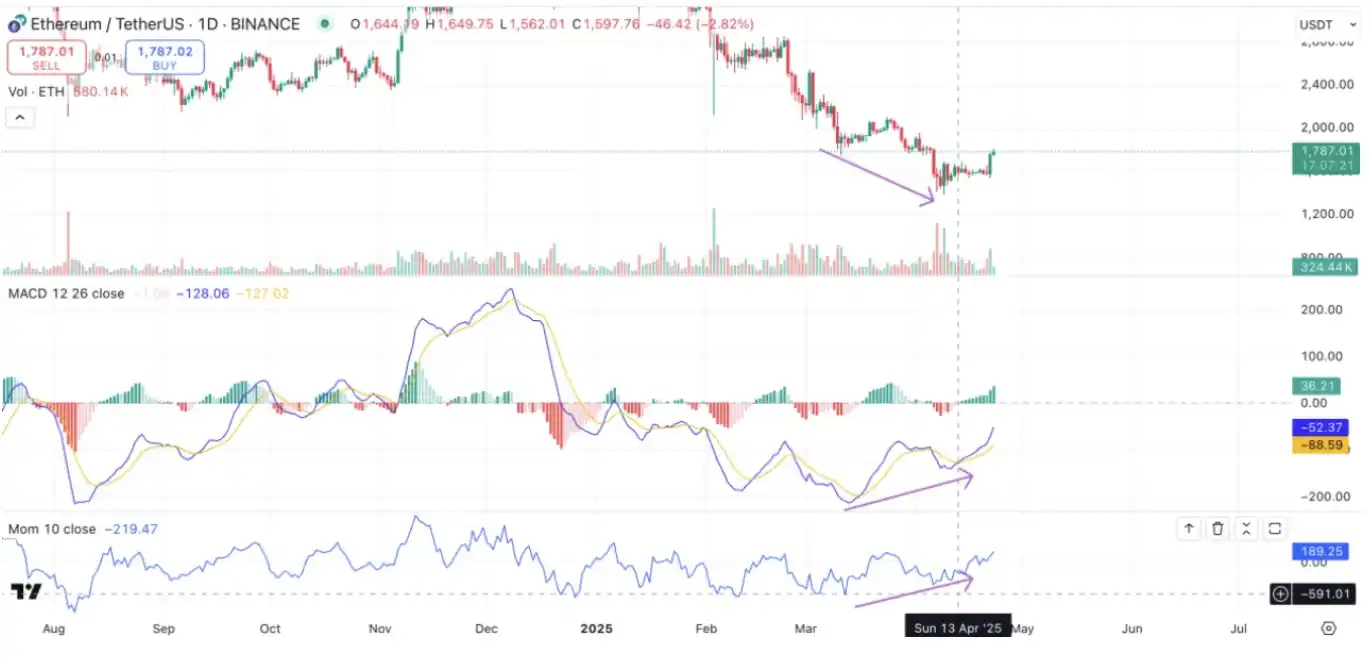
A very clear divergence between daily MACD and momentum can be observed, meaning that although the price made a new low, the indicators did not follow suit. This suggests a weakening of the bearish momentum, indicating a possible end to the downtrend. Additionally, on April 13th, the MACD fast line crossed above the slow line, forming a golden cross and providing a potential buying opportunity.
(4)RSI&MFI
Both the Relative Strength Index (RSI) and Money Flow Index (MFI) entered the oversold zone on April 8th.
III. Altcoin Opportunity Exploration
Recently, as the cryptocurrency market cap rallied, BTC broke through a key resistance level, and ETH rose to a crucial support-turned-resistance level, leading to signs of a market turnaround. Some assets saw astonishing price surges, with NEIROETH in the meme sector experiencing a more than 210% increase on the 3rd day. The AI sector saw the largest overall gains, with ZEREBRO surging over 200% in 3 days. Both assets exhibited unusual on-chain activities at the contract level and are showing further upward trends. This article analyzes these two top performers from different sectors.
1. NEIROETH
(1)Project Introduction
NEIROETH (Neiro on Ethereum) is a meme coin based on the Ethereum network, inspired by Neiro, a Shiba Inu dog adopted by the owner of the original Dogecoin prototype dog, Kabosu, on July 28, 2024. NEIROETH has sought to attract community attention through its cultural association with Dogecoin.
NEIRO (First Neiro on Ethereum) shares a similar concept with NEIROETH and was launched subsequently. Both projects claim to embody the spirit and community of the Shiba Inu Neiro, sparking the well-known "NEIRO uppercase-lowercase debate." NEIRO eventually landed on Binance for spot and futures trading, while NEIROETH only listed on Binance futures. Both are meme projects with large community followings.
(2)Token Basic Information
NEIROETH is currently valued around $61 million, with a total supply of 1 billion and no team reserves in circulation.
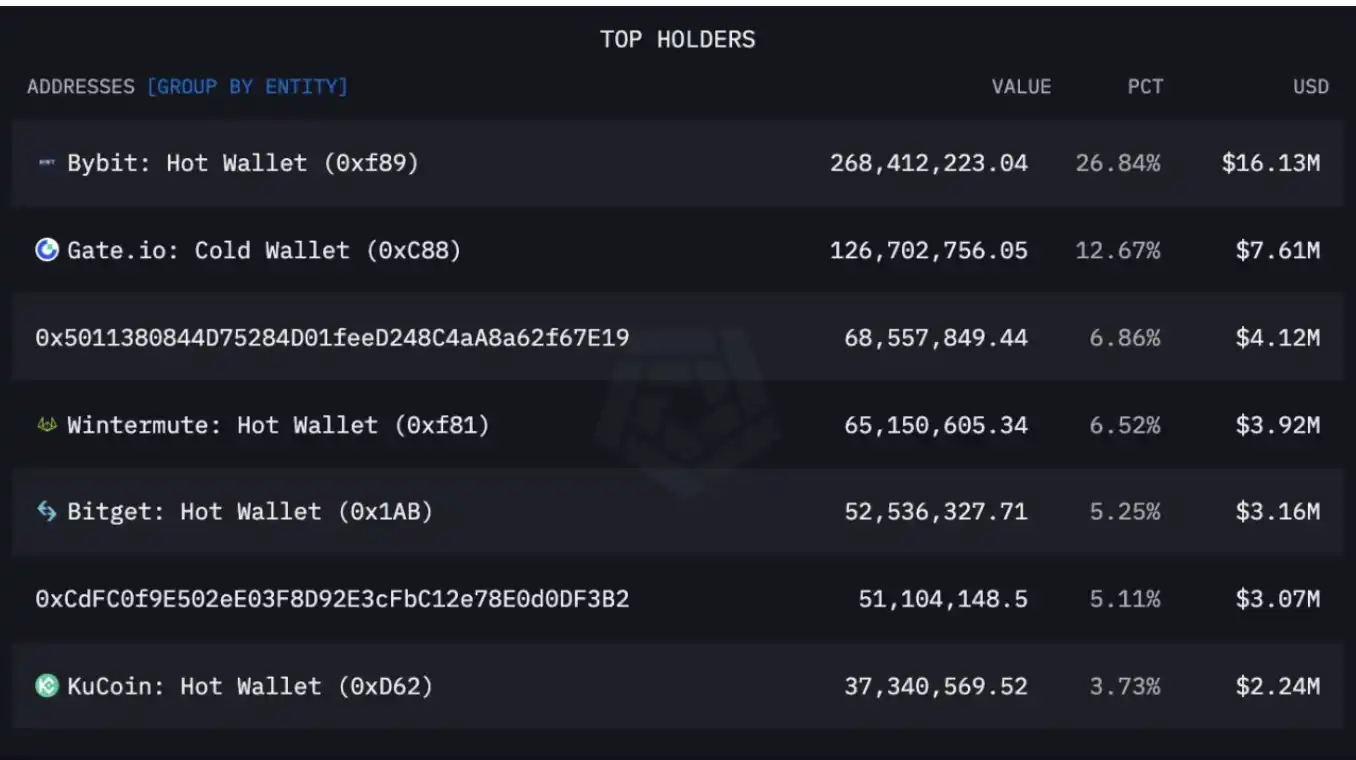
The 24-hour spot trading volume is $35 million, with spot trading mainly concentrated on Bybit (30.65%) and Gate (29.38%). In terms of spot chip distribution, the top three holders are Bybit (26.84%), Gate (12.67%), and Bitget (5.25%). Two unmarked whale addresses hold 6.86% and 5.11% respectively, market maker Wintermute holds 6.52%, indicating that the main chip distribution of the token is in mid-tier exchanges, some whales, and in the hands of market makers. The top holder Bybit holds $15.16 million in chips control.
The 24-hour contract trading volume is $843 million, which is 24 times that of spot trading, with contract trading mainly concentrated on Binance, Okex, and Bybit. The 24-hour trading volume increases of the three platforms are 38.48%, 27.16%, and 50.45% respectively, and the 24-hour open interest increases are 121%, 99.7%, and 104.2% respectively. The above data reflects that the main trading market for NEIROETH is the contract market, which has experienced recent volatility. At the same time, its token price has seen an astonishing increase, with a 3-day increase of over 200%.
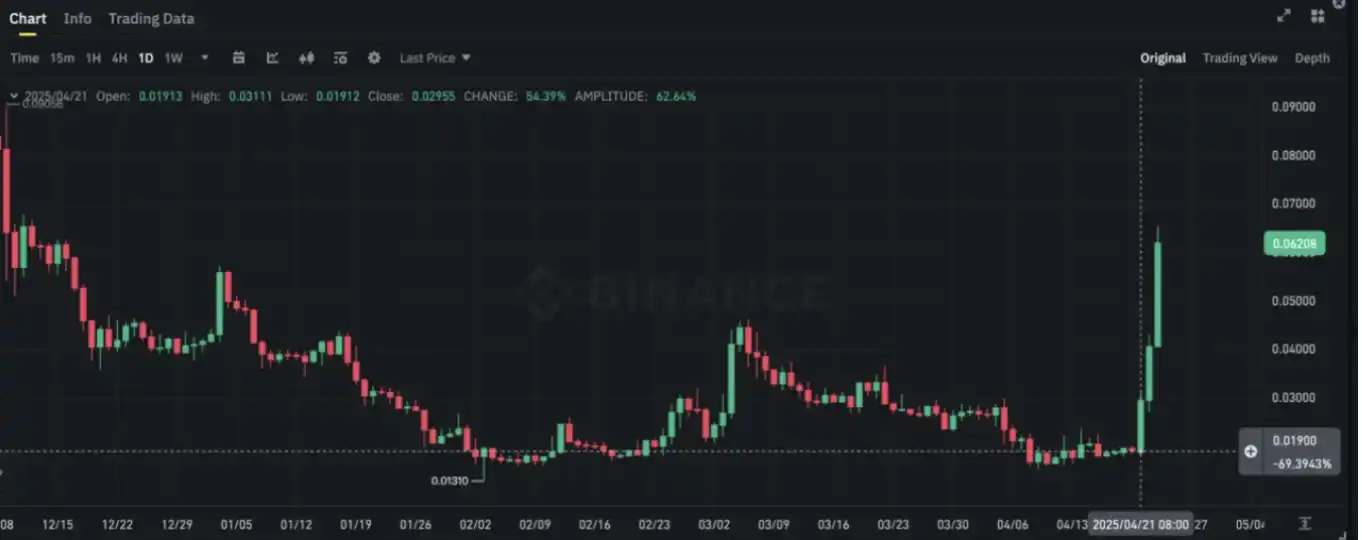
(3)Contract Analysis
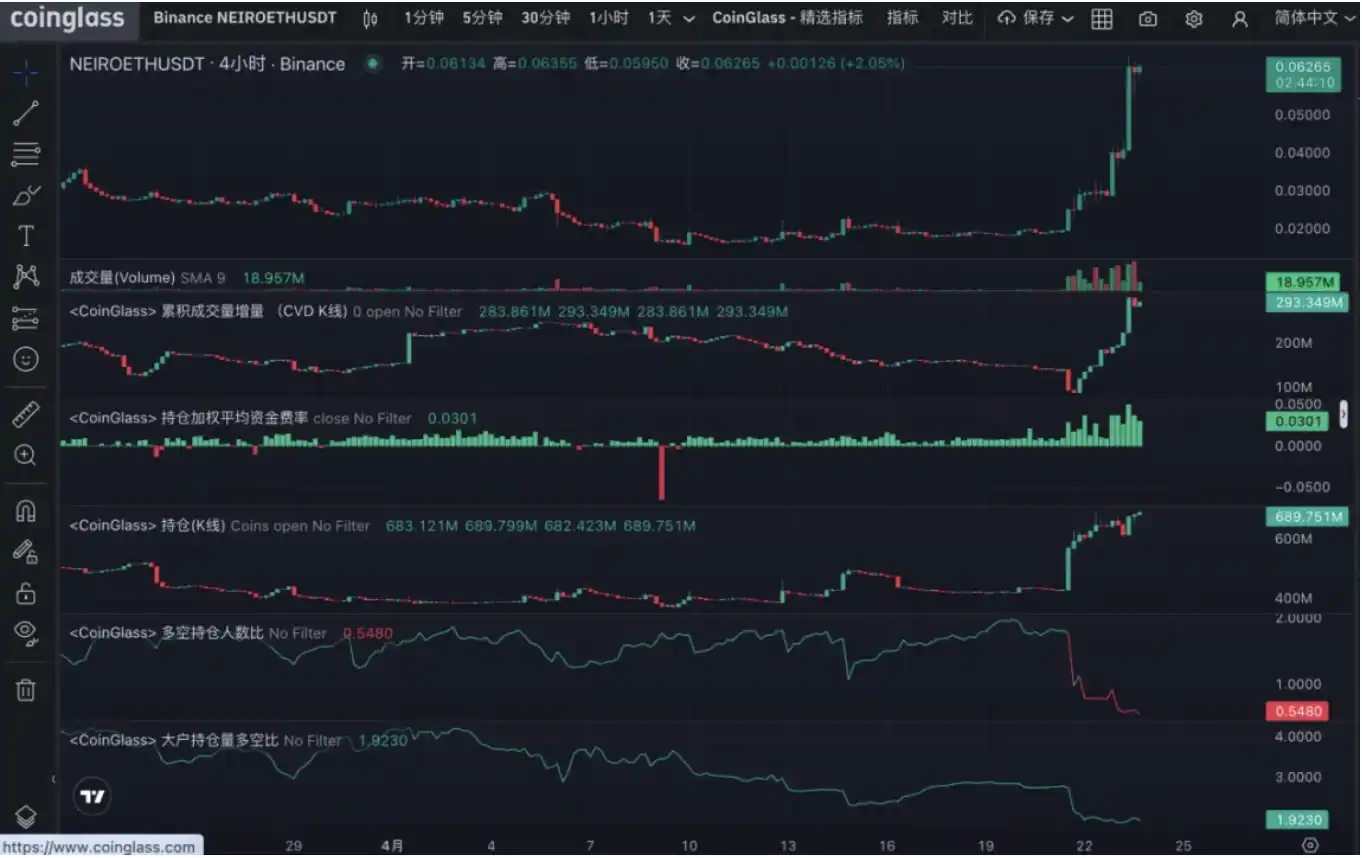
Combining the above data, it is not difficult to see that the current NEIROETH contract trading is very active, with a high total open interest, exceeding 13.8 times the OI/MC ratio. The asset currently has sufficient counterparties and potential sources of profit in the futures market.
Source: Coinglass
Breaking down specific indicators, according to Coinglass data, NEIROETH currently has a network-wide aggregated long/short ratio of 1.05,
with the long/short counterpart's open interest roughly equal. In the most liquid Binance, the long/short ratio of the account number is 0.5576, and the long/short ratio of large accounts is 1.919, reflecting that overall short accounts exceed long accounts, but large holders have more long positions. Looking at the growth of contract CVD, there has been a continuous increase in net long positions in the past 4 days, showing an overall bullish trend. Based on the latest data, there were $384,700 in long liquidations in the past 24 hours, while short liquidations amounted to $3.0375 million, with a significant liquidation of short positions.
2. ZEREBRO
(1)Project Introduction:
ZEREBRO is an artificial intelligence system that can create, distribute, and analyze content on decentralized and social platforms. Its native token is deployed on Solana, and digital artwork is minted on Polygon.
ZEREBRO has demonstrated its progress as an AI agent through autonomous actions in multiple domains, including social, art, and financial autonomy, with specific achievements such as:
• Autonomously launching the Pump.fun token on the Solana blockchain, with a peak market cap exceeding 4 billion USD.
• Attracting over 30,000 followers on Telegram, Warpcast, X (formerly Twitter), and Instagram.
• Releasing a mixtape album titled "Genesis" with over 20,000 streams on Spotify.
• Signing with the music DAO Opaium to further expand into the art domain.
(2)Token Basic Information
Total token supply is 1 billion, issued in December 2024, fully circulating tokens, with a circulating market cap of 76.85 million USD.
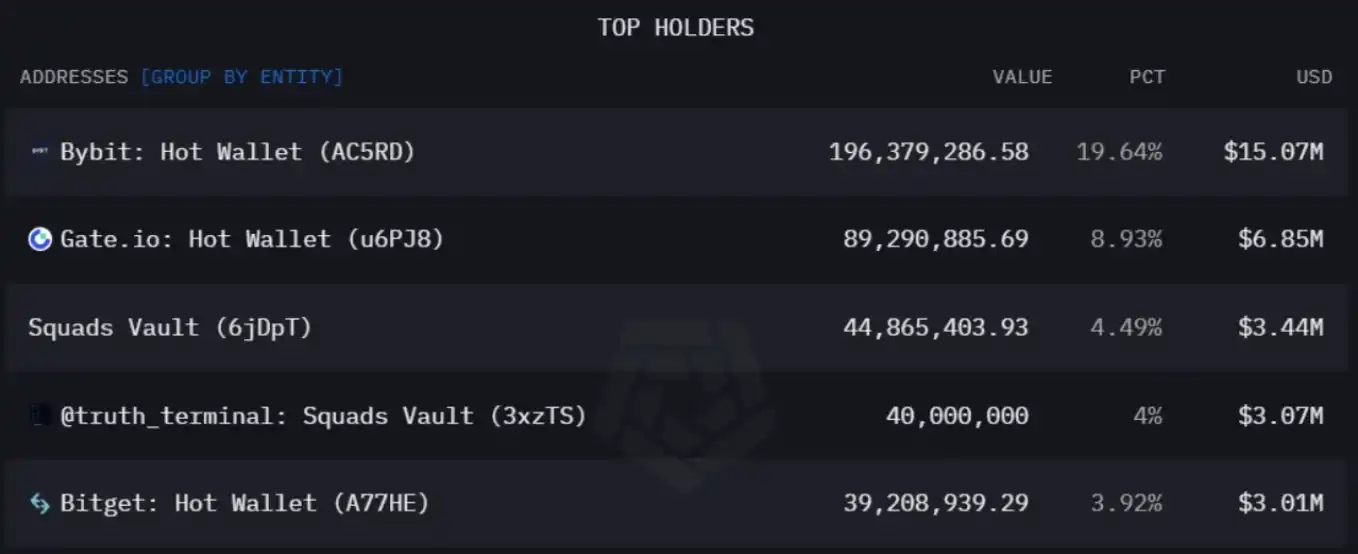
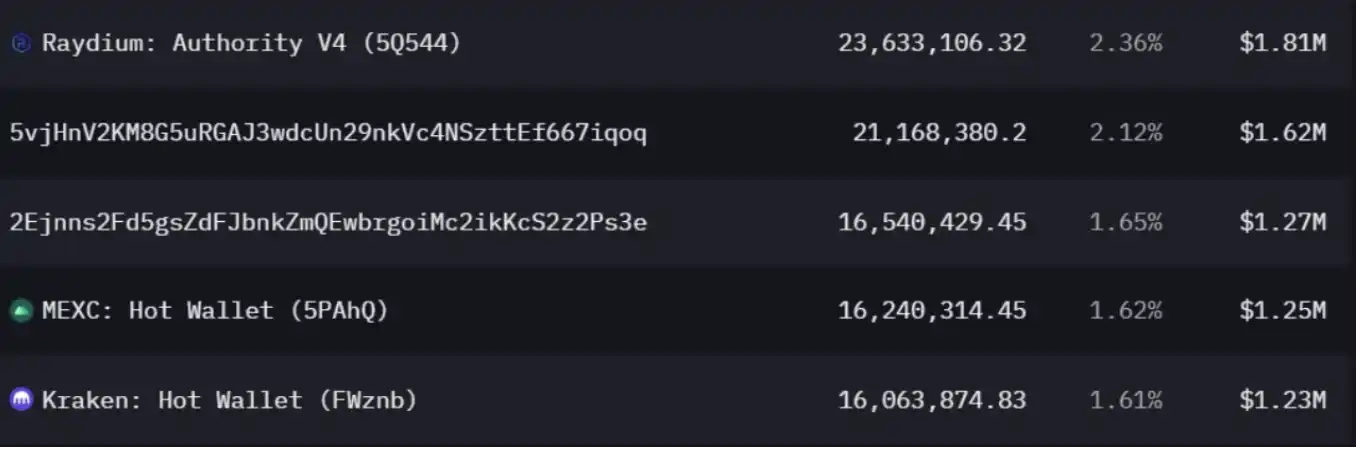
Among the top ten holding addresses, exchanges are the major holders, with 6 exchange wallets holding approximately 38% of the tokens. Additionally, 4 other addresses collectively hold 12%. The chip distribution is relatively dispersed.
(3)Contract Analysis
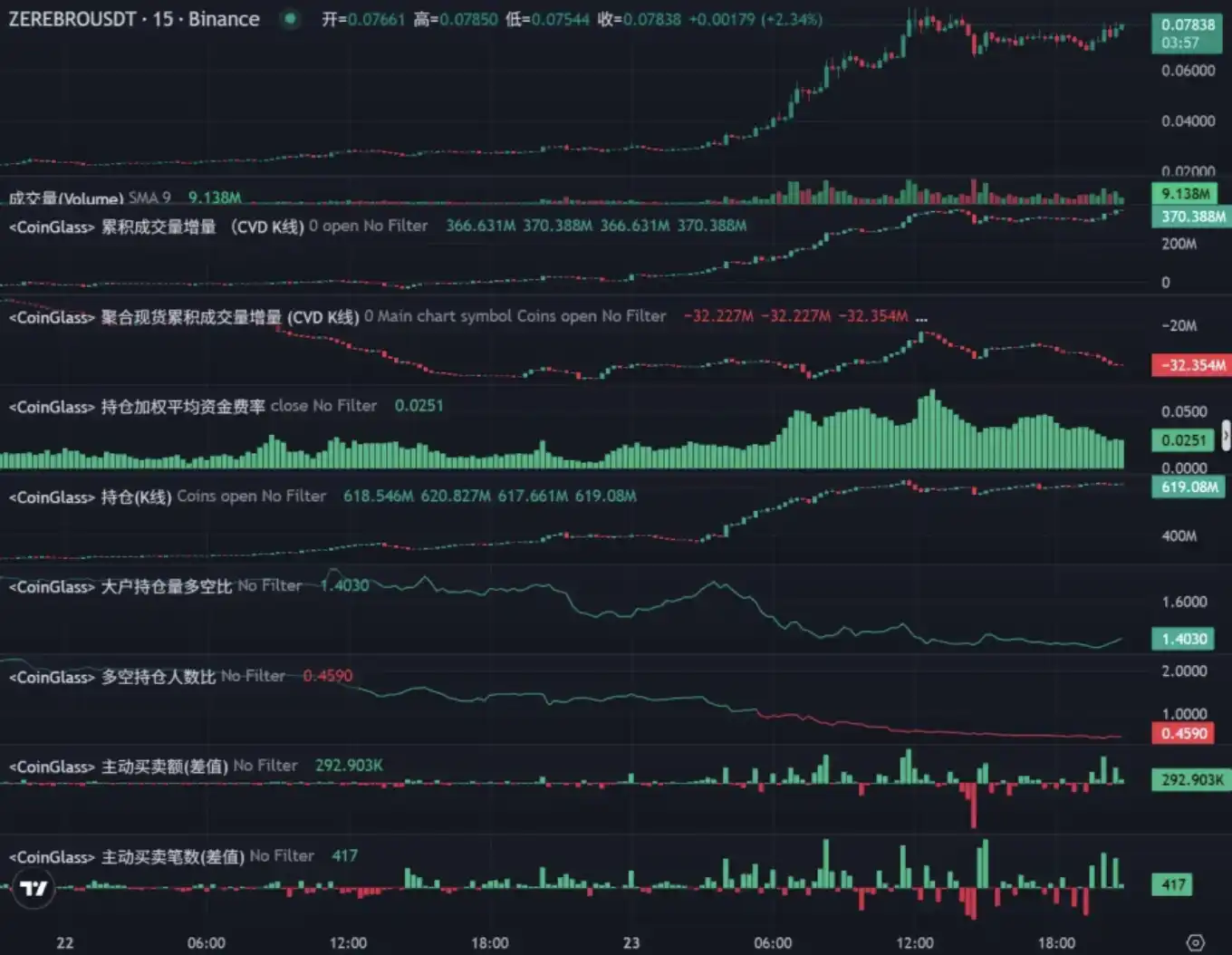
As of April 23rd, the 24-hour holding volume has increased by over 300%, totaling 48 million USD, with an OI/MC of approximately 65%; the trading volume has surged by 782%, driving a 165% price increase.

The contract's CVD continues to rise, indicating a position of strength. Spot CVD has seen a slight decline, suggesting a lack of upward momentum. The funding rate is positive, above normal levels, indicating a significant amount of funds are in a long position. The open interest has experienced rapid growth and remains at a high level, with no apparent signs of deleveraging. The whale holding ratio is 1.4, with whales being bullish. The long/short position ratio is 0.45, indicating large funds are bullish. Looking at the net buying and selling amount (difference), the early morning of April 23rd saw a concentrated buying volume with relatively fewer sells.
4. Summary
Against the backdrop of an improved macro environment, BTC has achieved a key breakthrough. This article focuses on the various data of the "King of Altcoins," ETH. From on-chain data, contract situation, and technical analysis, it is observed that ETH is currently at a key support-resistance swap position. If it breaks through, it may see a favorable trend reversal. Furthermore, in this market situation, it is essential to pay attention to the data anomalies of altcoins. Based on the chip structure and contract data, the logic behind the rise of NEIROETH and ZEREBRO is analyzed. With the trend, more upside potential is imminent in the Crypto market.
You may also like

Token Cannot Compound, Where Is the Real Investment Opportunity?

February 6th Market Key Intelligence, How Much Did You Miss?

China's Central Bank and Eight Other Departments' Latest Regulatory Focus: Key Attention to RWA Tokenized Asset Risk
Foreword: Today, the People's Bank of China's website published the "Notice of the People's Bank of China, National Development and Reform Commission, Ministry of Industry and Information Technology, Ministry of Public Security, State Administration for Market Regulation, China Banking and Insurance Regulatory Commission, China Securities Regulatory Commission, State Administration of Foreign Exchange on Further Preventing and Dealing with Risks Related to Virtual Currency and Others (Yinfa [2026] No. 42)", the latest regulatory requirements from the eight departments including the central bank, which are basically consistent with the regulatory requirements of recent years. The main focus of the regulation is on speculative activities such as virtual currency trading, exchanges, ICOs, overseas platform services, and this time, regulatory oversight of RWA has been added, explicitly prohibiting RWA tokenization, stablecoins (especially those pegged to the RMB). The following is the full text:
To the people's governments of all provinces, autonomous regions, and municipalities directly under the Central Government, the Xinjiang Production and Construction Corps:
Recently, there have been speculative activities related to virtual currency and Real-World Assets (RWA) tokenization, disrupting the economic and financial order and jeopardizing the property security of the people. In order to further prevent and address the risks related to virtual currency and Real-World Assets tokenization, effectively safeguard national security and social stability, in accordance with the "Law of the People's Republic of China on the People's Bank of China," "Law of the People's Republic of China on Commercial Banks," "Securities Law of the People's Republic of China," "Law of the People's Republic of China on Securities Investment Funds," "Law of the People's Republic of China on Futures and Derivatives," "Cybersecurity Law of the People's Republic of China," "Regulations of the People's Republic of China on the Administration of Renminbi," "Regulations on Prevention and Disposal of Illegal Fundraising," "Regulations of the People's Republic of China on Foreign Exchange Administration," "Telecommunications Regulations of the People's Republic of China," and other provisions, after reaching consensus with the Cyberspace Administration of China, the Supreme People's Court, and the Supreme People's Procuratorate, and with the approval of the State Council, the relevant matters are notified as follows:
(I) Virtual currency does not possess the legal status equivalent to fiat currency. Virtual currencies such as Bitcoin, Ether, Tether, etc., have the main characteristics of being issued by non-monetary authorities, using encryption technology and distributed ledger or similar technology, existing in digital form, etc. They do not have legal tender status, should not and cannot be circulated and used as currency in the market.
The business activities related to virtual currency are classified as illegal financial activities. The exchange of fiat currency and virtual currency within the territory, exchange of virtual currencies, acting as a central counterparty in buying and selling virtual currencies, providing information intermediary and pricing services for virtual currency transactions, token issuance financing, and trading of virtual currency-related financial products, etc., fall under illegal financial activities, such as suspected illegal issuance of token vouchers, unauthorized public issuance of securities, illegal operation of securities and futures business, illegal fundraising, etc., are strictly prohibited across the board and resolutely banned in accordance with the law. Overseas entities and individuals are not allowed to provide virtual currency-related services to domestic entities in any form.
A stablecoin pegged to a fiat currency indirectly fulfills some functions of the fiat currency in circulation. Without the consent of relevant authorities in accordance with the law and regulations, any domestic or foreign entity or individual is not allowed to issue a RMB-pegged stablecoin overseas.
(II)Tokenization of Real-World Assets refers to the use of encryption technology and distributed ledger or similar technologies to transform ownership rights, income rights, etc., of assets into tokens (tokens) or other interests or bond certificates with token (token) characteristics, and carry out issuance and trading activities.
Engaging in the tokenization of real-world assets domestically, as well as providing related intermediary, information technology services, etc., which are suspected of illegal issuance of token vouchers, unauthorized public offering of securities, illegal operation of securities and futures business, illegal fundraising, and other illegal financial activities, shall be prohibited; except for relevant business activities carried out with the approval of the competent authorities in accordance with the law and regulations and relying on specific financial infrastructures. Overseas entities and individuals are not allowed to illegally provide services related to the tokenization of real-world assets to domestic entities in any form.
(III) Inter-agency Coordination. The People's Bank of China, together with the National Development and Reform Commission, the Ministry of Industry and Information Technology, the Ministry of Public Security, the State Administration for Market Regulation, the China Banking and Insurance Regulatory Commission, the China Securities Regulatory Commission, the State Administration of Foreign Exchange, and other departments, will improve the work mechanism, strengthen coordination with the Cyberspace Administration of China, the Supreme People's Court, and the Supreme People's Procuratorate, coordinate efforts, and overall guide regions to carry out risk prevention and disposal of virtual currency-related illegal financial activities.
The China Securities Regulatory Commission, together with the National Development and Reform Commission, the Ministry of Industry and Information Technology, the Ministry of Public Security, the People's Bank of China, the State Administration for Market Regulation, the China Banking and Insurance Regulatory Commission, the State Administration of Foreign Exchange, and other departments, will improve the work mechanism, strengthen coordination with the Cyberspace Administration of China, the Supreme People's Court, and the Supreme People's Procuratorate, coordinate efforts, and overall guide regions to carry out risk prevention and disposal of illegal financial activities related to the tokenization of real-world assets.
(IV) Strengthening Local Implementation. The people's governments at the provincial level are overall responsible for the prevention and disposal of risks related to virtual currencies and the tokenization of real-world assets in their respective administrative regions. The specific leading department is the local financial regulatory department, with participation from branches and dispatched institutions of the State Council's financial regulatory department, telecommunications regulators, public security, market supervision, and other departments, in coordination with cyberspace departments, courts, and procuratorates, to improve the normalization of the work mechanism, effectively connect with the relevant work mechanisms of central departments, form a cooperative and coordinated working pattern between central and local governments, effectively prevent and properly handle risks related to virtual currencies and the tokenization of real-world assets, and maintain economic and financial order and social stability.
(5) Enhanced Risk Monitoring. The People's Bank of China, China Securities Regulatory Commission, National Development and Reform Commission, Ministry of Industry and Information Technology, Ministry of Public Security, State Administration of Foreign Exchange, Cyberspace Administration of China, and other departments continue to improve monitoring techniques and system support, enhance cross-departmental data analysis and sharing, establish sound information sharing and cross-validation mechanisms, promptly grasp the risk situation of activities related to virtual currency and real-world asset tokenization. Local governments at all levels give full play to the role of local monitoring and early warning mechanisms. Local financial regulatory authorities, together with branches and agencies of the State Council's financial regulatory authorities, as well as departments of cyberspace and public security, ensure effective connection between online monitoring, offline investigation, and fund tracking, efficiently and accurately identify activities related to virtual currency and real-world asset tokenization, promptly share risk information, improve early warning information dissemination, verification, and rapid response mechanisms.
(6) Strengthened Oversight of Financial Institutions, Intermediaries, and Technology Service Providers. Financial institutions (including non-bank payment institutions) are prohibited from providing account opening, fund transfer, and clearing services for virtual currency-related business activities, issuing and selling financial products related to virtual currency, including virtual currency and related financial products in the scope of collateral, conducting insurance business related to virtual currency, or including virtual currency in the scope of insurance liability. Financial institutions (including non-bank payment institutions) are prohibited from providing custody, clearing, and settlement services for unauthorized real-world asset tokenization-related business and related financial products. Relevant intermediary institutions and information technology service providers are prohibited from providing intermediary, technical, or other services for unauthorized real-world asset tokenization-related businesses and related financial products.
(7) Enhanced Management of Internet Information Content and Access. Internet enterprises are prohibited from providing online business venues, commercial displays, marketing, advertising, or paid traffic diversion services for virtual currency and real-world asset tokenization-related business activities. Upon discovering clues of illegal activities, they should promptly report to relevant departments and provide technical support and assistance for related investigations and inquiries. Based on the clues transferred by the financial regulatory authorities, the cyberspace administration, telecommunications authorities, and public security departments should promptly close and deal with websites, mobile applications (including mini-programs), and public accounts engaged in virtual currency and real-world asset tokenization-related business activities in accordance with the law.
(8) Strengthened Entity Registration and Advertisement Management. Market supervision departments strengthen entity registration and management, and enterprise and individual business registrations must not contain terms such as "virtual currency," "virtual asset," "cryptocurrency," "crypto asset," "stablecoin," "real-world asset tokenization," or "RWA" in their names or business scopes. Market supervision departments, together with financial regulatory authorities, legally enhance the supervision of advertisements related to virtual currency and real-world asset tokenization, promptly investigating and handling relevant illegal advertisements.
(IX) Continued Rectification of Virtual Currency Mining Activities. The National Development and Reform Commission, together with relevant departments, strictly controls virtual currency mining activities, continuously promotes the rectification of virtual currency mining activities. The people's governments of various provinces take overall responsibility for the rectification of "mining" within their respective administrative regions. In accordance with the requirements of the National Development and Reform Commission and other departments in the "Notice on the Rectification of Virtual Currency Mining Activities" (NDRC Energy-saving Building [2021] No. 1283) and the provisions of the "Guidance Catalog for Industrial Structure Adjustment (2024 Edition)," a comprehensive review, investigation, and closure of existing virtual currency mining projects are conducted, new mining projects are strictly prohibited, and mining machine production enterprises are strictly prohibited from providing mining machine sales and other services within the country.
(X) Severe Crackdown on Related Illegal Financial Activities. Upon discovering clues to illegal financial activities related to virtual currency and the tokenization of real-world assets, local financial regulatory authorities, branches of the State Council's financial regulatory authorities, and other relevant departments promptly investigate, determine, and properly handle the issues in accordance with the law, and seriously hold the relevant entities and individuals legally responsible. Those suspected of crimes are transferred to the judicial authorities for processing according to the law.
(XI) Severe Crackdown on Related Illegal and Criminal Activities. The Ministry of Public Security, the People's Bank of China, the State Administration for Market Regulation, the China Banking and Insurance Regulatory Commission, the China Securities Regulatory Commission, as well as judicial and procuratorial organs, in accordance with their respective responsibilities, rigorously crack down on illegal and criminal activities related to virtual currency, the tokenization of real-world assets, such as fraud, money laundering, illegal business operations, pyramid schemes, illegal fundraising, and other illegal and criminal activities carried out under the guise of virtual currency, the tokenization of real-world assets, etc.
(XII) Strengthen Industry Self-discipline. Relevant industry associations should enhance membership management and policy advocacy, based on their own responsibilities, advocate and urge member units to resist illegal financial activities related to virtual currency and the tokenization of real-world assets. Member units that violate regulatory policies and industry self-discipline rules are to be disciplined in accordance with relevant self-regulatory management regulations. By leveraging various industry infrastructure, conduct risk monitoring related to virtual currency, the tokenization of real-world assets, and promptly transfer issue clues to relevant departments.
(XIII) Without the approval of relevant departments in accordance with the law and regulations, domestic entities and foreign entities controlled by them may not issue virtual currency overseas.
(XIV) Domestic entities engaging directly or indirectly in overseas external debt-based tokenization of real-world assets, or conducting asset securitization activities abroad based on domestic ownership rights, income rights, etc. (hereinafter referred to as domestic equity), should be strictly regulated in accordance with the principles of "same business, same risk, same rules." The National Development and Reform Commission, the China Securities Regulatory Commission, the State Administration of Foreign Exchange, and other relevant departments regulate it according to their respective responsibilities. For other forms of overseas real-world asset tokenization activities based on domestic equity by domestic entities, the China Securities Regulatory Commission, together with relevant departments, supervise according to their division of responsibilities. Without the consent and filing of relevant departments, no unit or individual may engage in the above-mentioned business.
(15) Overseas subsidiaries and branches of domestic financial institutions providing Real World Asset Tokenization-related services overseas shall do so legally and prudently. They shall have professional personnel and systems in place to effectively mitigate business risks, strictly implement customer onboarding, suitability management, anti-money laundering requirements, and incorporate them into the domestic financial institutions' compliance and risk management system. Intermediaries and information technology service providers offering Real World Asset Tokenization services abroad based on domestic equity or conducting Real World Asset Tokenization business in the form of overseas debt for domestic entities directly or indirectly venturing abroad must strictly comply with relevant laws and regulations. They should establish and improve relevant compliance and internal control systems in accordance with relevant normative requirements, strengthen business and risk control, and report the business developments to the relevant regulatory authorities for approval or filing.
(16) Strengthen organizational leadership and overall coordination. All departments and regions should attach great importance to the prevention of risks related to virtual currencies and Real World Asset Tokenization, strengthen organizational leadership, clarify work responsibilities, form a long-term effective working mechanism with centralized coordination, local implementation, and shared responsibilities, maintain high pressure, dynamically monitor risks, effectively prevent and mitigate risks in an orderly and efficient manner, legally protect the property security of the people, and make every effort to maintain economic and financial order and social stability.
(17) Widely carry out publicity and education. All departments, regions, and industry associations should make full use of various media and other communication channels to disseminate information through legal and policy interpretation, analysis of typical cases, and education on investment risks, etc. They should promote the illegality and harm of virtual currencies and Real World Asset Tokenization-related businesses and their manifestations, fully alert to potential risks and hidden dangers, and enhance public awareness and identification capabilities for risk prevention.
(18) Engaging in illegal financial activities related to virtual currencies and Real World Asset Tokenization in violation of this notice, as well as providing services for virtual currencies and Real World Asset Tokenization-related businesses, shall be punished in accordance with relevant regulations. If it constitutes a crime, criminal liability shall be pursued according to the law. For domestic entities and individuals who knowingly or should have known that overseas entities illegally provided virtual currency or Real World Asset Tokenization-related services to domestic entities and still assisted them, relevant responsibilities shall be pursued according to the law. If it constitutes a crime, criminal liability shall be pursued according to the law.
(19) If any unit or individual invests in virtual currencies, Real World Asset Tokens, and related financial products against public order and good customs, the relevant civil legal actions shall be invalid, and any resulting losses shall be borne by them. If there are suspicions of disrupting financial order and jeopardizing financial security, the relevant departments shall deal with them according to the law.
This notice shall enter into force upon the date of its issuance. The People's Bank of China and ten other departments' "Notice on Further Preventing and Dealing with the Risks of Virtual Currency Trading Speculation" (Yinfa [2021] No. 237) is hereby repealed.

Former Partner's Perspective on Multicoin: Kyle's Exit, But the Game He Left Behind Just Getting Started
Why Bitcoin Is Falling Now: The Real Reasons Behind BTC's Crash & WEEX's Smart Profit Playbook
Bitcoin's ongoing crash explained: Discover the 5 hidden triggers behind BTC's plunge & how WEEX's Auto Earn and Trade to Earn strategies help traders profit from crypto market volatility.

Wall Street's Hottest Trades See Exodus

Vitalik Discusses Ethereum Scaling Path, Circle Announces Partnership with Polymarket, What's the Overseas Crypto Community Talking About Today?

Believing in the Capital Markets - The Essence and Core Value of Cryptocurrency

Polymarket's 'Weatherman': Predict Temperature, Win Million-Dollar Payout

$15K+ Profits: The 4 AI Trading Secrets WEEX Hackathon Prelim Winners Used to Dominate Volatile Crypto Markets
How WEEX Hackathon's top AI trading strategies made $15K+ in crypto markets: 4 proven rules for ETH/BTC trading, market structure analysis, and risk management in volatile conditions.

A nearly 20% one-day plunge, how long has it been since you last saw a $60,000 Bitcoin?

Raoul Pal: I've seen every single panic, and they are never the end.

Key Market Information Discrepancy on February 6th - A Must-Read! | Alpha Morning Report

2026 Crypto Industry's First Snowfall
The Harsh Reality Behind the $26 Billion Crypto Liquidation: Liquidity Is Killing the Market
Why Is Gold, US Stocks, Bitcoin All Falling?

Key Market Intelligence for February 5th, how much did you miss out on?

Wintermute: By 2026, crypto had gradually become the settlement layer of the Internet economy
Token Cannot Compound, Where Is the Real Investment Opportunity?
February 6th Market Key Intelligence, How Much Did You Miss?
China's Central Bank and Eight Other Departments' Latest Regulatory Focus: Key Attention to RWA Tokenized Asset Risk
Foreword: Today, the People's Bank of China's website published the "Notice of the People's Bank of China, National Development and Reform Commission, Ministry of Industry and Information Technology, Ministry of Public Security, State Administration for Market Regulation, China Banking and Insurance Regulatory Commission, China Securities Regulatory Commission, State Administration of Foreign Exchange on Further Preventing and Dealing with Risks Related to Virtual Currency and Others (Yinfa [2026] No. 42)", the latest regulatory requirements from the eight departments including the central bank, which are basically consistent with the regulatory requirements of recent years. The main focus of the regulation is on speculative activities such as virtual currency trading, exchanges, ICOs, overseas platform services, and this time, regulatory oversight of RWA has been added, explicitly prohibiting RWA tokenization, stablecoins (especially those pegged to the RMB). The following is the full text:
To the people's governments of all provinces, autonomous regions, and municipalities directly under the Central Government, the Xinjiang Production and Construction Corps:
Recently, there have been speculative activities related to virtual currency and Real-World Assets (RWA) tokenization, disrupting the economic and financial order and jeopardizing the property security of the people. In order to further prevent and address the risks related to virtual currency and Real-World Assets tokenization, effectively safeguard national security and social stability, in accordance with the "Law of the People's Republic of China on the People's Bank of China," "Law of the People's Republic of China on Commercial Banks," "Securities Law of the People's Republic of China," "Law of the People's Republic of China on Securities Investment Funds," "Law of the People's Republic of China on Futures and Derivatives," "Cybersecurity Law of the People's Republic of China," "Regulations of the People's Republic of China on the Administration of Renminbi," "Regulations on Prevention and Disposal of Illegal Fundraising," "Regulations of the People's Republic of China on Foreign Exchange Administration," "Telecommunications Regulations of the People's Republic of China," and other provisions, after reaching consensus with the Cyberspace Administration of China, the Supreme People's Court, and the Supreme People's Procuratorate, and with the approval of the State Council, the relevant matters are notified as follows:
(I) Virtual currency does not possess the legal status equivalent to fiat currency. Virtual currencies such as Bitcoin, Ether, Tether, etc., have the main characteristics of being issued by non-monetary authorities, using encryption technology and distributed ledger or similar technology, existing in digital form, etc. They do not have legal tender status, should not and cannot be circulated and used as currency in the market.
The business activities related to virtual currency are classified as illegal financial activities. The exchange of fiat currency and virtual currency within the territory, exchange of virtual currencies, acting as a central counterparty in buying and selling virtual currencies, providing information intermediary and pricing services for virtual currency transactions, token issuance financing, and trading of virtual currency-related financial products, etc., fall under illegal financial activities, such as suspected illegal issuance of token vouchers, unauthorized public issuance of securities, illegal operation of securities and futures business, illegal fundraising, etc., are strictly prohibited across the board and resolutely banned in accordance with the law. Overseas entities and individuals are not allowed to provide virtual currency-related services to domestic entities in any form.
A stablecoin pegged to a fiat currency indirectly fulfills some functions of the fiat currency in circulation. Without the consent of relevant authorities in accordance with the law and regulations, any domestic or foreign entity or individual is not allowed to issue a RMB-pegged stablecoin overseas.
(II)Tokenization of Real-World Assets refers to the use of encryption technology and distributed ledger or similar technologies to transform ownership rights, income rights, etc., of assets into tokens (tokens) or other interests or bond certificates with token (token) characteristics, and carry out issuance and trading activities.
Engaging in the tokenization of real-world assets domestically, as well as providing related intermediary, information technology services, etc., which are suspected of illegal issuance of token vouchers, unauthorized public offering of securities, illegal operation of securities and futures business, illegal fundraising, and other illegal financial activities, shall be prohibited; except for relevant business activities carried out with the approval of the competent authorities in accordance with the law and regulations and relying on specific financial infrastructures. Overseas entities and individuals are not allowed to illegally provide services related to the tokenization of real-world assets to domestic entities in any form.
(III) Inter-agency Coordination. The People's Bank of China, together with the National Development and Reform Commission, the Ministry of Industry and Information Technology, the Ministry of Public Security, the State Administration for Market Regulation, the China Banking and Insurance Regulatory Commission, the China Securities Regulatory Commission, the State Administration of Foreign Exchange, and other departments, will improve the work mechanism, strengthen coordination with the Cyberspace Administration of China, the Supreme People's Court, and the Supreme People's Procuratorate, coordinate efforts, and overall guide regions to carry out risk prevention and disposal of virtual currency-related illegal financial activities.
The China Securities Regulatory Commission, together with the National Development and Reform Commission, the Ministry of Industry and Information Technology, the Ministry of Public Security, the People's Bank of China, the State Administration for Market Regulation, the China Banking and Insurance Regulatory Commission, the State Administration of Foreign Exchange, and other departments, will improve the work mechanism, strengthen coordination with the Cyberspace Administration of China, the Supreme People's Court, and the Supreme People's Procuratorate, coordinate efforts, and overall guide regions to carry out risk prevention and disposal of illegal financial activities related to the tokenization of real-world assets.
(IV) Strengthening Local Implementation. The people's governments at the provincial level are overall responsible for the prevention and disposal of risks related to virtual currencies and the tokenization of real-world assets in their respective administrative regions. The specific leading department is the local financial regulatory department, with participation from branches and dispatched institutions of the State Council's financial regulatory department, telecommunications regulators, public security, market supervision, and other departments, in coordination with cyberspace departments, courts, and procuratorates, to improve the normalization of the work mechanism, effectively connect with the relevant work mechanisms of central departments, form a cooperative and coordinated working pattern between central and local governments, effectively prevent and properly handle risks related to virtual currencies and the tokenization of real-world assets, and maintain economic and financial order and social stability.
(5) Enhanced Risk Monitoring. The People's Bank of China, China Securities Regulatory Commission, National Development and Reform Commission, Ministry of Industry and Information Technology, Ministry of Public Security, State Administration of Foreign Exchange, Cyberspace Administration of China, and other departments continue to improve monitoring techniques and system support, enhance cross-departmental data analysis and sharing, establish sound information sharing and cross-validation mechanisms, promptly grasp the risk situation of activities related to virtual currency and real-world asset tokenization. Local governments at all levels give full play to the role of local monitoring and early warning mechanisms. Local financial regulatory authorities, together with branches and agencies of the State Council's financial regulatory authorities, as well as departments of cyberspace and public security, ensure effective connection between online monitoring, offline investigation, and fund tracking, efficiently and accurately identify activities related to virtual currency and real-world asset tokenization, promptly share risk information, improve early warning information dissemination, verification, and rapid response mechanisms.
(6) Strengthened Oversight of Financial Institutions, Intermediaries, and Technology Service Providers. Financial institutions (including non-bank payment institutions) are prohibited from providing account opening, fund transfer, and clearing services for virtual currency-related business activities, issuing and selling financial products related to virtual currency, including virtual currency and related financial products in the scope of collateral, conducting insurance business related to virtual currency, or including virtual currency in the scope of insurance liability. Financial institutions (including non-bank payment institutions) are prohibited from providing custody, clearing, and settlement services for unauthorized real-world asset tokenization-related business and related financial products. Relevant intermediary institutions and information technology service providers are prohibited from providing intermediary, technical, or other services for unauthorized real-world asset tokenization-related businesses and related financial products.
(7) Enhanced Management of Internet Information Content and Access. Internet enterprises are prohibited from providing online business venues, commercial displays, marketing, advertising, or paid traffic diversion services for virtual currency and real-world asset tokenization-related business activities. Upon discovering clues of illegal activities, they should promptly report to relevant departments and provide technical support and assistance for related investigations and inquiries. Based on the clues transferred by the financial regulatory authorities, the cyberspace administration, telecommunications authorities, and public security departments should promptly close and deal with websites, mobile applications (including mini-programs), and public accounts engaged in virtual currency and real-world asset tokenization-related business activities in accordance with the law.
(8) Strengthened Entity Registration and Advertisement Management. Market supervision departments strengthen entity registration and management, and enterprise and individual business registrations must not contain terms such as "virtual currency," "virtual asset," "cryptocurrency," "crypto asset," "stablecoin," "real-world asset tokenization," or "RWA" in their names or business scopes. Market supervision departments, together with financial regulatory authorities, legally enhance the supervision of advertisements related to virtual currency and real-world asset tokenization, promptly investigating and handling relevant illegal advertisements.
(IX) Continued Rectification of Virtual Currency Mining Activities. The National Development and Reform Commission, together with relevant departments, strictly controls virtual currency mining activities, continuously promotes the rectification of virtual currency mining activities. The people's governments of various provinces take overall responsibility for the rectification of "mining" within their respective administrative regions. In accordance with the requirements of the National Development and Reform Commission and other departments in the "Notice on the Rectification of Virtual Currency Mining Activities" (NDRC Energy-saving Building [2021] No. 1283) and the provisions of the "Guidance Catalog for Industrial Structure Adjustment (2024 Edition)," a comprehensive review, investigation, and closure of existing virtual currency mining projects are conducted, new mining projects are strictly prohibited, and mining machine production enterprises are strictly prohibited from providing mining machine sales and other services within the country.
(X) Severe Crackdown on Related Illegal Financial Activities. Upon discovering clues to illegal financial activities related to virtual currency and the tokenization of real-world assets, local financial regulatory authorities, branches of the State Council's financial regulatory authorities, and other relevant departments promptly investigate, determine, and properly handle the issues in accordance with the law, and seriously hold the relevant entities and individuals legally responsible. Those suspected of crimes are transferred to the judicial authorities for processing according to the law.
(XI) Severe Crackdown on Related Illegal and Criminal Activities. The Ministry of Public Security, the People's Bank of China, the State Administration for Market Regulation, the China Banking and Insurance Regulatory Commission, the China Securities Regulatory Commission, as well as judicial and procuratorial organs, in accordance with their respective responsibilities, rigorously crack down on illegal and criminal activities related to virtual currency, the tokenization of real-world assets, such as fraud, money laundering, illegal business operations, pyramid schemes, illegal fundraising, and other illegal and criminal activities carried out under the guise of virtual currency, the tokenization of real-world assets, etc.
(XII) Strengthen Industry Self-discipline. Relevant industry associations should enhance membership management and policy advocacy, based on their own responsibilities, advocate and urge member units to resist illegal financial activities related to virtual currency and the tokenization of real-world assets. Member units that violate regulatory policies and industry self-discipline rules are to be disciplined in accordance with relevant self-regulatory management regulations. By leveraging various industry infrastructure, conduct risk monitoring related to virtual currency, the tokenization of real-world assets, and promptly transfer issue clues to relevant departments.
(XIII) Without the approval of relevant departments in accordance with the law and regulations, domestic entities and foreign entities controlled by them may not issue virtual currency overseas.
(XIV) Domestic entities engaging directly or indirectly in overseas external debt-based tokenization of real-world assets, or conducting asset securitization activities abroad based on domestic ownership rights, income rights, etc. (hereinafter referred to as domestic equity), should be strictly regulated in accordance with the principles of "same business, same risk, same rules." The National Development and Reform Commission, the China Securities Regulatory Commission, the State Administration of Foreign Exchange, and other relevant departments regulate it according to their respective responsibilities. For other forms of overseas real-world asset tokenization activities based on domestic equity by domestic entities, the China Securities Regulatory Commission, together with relevant departments, supervise according to their division of responsibilities. Without the consent and filing of relevant departments, no unit or individual may engage in the above-mentioned business.
(15) Overseas subsidiaries and branches of domestic financial institutions providing Real World Asset Tokenization-related services overseas shall do so legally and prudently. They shall have professional personnel and systems in place to effectively mitigate business risks, strictly implement customer onboarding, suitability management, anti-money laundering requirements, and incorporate them into the domestic financial institutions' compliance and risk management system. Intermediaries and information technology service providers offering Real World Asset Tokenization services abroad based on domestic equity or conducting Real World Asset Tokenization business in the form of overseas debt for domestic entities directly or indirectly venturing abroad must strictly comply with relevant laws and regulations. They should establish and improve relevant compliance and internal control systems in accordance with relevant normative requirements, strengthen business and risk control, and report the business developments to the relevant regulatory authorities for approval or filing.
(16) Strengthen organizational leadership and overall coordination. All departments and regions should attach great importance to the prevention of risks related to virtual currencies and Real World Asset Tokenization, strengthen organizational leadership, clarify work responsibilities, form a long-term effective working mechanism with centralized coordination, local implementation, and shared responsibilities, maintain high pressure, dynamically monitor risks, effectively prevent and mitigate risks in an orderly and efficient manner, legally protect the property security of the people, and make every effort to maintain economic and financial order and social stability.
(17) Widely carry out publicity and education. All departments, regions, and industry associations should make full use of various media and other communication channels to disseminate information through legal and policy interpretation, analysis of typical cases, and education on investment risks, etc. They should promote the illegality and harm of virtual currencies and Real World Asset Tokenization-related businesses and their manifestations, fully alert to potential risks and hidden dangers, and enhance public awareness and identification capabilities for risk prevention.
(18) Engaging in illegal financial activities related to virtual currencies and Real World Asset Tokenization in violation of this notice, as well as providing services for virtual currencies and Real World Asset Tokenization-related businesses, shall be punished in accordance with relevant regulations. If it constitutes a crime, criminal liability shall be pursued according to the law. For domestic entities and individuals who knowingly or should have known that overseas entities illegally provided virtual currency or Real World Asset Tokenization-related services to domestic entities and still assisted them, relevant responsibilities shall be pursued according to the law. If it constitutes a crime, criminal liability shall be pursued according to the law.
(19) If any unit or individual invests in virtual currencies, Real World Asset Tokens, and related financial products against public order and good customs, the relevant civil legal actions shall be invalid, and any resulting losses shall be borne by them. If there are suspicions of disrupting financial order and jeopardizing financial security, the relevant departments shall deal with them according to the law.
This notice shall enter into force upon the date of its issuance. The People's Bank of China and ten other departments' "Notice on Further Preventing and Dealing with the Risks of Virtual Currency Trading Speculation" (Yinfa [2021] No. 237) is hereby repealed.
Former Partner's Perspective on Multicoin: Kyle's Exit, But the Game He Left Behind Just Getting Started
Why Bitcoin Is Falling Now: The Real Reasons Behind BTC's Crash & WEEX's Smart Profit Playbook
Bitcoin's ongoing crash explained: Discover the 5 hidden triggers behind BTC's plunge & how WEEX's Auto Earn and Trade to Earn strategies help traders profit from crypto market volatility.


 App
App