
- Buy Crypto
- Markets
 Futures
- Spot
- Copy Trade
 Earn
Earn- More
Deeply Hidden in Privacy, Written Before Nillion Coin Launch

Original Article Title: "Deep Privacy, Written Before the Nillion Coin Launch"
Original Article Author: Lord Zuo
Chariots reveal horsepower, Bi Gan sees people's hearts. NIL reaches for the sky, XMR delisted in the meantime.
Blockchain originated from privacy technology, especially cryptography. From elliptic curves to zero-knowledge proofs, all prove the success of privacy economics in the Web 3.0 era.
However, things are never perfect. From XMR frequently delisted from CEX/DEX, to the Tornado Cash founder's arrest, you will find that even if Nillion can list on Binance, the hacker spirit of privacy projects is receding. Their final product delivery capability is also far from perfect.
In refining privacy products, blockchain projects in the same category need to learn from their Web2 counterparts to improve their execution.
Proton Proves Privacy Can Be a Well-Functioning Product
Privacy is a Feature,Not a Product.
Mere talk of privacy as a product enhancement is meaningless. In other words, privacy also needs PMF. Giants such as Google and Meta can invade privacy while making it irresistible, thanks to convenience and network effects. Plug and play, ubiquitous usage in both personal and office settings lead to eventual acceptance of everything Google has to offer.

Image Description: Giant Fine, Image Source: Proton
In this regard, the regulatory authorities have failed miserably with the fine-as-management model. Taking the legendary fine against Google of 2.974 billion USD as an example, Google would probably earn it back in just 16 days. Yet, these fines cannot become the income of European tech companies, making them further powerless against Google.
Faced with this issue, Proton's approach is to build its own ecosystem, starting from CERN (European Organization for Nuclear Research). Scientific researchers' inherently pure reputation is higher than that of commercial companies. With cryptographic technology, open-source code, and product audits, the privacy products they build truly have practical significance—you can achieve the same functionalities without using Google's ecosystem.
Of course, the current network effects and economies of scale are still unable to compete with the giants. However, compared to blockchain peers, the products they offer are sufficient for daily use and qualify as a Google Alternative.
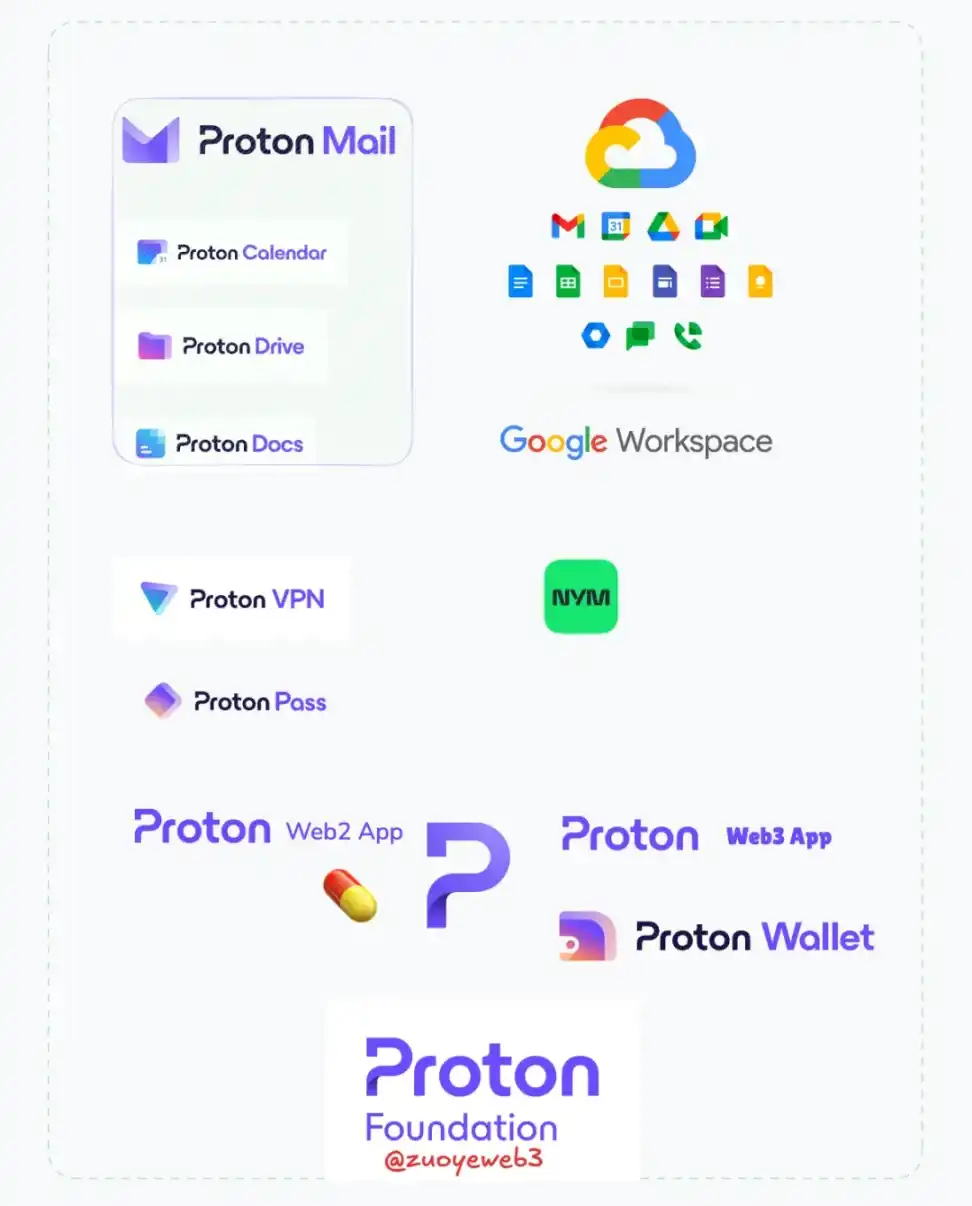
Image Description: Proton Product and Partial Comparison, Image Source: @zuoyeweb3
Compared to the Google Workspace suite, the current Proton is mainly centered around Proton Mail's own competitive products. It is worth mentioning that Proton Mail is also a favorite of Twitter, Square, and other founder Jack Dorsey.
Proton Mail is different from typical email products in that it does not require binding a phone number to use, and it supports end-to-end encryption mode to ensure the privacy of email transmission. Before Telegram became regulated, using Proton Mail in conjunction with TG's end-to-end mode could basically establish a relatively high-level commercial privacy experience.
Of course, after Telegram's decline, Proton Mail combined with Signal can also meet the privacy surfing needs of most people.
Similar to Telegram, Proton has also begun to enter the Web3 field. Its first product is the Proton Wallet. Unlike transaction-oriented products such as Bitget Wallet and Binance Wallet, Proton Wallet is extremely restrained and has relatively simple functionality.
The significance of Proton lies in proving the feasibility of building products based on privacy technology. Different from the ad-based profit model of traditional giants, Proton adopts a paid system. In contrast to the tokenomics system of its Web3 peers, Proton has not taken the step of issuing tokens, which we can call:
The tokenless implementation of encryption technology.
From Skiff to Nillion, Tokenization of Encryption Technology
If Proton is considered Don Quixote, then Skiff, Nym, Privasea to Nillion are the dwarfs, who have not yet found their own PMF, but the token (Snow White) is one step ahead.
On February 9, 2024, Notion announced the acquisition of Skiff. This is also the first case of a Web2 major product acquiring a Web3 startup. Pioneering a new industry trend without taking the token issuance route. On another note, Stripe's acquisition of Bridge was actually the second time.
Skiff and Google Suite are also quite similar, ranging from an IPFS-based document suite to an encrypted email service. However, there is a huge problem: the UI is extremely unattractive, providing a poor user experience. This is also the biggest issue with current Web3 products, as they are hindered by the slow and expensive nature of the blockchain's underlying technology, making it difficult to compete with Web2 counterparts when developing large-scale products.
Proton is a suitable Google alternative, but Skiff is not a qualified Proton alternative.
Furthermore, the development of other Web3 privacy products has been less than satisfactory. Nym has gradually shifted its focus to the VPN field, Privasea with an FHE focus emphasizes more on AI integration, and today's Nillion is still stuck in the previous cycle's MPC narrative.
Yes, narratives are cyclical. The concepts of MPC and Blind Computation (Blind Compute, NBC) built by Nillion are derivative narratives in the Ethereum and ZK applications within the L2/Rollup domain. AA wallets and MPC paradigms fall into this category. With Ethereum's weak price performance, privacy-focused products are being abandoned by the market. The most glaring example is that FHE did not become the next step for ZK. Reference article: FHE is the next step for ZK, says encryption technology.
It's not that privacy technology is unimportant; it's that the combination of privacy technology and tokens is no longer essential or, at least, not important in the current stage.
Without privacy technology, Proton cannot establish its own business logic and product matrix; this is the key to achieving Product-Market Fit. However, for products like Nillion, investments from Binance and Hack VC seem to be more crucial.
As for the concept of Blind Computation, the Trust Layer, the multi-ecosystem, and privacy AI are not Nillion's true sources of profit. We all know this very well. Nillion's only product may truly be its token. From this perspective, at least Nym really needs to go after the VPN market.
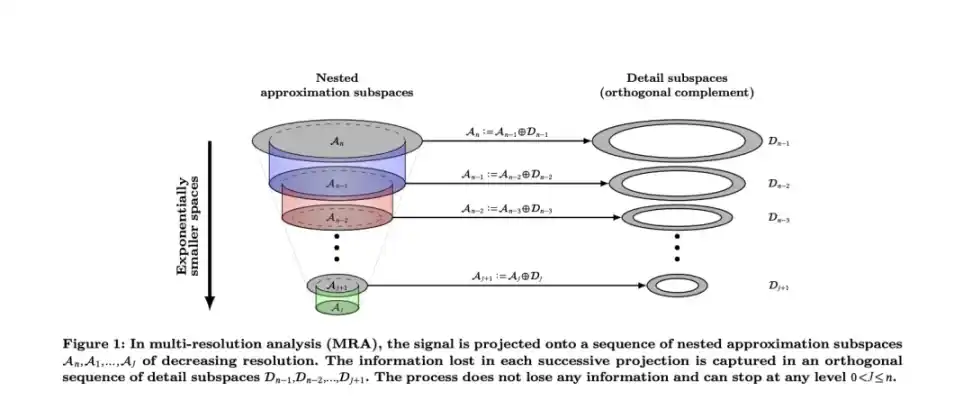
Image Description: Nillion's latest paper, Image Source: Nillion
In its latest technical paper, Nillion's research focus remains on the practical application of MPC. Traditional secure-sharing MPC algorithms lead to a drastic increase in data volume during computation, and Nillion is researching how to reduce algorithm complexity to improve computational efficiency.
Well, let's take a look at the Nillion token's listing performance. As the saying goes, this kind of Web3 privacy technology combined with AI cannot find a real application scenario because neither OpenAI nor DeepSeek consider these factors. If a new product adds privacy technology to seize market share from them, then it would be a meaningful pioneering move.
If it lacks meaning, then let's turn our attention to @Optimism; it truly believes that privacy is crucial.

However, while Privacy is Good, there still needs to be a Privacy Product to demonstrate it. Mere discussions of MPC / ZK / TEE / FHE / AI without solving any problems are meaningless. Everyone can chant slogans that do not address the issue, but in the end, it will harm the social credibility of the underlying technology.
The consequences have already emerged. Now, people are talking about L2 color shifts, which will also make people feel like ZK is a scam.
Following the significant loss at Bybit due to Safe, silence is not limited to Vitalik; it also includes frontend developers and multi-signature mechanisms.
Conclusion
Monero, the XMR cryptocurrency, may feel somewhat unfamiliar to people in today's BNB Chain Meme Express era, but it should be regarded as the final attempt, after Bitcoin, to truly consider the integration of cryptographic technology and its own application scenarios.
On February 7, 2024, two days before Skiff officially "joined" Notion, XMR was delisted from Binance, "withdrawing" from its largest source of liquidity. Perhaps since then, so-called privacy technologies are all akin to F-47, merely part of a win-learning process, albeit the Web3 privacy economics has not completely collapsed.
You may also like

Why Is Gold, US Stocks, Bitcoin All Falling?

Key Market Intelligence for February 5th, how much did you miss out on?

Wintermute: By 2026, crypto had gradually become the settlement layer of the Internet economy

Tether Q4 2025 Report: USDT Market Cap Nears $190 Billion, Multiple Metrics Reach All-Time Highs

Kyle Samani's about-face, one of the biggest believers in web3, has also left the industry

Bhutan Quietly Sells Over $22M in Bitcoin, Drawing Speculation Over Possible Moves
Key Takeaways Bhutan has transferred over $22 million in Bitcoin from sovereign wallets in the past week. The…

BitMine Endures a $7B Unrealized Loss as Ethereum Dips Below $2,100
Key Takeaways BitMine is facing a significant financial challenge with an unrealized loss of over $7 billion in…

Trump-Linked World Liberty Financial Under Scrutiny Following $500 Million UAE Stake
Key Takeaways A U.S. House investigation is examining a $500 million UAE stake in Trump-related World Liberty Financial.…

Asia Market Open: Bitcoin Tumbles as Asian Equities Reflect Global Tech Retreat
Key Takeaways: Bitcoin’s price plunged by 6% to $72,000, reflecting the spillover effects from the global tech sector’s…

Crypto Firms Propose Concessions to Banks as Stablecoin Disputes Stall Key Crypto Bill
Key Takeaways: Crypto companies are attempting to navigate stablecoin disputes with banks but agreements remain elusive. Industry representatives…
CoolWallet Introduces TRON Energy Rental to Minimize TRX Transaction Costs
Key Takeaways CoolWallet has integrated TRON’s energy rental services, offering users lower transaction fees while maintaining asset security.…

CFTC Officially Withdraws Biden-Era Proposal to Ban Political and Sports Prediction Markets
Key Takeaways: The CFTC has rescinded a 2024 proposal and subsequent 2025 advisory that aimed to prohibit event…

Binance Says Assets Rose Amid Alleged Bank Run Attempt
Key Takeaways: Binance reported an unexpected increase in assets during a community-driven withdrawal campaign, challenging conventional expectations of…

Same Macro Tape, Different Bid – Gold Absorbs Flows as Bitcoin Swings
Key Takeaways: Gold is experiencing significant demand growth, especially via ETFs and central banks, projecting a robust performance…
Crypto Price Prediction Today, February 4 – Focus on XRP, Cardano, and Dogecoin
Key Takeaways Bitcoin is facing significant pressure, affecting the entire cryptocurrency market, including heavyweights like XRP, Cardano, and…

Vitalik Buterin Urges Ethereum Builders to Innovate Beyond Clone Chains
Key Takeaways Vitalik Buterin criticizes the trend of creating copy-paste EVM chains, encouraging developers to focus on truly…
Best Crypto to Buy Now February 4: XRP, Solana, Hyperliquid Picks
Key Takeaways XRP remains one of the top picks for cross-border transactions due to its high speed and…
XRP Price Prediction: Ripple Quietly Unlocks a Billion Tokens – Is a Price Shock Coming in the Next Few Hours?
Key Takeaways Ripple has released one billion XRP tokens into the market, potentially causing a shift in XRP…
Why Is Gold, US Stocks, Bitcoin All Falling?
Key Market Intelligence for February 5th, how much did you miss out on?
Wintermute: By 2026, crypto had gradually become the settlement layer of the Internet economy
Tether Q4 2025 Report: USDT Market Cap Nears $190 Billion, Multiple Metrics Reach All-Time Highs
Kyle Samani's about-face, one of the biggest believers in web3, has also left the industry
Bhutan Quietly Sells Over $22M in Bitcoin, Drawing Speculation Over Possible Moves
Key Takeaways Bhutan has transferred over $22 million in Bitcoin from sovereign wallets in the past week. The…


 App
App