
- Buy Crypto
- Markets
 Futures
- Spot
- Copy Trade
 Earn
Earn- More
Farcaster Metamorphosis: a16z Spends $180M to Demolish Web3 Social

ABCDE has announced the cessation of new project investments and the suspension of fundraising for its second fund, triggering another round of "VC is dead" lamentation on Crypto Twitter. However, in the previous cycle, VCs shone brightly, relying on storytelling to inflate valuations, packaging each PowerPoint presentation as the future of the internet.
As the decentralized social media leader Farcaster, which has raised a total of $180 million in two bull markets, undoubtedly embodies the VC narrative. However, Farcaster's answer is gradually becoming clear—not betting on "decentralized imagination" anymore but on "assetization execution." Farcaster is not a failed product but rather another narrative collapse in the crypto world. VCs have realized they do not possess the ability to reshape the world; they were merely cashing out of a pre-funded valuation story.
From Farcaster to Warpcast and Back to Farcaster
Recently, Dan, the co-founder of the Farcaster protocol, announced that the team is considering renaming the current official client app, known as Warpcast, back to Farcaster and simultaneously adjusting its web domain to farcaster.xyz. This move aims to simplify the brand system and address the confusion between the protocol and the application for new users.
In 2021, Farcaster was launched as a desktop product, which later transformed into a mobile and web application in 2023 under the name Warpcast. Although the initial renaming was intended to make it easier for other developers to build their own clients based on the protocol if the client (Warpcast) and the protocol itself (Farcaster) had different names, this vision did not materialize as anticipated. According to feedback from the team, in reality, the vast majority of users still register accounts and access the protocol through Warpcast.
In May of last year, BlockBeats analyzed the Farcaster ecosystem, noting that the front-end application Warpcast held the core features of the Farcaster protocol, such as private messaging and channels. The ecosystem exhibited a significant Matthew effect, with unofficial clients struggling to survive in the margins and identifying pain points of Warpcast for feature development. Nevertheless, applications like Supercast and Tako adopted differentiation strategies to build their social platforms.
Related Reading: "No Opportunity on Farcaster anymore?"
Today, the Farcaster team officially announced the rebranding of the Warpcast frontend to Farcaster, somewhat betraying the frontend application developers who chose the Farcaster protocol.
In fact, this renaming operation is just a small reflection of Farcaster's transformation. Since last October, the Farcaster protocol has made adjustments in product updates, strategic positioning, personnel changes, and more.
One detail is that after this, developer meetings will no longer distinguish between "Farcaster topics" and "Warpcast updates" but will focus on specific overall issues such as Growth, Direct Cast, reducing registration costs, Hub stability, FIP governance, and identity systems.
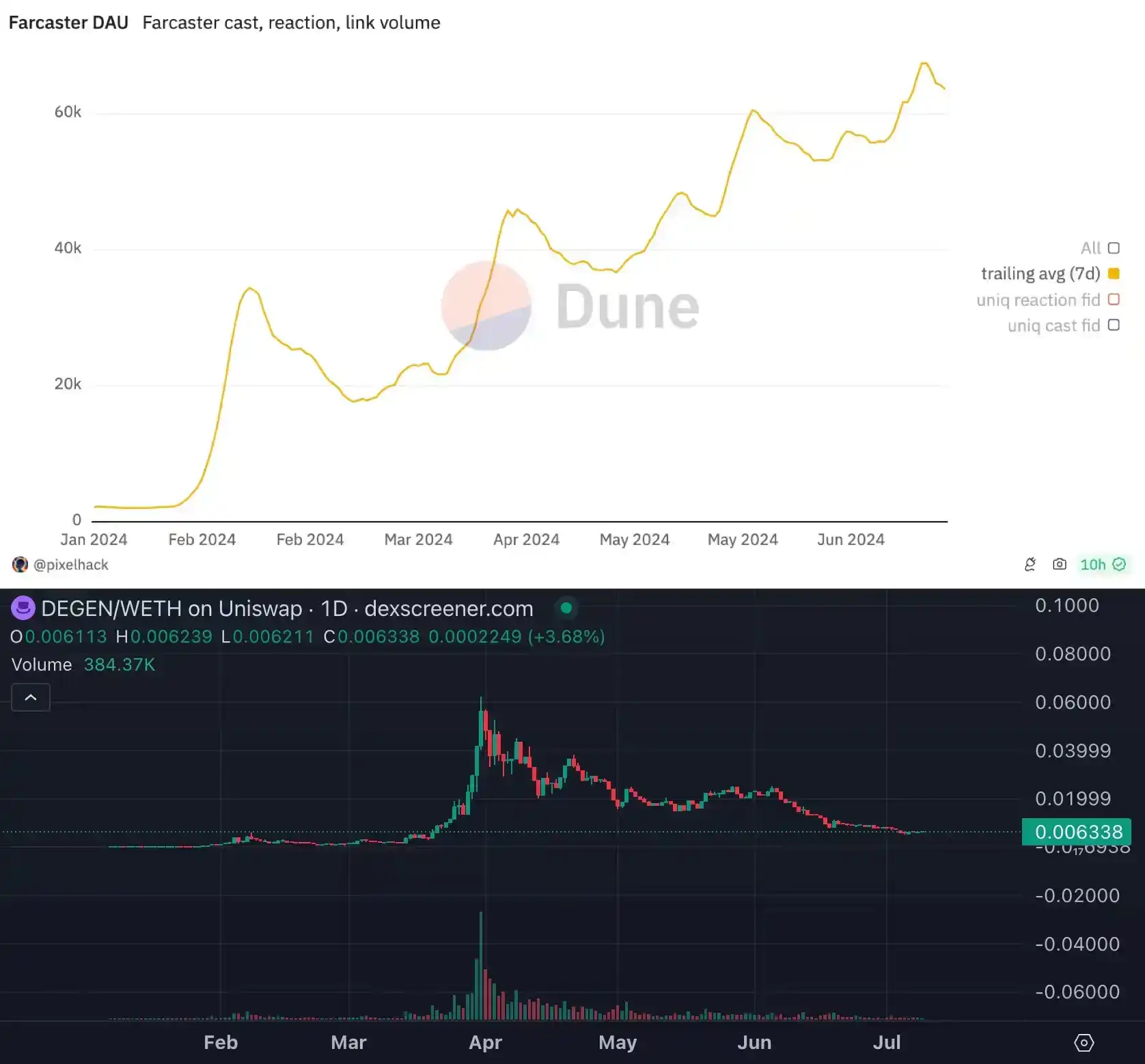
However, in terms of user stickiness, Farcaster has so far failed to overcome the typical cold start platform problem. According to Dune data, since open registration in the second half of 2023, its DAU/MAU ratio has long hovered around 0.2, briefly reaching 0.4 in early 2024 due to DEGEN's popularity surge, then quickly falling back.
The DAU/MAU ratio refers to the ratio of daily active users to monthly active users, used to measure the number of days users interact with the application per month. A ratio approaching 1 indicates higher user activity, while a ratio below 0.2 suggests weak application virality and interactivity.
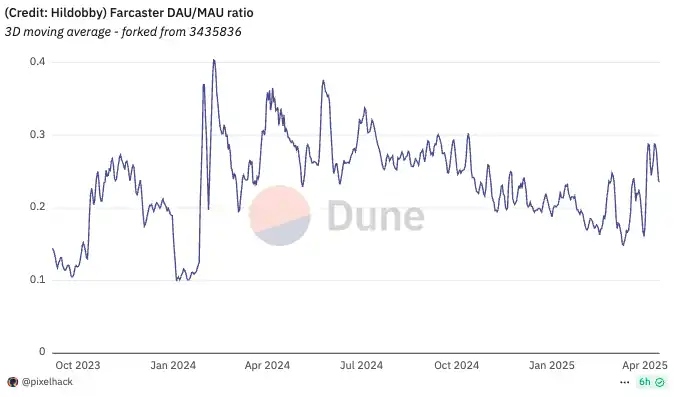
In contrast, early Web2 community products such as Reddit or Mastodon have maintained a stable DAU/MAU ratio in the range of 0.25 to 0.3. Even smaller-scale, more niche social apps like Discord servers often maintain an active ratio above 0.3. Farcaster's data shows that despite its high relevance in the Crypto community, user usage habits have not truly been established, with active users mainly concentrated among a few heavy creators and on-chain natives, without forming a sustainable content consumption and social loop.
Creating Content? Creating Assets? Farcaster Has No Answer
In the initial product logic, Farcaster attempted to build a decentralized social graph through content tools, where the once promising Channel (similar to topic groups) was the core unit carrying communities and traffic in this graph. However, the incentive effect of assets far surpassed the self-organizing ability of content, leading to a shift in product logic.
Abandoned Channel
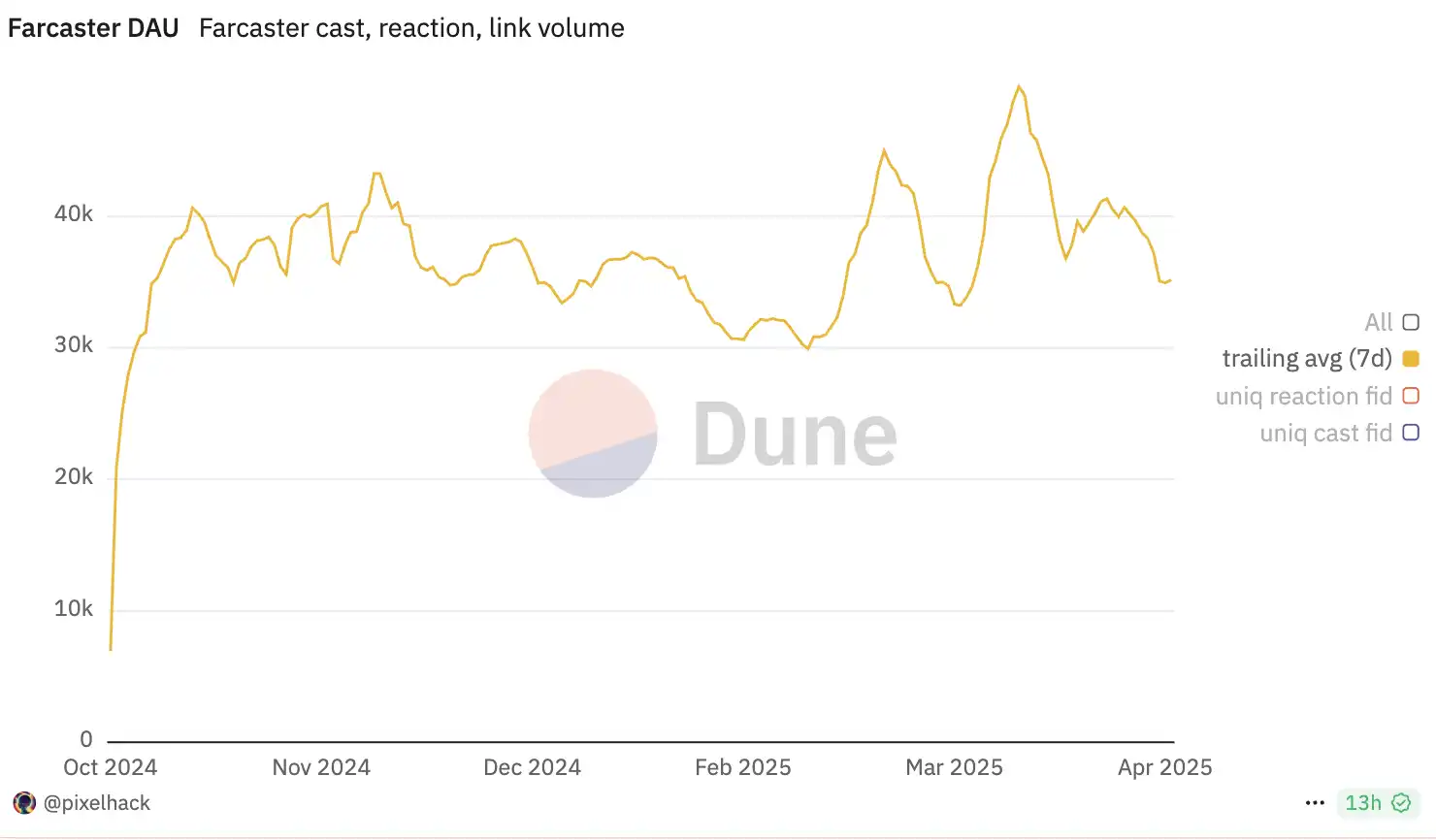
In February 2024, the social token $DEGEN rose to fame in the Warpcast channel named Degen, becoming a key driver of Farcaster's mainstream adoption. At that time, Farcaster had only opened network registration four months prior, with daily active users surpassing 30,000. With the $DEGEN token fermenting and other similarly popular channel tokens like Higher emerging, Farcaster's daily active users peaked at 70,000.
The Farcaster team realized that channels were a vehicle to bring people, attention, and liquidity together. Farcaster's founder, Dan, saw this as a key difference from centralized social media platforms like Twitter, allowing small communities to exist within a broader social graph. Although just a feature of Warpcast, the plan was for full decentralization, where channels could enhance user engagement and create a more intimate social experience by fostering these small, focused communities.
Thus, the team established the core development focus of channels, creating various concepts around it, including channel host rights, channel ownership, and even projects and clients centered around channels. Dan even urged users not to squat on channel names to later sell them to brands, referencing a past incident involving the podcast show Bankless and a user squabble over channel names.
However, this approach did not last long. In July 2024, Farcaster Protocol's network scalability bottleneck became apparent. During a developer conference, the team announced a pause in the decentralization of channels to rethink the implementation path.
When responding to users asking why they couldn't speak in certain topic channels, Dan stated that channels would not bring any additional distribution bonuses. Although there had been attempts in the past, the results were unsatisfactory. He said, "Channels are suitable for community operation but not for discussing a specific topic. We won't recommend them to new users." Historical data showed that channels had a limited impact on user growth, and due to limited resources, the Farcaster team had no immediate plans to add new features to channels.
On the product priority list, Mini App and Wallet took precedence, shifting Farcaster from a content- and social graph-centric social protocol to a transaction-focused protocol, as the latter could attract more native users in the crypto space.
Built-in Wallet Exacerbates Monopoly
In a podcast, Farcaster co-founder Dan shared his latest understanding of the "User" concept: users who only register an account and engage lightly, although superficially increasing activity levels, the true value to the network comes from wallet users who hold cryptocurrency assets and are willing to engage on-chain. This refined user cognition directly influenced the team's product strategy on the wallet system.
By the end of November 2024, Farcaster began exploring the integration of a tradable wallet within the application to facilitate on-chain transactions. The goal is to increase on-chain interaction frequency to enhance ecosystem stickiness and monetization potential. In fact, each Warpcast user already has a "Farcaster Wallet" created by default at registration, which binds user identity for logging into Warpcast and Frames, but since it is only stored locally on the phone, its functionality leans towards authentication and signature rather than fund movement.
In contrast, the newly launched "Warpcast Wallet" is a wallet that can send and receive assets, which users can generate at registration and use for token deposits, exchanges, transfers, and on-chain interaction.
The timing of integrating the tradable wallet by Farcaster is hard not to associate with the emergence of Clanker.
Clanker is an AI Token Issuer on Warpcast, where users can post and tag Clanker to release tradable tokens on Uniswap. Its official token $CLANKER surged 20x in November last year, making Base and Warpcast competitive with Solana in the AI concept space. Also, due to the wealth effect of $CLANKER, Farcaster's daily active users reached a new high since last summer.
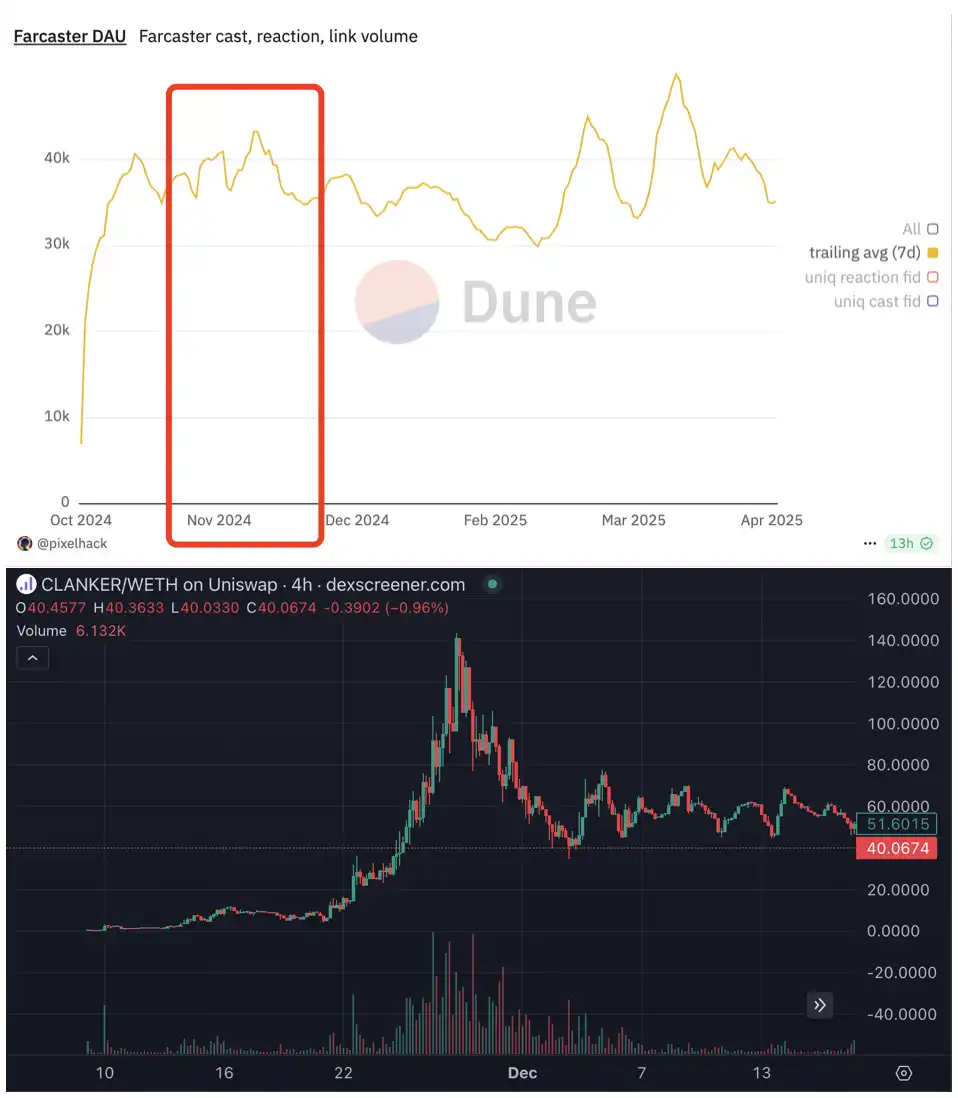
Unlike the fate of $DEGEN, as another breakout target from Warpcast, $CLANKER received attention and support from the team and the core community from the beginning. However, in this process, the Agent, DEX, consumer wallet, etc., all benefited from this asset issuance frenzy, but Warpcast did not receive any economic return.
Clanker's success made the team realize that if more on-chain interactions are to occur within the Farcaster ecosystem, relying solely on open protocols and third-party integrations is not enough; they must have a native tradable wallet system, thus giving rise to the Warpcast Wallet.
From a product design perspective, the role played by the Warpcast Wallet is to act as a bridge between user social interactions and on-chain activities—users can complete transactions, tip, or claim airdrops by simply clicking on Frame without needing to switch interfaces or connect an external wallet. This "social meets financial" product logic makes Farcaster more like a "Singapore" of the crypto world—having a small user base but high wallet activity and per capita funds.
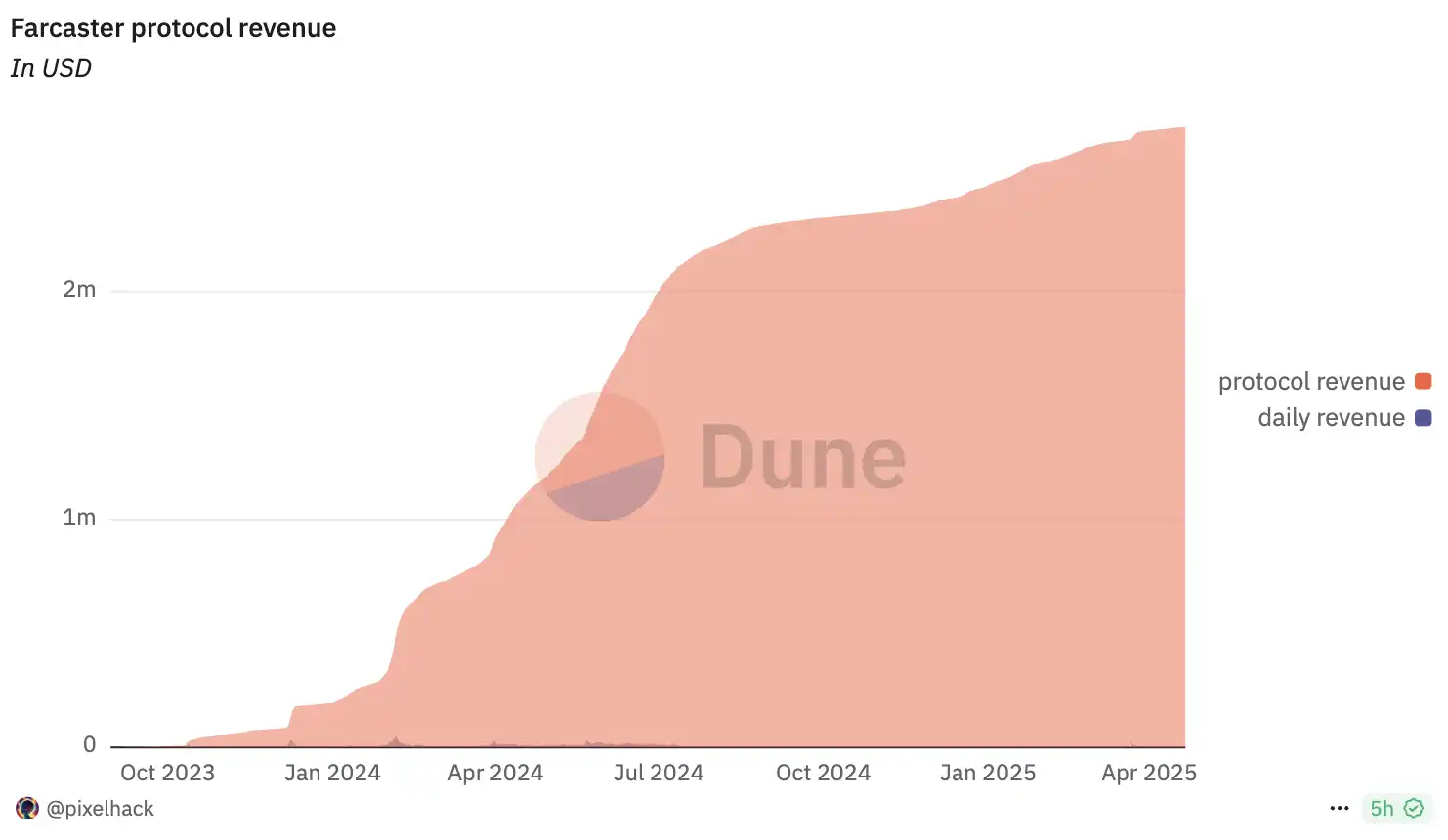
According to the official documentation, users are required to pay a 0.85% fee when using the Warpcast Wallet, with 0.15% going to the 0x Protocol providing transaction routing, and the remaining 0.70% going directly to Warpcast's revenue. Data from Dune shows that since its launch, the revenue curve of the Farcaster protocol has been steadily rising, providing initial validation of the feasibility of the embedded wallet as a monetization path.
However, it is worth noting that the Warpcast embedded wallet is not written into the protocol layer. Additionally, with the intention of renaming the Warpcast client to Farcaster, BlockBeats has learned that some Farcaster developers believe the protocol is becoming increasingly centralized and monopolistic.
The Greatest Innovation is Just a "WeChat Mini Program"
With the introduction of the embedded wallet, Farcaster has made further progress towards becoming an asset-oriented social application. The official statement mentioned that one of the purposes of launching the wallet was to attract developers to build applications based on the Frame framework and thereby drive the integration of transaction activities and content distribution.
Frame was first introduced in early 2024 as a lightweight application standard running on top of the Farcaster protocol, allowing developers to embed small programs into social clients. When a user clicks on Frame, developers can identify their wallet address and push content to them or trigger interactive operations. However, as the overall popularity of Farcaster has declined, the use of Frame has also shown a clear downward trend.
To address this situation, Farcaster launched Frame v2 at the end of 2024. The new version supports the development of applications with HTML, CSS, and JavaScript that provide a near-native experience. Developers can deploy products quickly using the Mini App SDK without having to go through the app store approval process. Frame v2 not only enhances interaction complexity but also deeply integrates with the embedded wallet, further strengthening transactional attributes, making the overall experience more akin to a WeChat Mini Program.
In March 2025, Linda Xie, co-founder of Scalar Capital and Bountycaster, joined the Farcaster team to lead developer relations, with a focus on advancing the development and promotion of Frame. Simultaneously, Farcaster launched the "Airdrop Plan," encouraging developers to build applications using Frame v2 and reach users through asset airdrops. While not an official token airdrop, this mechanism effectively drove user growth. In mid-March, Farcaster's daily active users briefly exceeded 40,000, reaching a milestone.
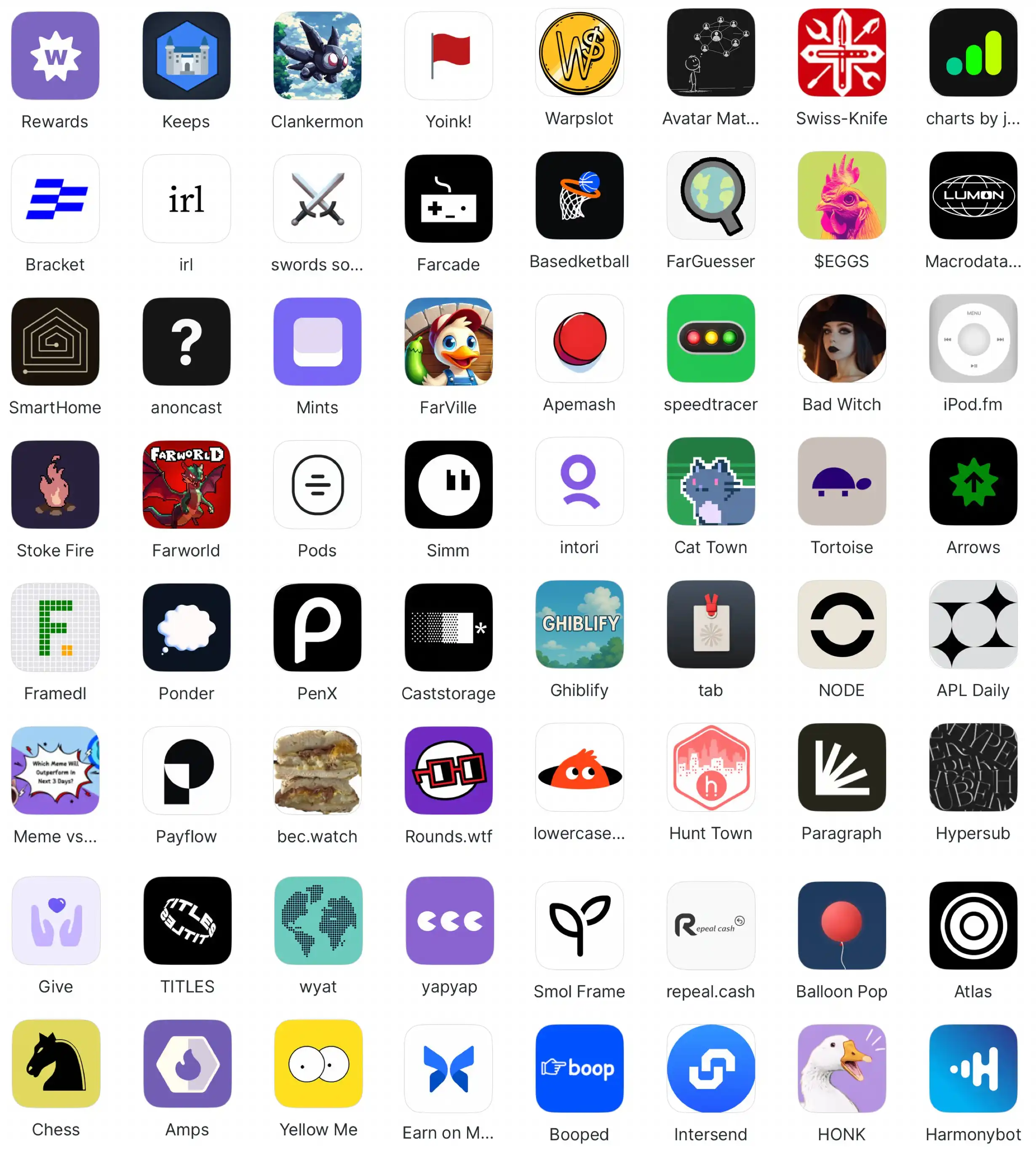
In early April 2025, Farcaster officially renamed Frame to Mini App and positioned it alongside the Wallet in the bottom navigation bar of the Warpcast client.
Currently, a set of lightweight applications supporting on-chain interactions have been integrated into Warpcast, with Mini App now a key part of the ecosystem. However, from user growth data, it is evident that Mini App's user acquisition capabilities have not been significantly leveraged, and its long-term impact is still under observation.
The Disappearance of "Web3" and the Decline of Silicon Valley Titans
In fact, Farcaster's transformation is not unique; it simply was the first to expose the structural dilemma of the entire Web3 social track—a scenario where open protocols struggle to achieve user scale, content distribution fails to drive engagement, and ultimately, platforms revert to the asset-driven reality.
Do We Really Need a "Decentralized Social Platform"?
From $DEGEN to $CLANKER, almost every time Farcaster gained traction, it was closely tied to assets. What truly propelled the surge in daily active users was not the protocol's evolution or the client's innovation but rather repeated wealth effects driven by tokens. This recurring pattern reveals a core fact: Farcaster is not "unused" but rather "only used when there is a profit to be made." These platforms indeed fulfill a certain market demand, but their role is not that of a social network but rather an asset distributor.
This is not by chance but rather the inevitable outcome of the long-standing misalignment between crypto narratives and real-world usage.
In 2020, BlockBeats wrote in an article titled "The World Hates Current Social Media" that decentralization and protocolization may be the only way for social products to break free from the "platform dilemma." In the face of increasing content censorship and platform monopolies, open protocols carry people's hopes for a "new social order."
Back then, Twitter was seen as a typical failure of protocol: it briefly opened its API, encouraged developers to build an ecosystem, but eventually returned to the old path of being an advertising platform with data monopolies. The original ambition of Farcaster was to "not become the second Twitter," claiming to be centered around an open protocol to connect developers, users, and assets, realizing a co-constructed, mutually beneficial decentralized social network.
However, three years later, Farcaster's replication was not of Twitter's initial protocol ideal but rather its later platform logic. Dan, who once urged everyone to "build their own client based on the protocol," now personally announced that the client is also called Farcaster, intertwining "protocol" and "product" significantly.
This shift in product, looking for Product/Market Fit (PMF), is rational at the surface, even a realistic compromise, but it also indicates that the so-called "open ecosystem" in the implementation process has quietly been misappropriated as a narrative tool for user growth. The developers' role is not truly supported but used to tell a story. Like when Twitter closed its API years ago, the developer ecosystem is only temporary fuel for driving the platform into a closed loop.
Over three years, Farcaster has proven one thing: In the Crypto context, a social protocol cannot fundamentally form the ecosystem we expected in 2020. Not because no one developed clients, but because no one used them. Not because it was not decentralized enough, but because decentralization was not a concern for users at all.
Today, SocialFi, like GameFi, has to some extent been labeled on the death track. Not long ago, a certain Key Opinion Leader (KOL) criticized the founder of a decentralized social application, saying, "After so long doing traffic, your fans are not as high as an ordinary individual KOL like me. What skills do you have? What have you done with your 2M funding? It's not as profitable as my SOL wallet." While it is a wry smile, it also can't help but reflect that the era of infrastructure built on narratives has ended, and the valuation systems of all VC projects are being reconstructed.
Crypto is Not the "Next Internet"
However, a16z is the biggest advocate of this narrative. Having invested early in Twitter, Facebook, and other social media, when the investment behemoth encounters decentralized social products, it naturally cannot ignore their presence. As a Google executive once said, "They're like a lunatic, aggressively intervening in every transaction."
The full name of a16z is Andreessen Horowitz, derived from the surnames of the two founders, Marc Andreessen and Ben Horowitz, established in 2009. As a famous software catcher, nearly all of the most prominent companies in the Internet field have been hit: Facebook, Twitter, Airbnb, Okta, Github, Stripe, etc. Their investment strategy combines early sensitivity and growth-stage decisiveness, being able to invest in Instagram in the seed round, enter Github in the Series A competition, and lead the Series G investment in Roblox with $150 million.
Its keen foresight and aggressive investment style are exemplified in its layout in the crypto field. When Coinbase, invested in 2013, went public, its market value soared to as high as $85.8 billion, making it one of the largest tech IPOs in history. After cashing out $4.4 billion, a16z still holds 7% of the company's shares. Well-known crypto projects such as OpenSea, Uniswap, and dYdX are also representative works of a16z.
The crypto bull market since 2021 has caused the paper value of major venture capital portfolios to skyrocket, with fund returns reaching 20 times or even 100 times, making cryptocurrency venture capital suddenly look like a money-printing machine. Limited partners (LPs) are flocking in, eager to catch the next big wave. The new funds raised by venture capital firms are 10 to 100 times larger than before, firmly believing that they can replicate those excess returns.
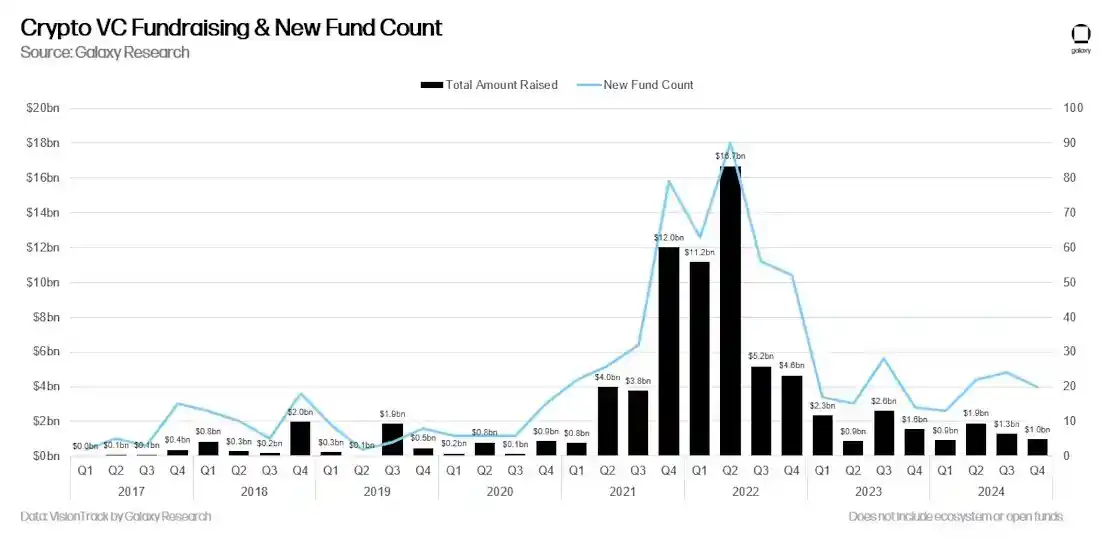
Farcaster is undoubtedly the product of the peak of this liquidity craze. In July 2022, Farcaster announced the completion of a $30 million financing round led by a16z. Two years later, Farcaster raised $150 million at a valuation of $1 billion, with Paradigm leading the round and notable VCs such as a16z crypto, Haun, USV, Variant, and Standard Crypto participating. With a valuation of $1 billion, it became the largest funding in the Web3 social track's history. At that time, a comment in Fortune magazine pointed out that this valuation was more of a result of internal fund game-playing rather than a true reflection of market demand.
Cryptocurrency investor Liron Shapira said, "If venture capital still has LP capital available, choosing to invest $150 million instead of returning it can earn an additional $20-30 million in management fees." This is not a market recognition of Web3 social, but a self-contained loop of capital operation. An article in Fortune magazine also stated that a source who requested anonymity due to business constraints expects Farcaster, like most protocols, to launch a token, and investors will be eager to capture its fully diluted value.
a16z partners have proposed that "technological waves often appear in combination," endorsing the intersection of Web3, AI, and hardware. However, they avoid a fundamental fact: every leap of the mobile Internet, whether it be smartphones or search engines, has been built on real user pain points and technological breakthroughs, not on a structural bubble under a capital narrative.
"Technology eats the world" was once a radical and precise judgment, but its applicable premise is that technology has a crushing advantage at the foundational level. The reason AI has erupted is that it challenges individual intelligence—a structurally irrepressible power differential; whereas blockchain challenges "sovereign currency," which is a credit system unchanged for two thousand years. It will not explosively disrupt societal structures like the Internet or AI; it will slowly evolve over long periods, be absorbed and co-opted by vested interest systems, and eventually become part of the existing order.
Therefore, in reality, the truly accepted and value-creating cryptocurrency systems are almost without exception "mechanism-driven + liquidity-first." From Uniswap to Lido, from GMX to friend.tech, they rely on capital attraction rather than idealism. The VC model of "investors driving world change" does not apply in this world.
Crypto has never lacked social tools. The so-called protocol ideal is just this industry's illusionary projection onto the internet platform era, attempting to replace business models with consensus mechanisms, but ultimately only deferring structural issues to the asset monetization stage.
The biggest crisis in the current crypto industry is not regulation, not technology, but strategic confusion and a vacuum of demand. Apart from "casino logic" and cross-border payments, almost no area demonstrates a sustained ability to create user value. The failure of VCs is fundamentally a loss of direction in the absence of value: if this industry itself lacks real value, then the discussion of value discovery is futile from the start.
You may also like

Token Cannot Compound, Where Is the Real Investment Opportunity?

February 6th Market Key Intelligence, How Much Did You Miss?

China's Central Bank and Eight Other Departments' Latest Regulatory Focus: Key Attention to RWA Tokenized Asset Risk
Foreword: Today, the People's Bank of China's website published the "Notice of the People's Bank of China, National Development and Reform Commission, Ministry of Industry and Information Technology, Ministry of Public Security, State Administration for Market Regulation, China Banking and Insurance Regulatory Commission, China Securities Regulatory Commission, State Administration of Foreign Exchange on Further Preventing and Dealing with Risks Related to Virtual Currency and Others (Yinfa [2026] No. 42)", the latest regulatory requirements from the eight departments including the central bank, which are basically consistent with the regulatory requirements of recent years. The main focus of the regulation is on speculative activities such as virtual currency trading, exchanges, ICOs, overseas platform services, and this time, regulatory oversight of RWA has been added, explicitly prohibiting RWA tokenization, stablecoins (especially those pegged to the RMB). The following is the full text:
To the people's governments of all provinces, autonomous regions, and municipalities directly under the Central Government, the Xinjiang Production and Construction Corps:
Recently, there have been speculative activities related to virtual currency and Real-World Assets (RWA) tokenization, disrupting the economic and financial order and jeopardizing the property security of the people. In order to further prevent and address the risks related to virtual currency and Real-World Assets tokenization, effectively safeguard national security and social stability, in accordance with the "Law of the People's Republic of China on the People's Bank of China," "Law of the People's Republic of China on Commercial Banks," "Securities Law of the People's Republic of China," "Law of the People's Republic of China on Securities Investment Funds," "Law of the People's Republic of China on Futures and Derivatives," "Cybersecurity Law of the People's Republic of China," "Regulations of the People's Republic of China on the Administration of Renminbi," "Regulations on Prevention and Disposal of Illegal Fundraising," "Regulations of the People's Republic of China on Foreign Exchange Administration," "Telecommunications Regulations of the People's Republic of China," and other provisions, after reaching consensus with the Cyberspace Administration of China, the Supreme People's Court, and the Supreme People's Procuratorate, and with the approval of the State Council, the relevant matters are notified as follows:
(I) Virtual currency does not possess the legal status equivalent to fiat currency. Virtual currencies such as Bitcoin, Ether, Tether, etc., have the main characteristics of being issued by non-monetary authorities, using encryption technology and distributed ledger or similar technology, existing in digital form, etc. They do not have legal tender status, should not and cannot be circulated and used as currency in the market.
The business activities related to virtual currency are classified as illegal financial activities. The exchange of fiat currency and virtual currency within the territory, exchange of virtual currencies, acting as a central counterparty in buying and selling virtual currencies, providing information intermediary and pricing services for virtual currency transactions, token issuance financing, and trading of virtual currency-related financial products, etc., fall under illegal financial activities, such as suspected illegal issuance of token vouchers, unauthorized public issuance of securities, illegal operation of securities and futures business, illegal fundraising, etc., are strictly prohibited across the board and resolutely banned in accordance with the law. Overseas entities and individuals are not allowed to provide virtual currency-related services to domestic entities in any form.
A stablecoin pegged to a fiat currency indirectly fulfills some functions of the fiat currency in circulation. Without the consent of relevant authorities in accordance with the law and regulations, any domestic or foreign entity or individual is not allowed to issue a RMB-pegged stablecoin overseas.
(II)Tokenization of Real-World Assets refers to the use of encryption technology and distributed ledger or similar technologies to transform ownership rights, income rights, etc., of assets into tokens (tokens) or other interests or bond certificates with token (token) characteristics, and carry out issuance and trading activities.
Engaging in the tokenization of real-world assets domestically, as well as providing related intermediary, information technology services, etc., which are suspected of illegal issuance of token vouchers, unauthorized public offering of securities, illegal operation of securities and futures business, illegal fundraising, and other illegal financial activities, shall be prohibited; except for relevant business activities carried out with the approval of the competent authorities in accordance with the law and regulations and relying on specific financial infrastructures. Overseas entities and individuals are not allowed to illegally provide services related to the tokenization of real-world assets to domestic entities in any form.
(III) Inter-agency Coordination. The People's Bank of China, together with the National Development and Reform Commission, the Ministry of Industry and Information Technology, the Ministry of Public Security, the State Administration for Market Regulation, the China Banking and Insurance Regulatory Commission, the China Securities Regulatory Commission, the State Administration of Foreign Exchange, and other departments, will improve the work mechanism, strengthen coordination with the Cyberspace Administration of China, the Supreme People's Court, and the Supreme People's Procuratorate, coordinate efforts, and overall guide regions to carry out risk prevention and disposal of virtual currency-related illegal financial activities.
The China Securities Regulatory Commission, together with the National Development and Reform Commission, the Ministry of Industry and Information Technology, the Ministry of Public Security, the People's Bank of China, the State Administration for Market Regulation, the China Banking and Insurance Regulatory Commission, the State Administration of Foreign Exchange, and other departments, will improve the work mechanism, strengthen coordination with the Cyberspace Administration of China, the Supreme People's Court, and the Supreme People's Procuratorate, coordinate efforts, and overall guide regions to carry out risk prevention and disposal of illegal financial activities related to the tokenization of real-world assets.
(IV) Strengthening Local Implementation. The people's governments at the provincial level are overall responsible for the prevention and disposal of risks related to virtual currencies and the tokenization of real-world assets in their respective administrative regions. The specific leading department is the local financial regulatory department, with participation from branches and dispatched institutions of the State Council's financial regulatory department, telecommunications regulators, public security, market supervision, and other departments, in coordination with cyberspace departments, courts, and procuratorates, to improve the normalization of the work mechanism, effectively connect with the relevant work mechanisms of central departments, form a cooperative and coordinated working pattern between central and local governments, effectively prevent and properly handle risks related to virtual currencies and the tokenization of real-world assets, and maintain economic and financial order and social stability.
(5) Enhanced Risk Monitoring. The People's Bank of China, China Securities Regulatory Commission, National Development and Reform Commission, Ministry of Industry and Information Technology, Ministry of Public Security, State Administration of Foreign Exchange, Cyberspace Administration of China, and other departments continue to improve monitoring techniques and system support, enhance cross-departmental data analysis and sharing, establish sound information sharing and cross-validation mechanisms, promptly grasp the risk situation of activities related to virtual currency and real-world asset tokenization. Local governments at all levels give full play to the role of local monitoring and early warning mechanisms. Local financial regulatory authorities, together with branches and agencies of the State Council's financial regulatory authorities, as well as departments of cyberspace and public security, ensure effective connection between online monitoring, offline investigation, and fund tracking, efficiently and accurately identify activities related to virtual currency and real-world asset tokenization, promptly share risk information, improve early warning information dissemination, verification, and rapid response mechanisms.
(6) Strengthened Oversight of Financial Institutions, Intermediaries, and Technology Service Providers. Financial institutions (including non-bank payment institutions) are prohibited from providing account opening, fund transfer, and clearing services for virtual currency-related business activities, issuing and selling financial products related to virtual currency, including virtual currency and related financial products in the scope of collateral, conducting insurance business related to virtual currency, or including virtual currency in the scope of insurance liability. Financial institutions (including non-bank payment institutions) are prohibited from providing custody, clearing, and settlement services for unauthorized real-world asset tokenization-related business and related financial products. Relevant intermediary institutions and information technology service providers are prohibited from providing intermediary, technical, or other services for unauthorized real-world asset tokenization-related businesses and related financial products.
(7) Enhanced Management of Internet Information Content and Access. Internet enterprises are prohibited from providing online business venues, commercial displays, marketing, advertising, or paid traffic diversion services for virtual currency and real-world asset tokenization-related business activities. Upon discovering clues of illegal activities, they should promptly report to relevant departments and provide technical support and assistance for related investigations and inquiries. Based on the clues transferred by the financial regulatory authorities, the cyberspace administration, telecommunications authorities, and public security departments should promptly close and deal with websites, mobile applications (including mini-programs), and public accounts engaged in virtual currency and real-world asset tokenization-related business activities in accordance with the law.
(8) Strengthened Entity Registration and Advertisement Management. Market supervision departments strengthen entity registration and management, and enterprise and individual business registrations must not contain terms such as "virtual currency," "virtual asset," "cryptocurrency," "crypto asset," "stablecoin," "real-world asset tokenization," or "RWA" in their names or business scopes. Market supervision departments, together with financial regulatory authorities, legally enhance the supervision of advertisements related to virtual currency and real-world asset tokenization, promptly investigating and handling relevant illegal advertisements.
(IX) Continued Rectification of Virtual Currency Mining Activities. The National Development and Reform Commission, together with relevant departments, strictly controls virtual currency mining activities, continuously promotes the rectification of virtual currency mining activities. The people's governments of various provinces take overall responsibility for the rectification of "mining" within their respective administrative regions. In accordance with the requirements of the National Development and Reform Commission and other departments in the "Notice on the Rectification of Virtual Currency Mining Activities" (NDRC Energy-saving Building [2021] No. 1283) and the provisions of the "Guidance Catalog for Industrial Structure Adjustment (2024 Edition)," a comprehensive review, investigation, and closure of existing virtual currency mining projects are conducted, new mining projects are strictly prohibited, and mining machine production enterprises are strictly prohibited from providing mining machine sales and other services within the country.
(X) Severe Crackdown on Related Illegal Financial Activities. Upon discovering clues to illegal financial activities related to virtual currency and the tokenization of real-world assets, local financial regulatory authorities, branches of the State Council's financial regulatory authorities, and other relevant departments promptly investigate, determine, and properly handle the issues in accordance with the law, and seriously hold the relevant entities and individuals legally responsible. Those suspected of crimes are transferred to the judicial authorities for processing according to the law.
(XI) Severe Crackdown on Related Illegal and Criminal Activities. The Ministry of Public Security, the People's Bank of China, the State Administration for Market Regulation, the China Banking and Insurance Regulatory Commission, the China Securities Regulatory Commission, as well as judicial and procuratorial organs, in accordance with their respective responsibilities, rigorously crack down on illegal and criminal activities related to virtual currency, the tokenization of real-world assets, such as fraud, money laundering, illegal business operations, pyramid schemes, illegal fundraising, and other illegal and criminal activities carried out under the guise of virtual currency, the tokenization of real-world assets, etc.
(XII) Strengthen Industry Self-discipline. Relevant industry associations should enhance membership management and policy advocacy, based on their own responsibilities, advocate and urge member units to resist illegal financial activities related to virtual currency and the tokenization of real-world assets. Member units that violate regulatory policies and industry self-discipline rules are to be disciplined in accordance with relevant self-regulatory management regulations. By leveraging various industry infrastructure, conduct risk monitoring related to virtual currency, the tokenization of real-world assets, and promptly transfer issue clues to relevant departments.
(XIII) Without the approval of relevant departments in accordance with the law and regulations, domestic entities and foreign entities controlled by them may not issue virtual currency overseas.
(XIV) Domestic entities engaging directly or indirectly in overseas external debt-based tokenization of real-world assets, or conducting asset securitization activities abroad based on domestic ownership rights, income rights, etc. (hereinafter referred to as domestic equity), should be strictly regulated in accordance with the principles of "same business, same risk, same rules." The National Development and Reform Commission, the China Securities Regulatory Commission, the State Administration of Foreign Exchange, and other relevant departments regulate it according to their respective responsibilities. For other forms of overseas real-world asset tokenization activities based on domestic equity by domestic entities, the China Securities Regulatory Commission, together with relevant departments, supervise according to their division of responsibilities. Without the consent and filing of relevant departments, no unit or individual may engage in the above-mentioned business.
(15) Overseas subsidiaries and branches of domestic financial institutions providing Real World Asset Tokenization-related services overseas shall do so legally and prudently. They shall have professional personnel and systems in place to effectively mitigate business risks, strictly implement customer onboarding, suitability management, anti-money laundering requirements, and incorporate them into the domestic financial institutions' compliance and risk management system. Intermediaries and information technology service providers offering Real World Asset Tokenization services abroad based on domestic equity or conducting Real World Asset Tokenization business in the form of overseas debt for domestic entities directly or indirectly venturing abroad must strictly comply with relevant laws and regulations. They should establish and improve relevant compliance and internal control systems in accordance with relevant normative requirements, strengthen business and risk control, and report the business developments to the relevant regulatory authorities for approval or filing.
(16) Strengthen organizational leadership and overall coordination. All departments and regions should attach great importance to the prevention of risks related to virtual currencies and Real World Asset Tokenization, strengthen organizational leadership, clarify work responsibilities, form a long-term effective working mechanism with centralized coordination, local implementation, and shared responsibilities, maintain high pressure, dynamically monitor risks, effectively prevent and mitigate risks in an orderly and efficient manner, legally protect the property security of the people, and make every effort to maintain economic and financial order and social stability.
(17) Widely carry out publicity and education. All departments, regions, and industry associations should make full use of various media and other communication channels to disseminate information through legal and policy interpretation, analysis of typical cases, and education on investment risks, etc. They should promote the illegality and harm of virtual currencies and Real World Asset Tokenization-related businesses and their manifestations, fully alert to potential risks and hidden dangers, and enhance public awareness and identification capabilities for risk prevention.
(18) Engaging in illegal financial activities related to virtual currencies and Real World Asset Tokenization in violation of this notice, as well as providing services for virtual currencies and Real World Asset Tokenization-related businesses, shall be punished in accordance with relevant regulations. If it constitutes a crime, criminal liability shall be pursued according to the law. For domestic entities and individuals who knowingly or should have known that overseas entities illegally provided virtual currency or Real World Asset Tokenization-related services to domestic entities and still assisted them, relevant responsibilities shall be pursued according to the law. If it constitutes a crime, criminal liability shall be pursued according to the law.
(19) If any unit or individual invests in virtual currencies, Real World Asset Tokens, and related financial products against public order and good customs, the relevant civil legal actions shall be invalid, and any resulting losses shall be borne by them. If there are suspicions of disrupting financial order and jeopardizing financial security, the relevant departments shall deal with them according to the law.
This notice shall enter into force upon the date of its issuance. The People's Bank of China and ten other departments' "Notice on Further Preventing and Dealing with the Risks of Virtual Currency Trading Speculation" (Yinfa [2021] No. 237) is hereby repealed.

Former Partner's Perspective on Multicoin: Kyle's Exit, But the Game He Left Behind Just Getting Started
Why Bitcoin Is Falling Now: The Real Reasons Behind BTC's Crash & WEEX's Smart Profit Playbook
Bitcoin's ongoing crash explained: Discover the 5 hidden triggers behind BTC's plunge & how WEEX's Auto Earn and Trade to Earn strategies help traders profit from crypto market volatility.

Wall Street's Hottest Trades See Exodus

Vitalik Discusses Ethereum Scaling Path, Circle Announces Partnership with Polymarket, What's the Overseas Crypto Community Talking About Today?

Believing in the Capital Markets - The Essence and Core Value of Cryptocurrency

Polymarket's 'Weatherman': Predict Temperature, Win Million-Dollar Payout

$15K+ Profits: The 4 AI Trading Secrets WEEX Hackathon Prelim Winners Used to Dominate Volatile Crypto Markets
How WEEX Hackathon's top AI trading strategies made $15K+ in crypto markets: 4 proven rules for ETH/BTC trading, market structure analysis, and risk management in volatile conditions.

A nearly 20% one-day plunge, how long has it been since you last saw a $60,000 Bitcoin?

Raoul Pal: I've seen every single panic, and they are never the end.

Key Market Information Discrepancy on February 6th - A Must-Read! | Alpha Morning Report

2026 Crypto Industry's First Snowfall
The Harsh Reality Behind the $26 Billion Crypto Liquidation: Liquidity Is Killing the Market
Why Is Gold, US Stocks, Bitcoin All Falling?

Key Market Intelligence for February 5th, how much did you miss out on?

Wintermute: By 2026, crypto had gradually become the settlement layer of the Internet economy
Token Cannot Compound, Where Is the Real Investment Opportunity?
February 6th Market Key Intelligence, How Much Did You Miss?
China's Central Bank and Eight Other Departments' Latest Regulatory Focus: Key Attention to RWA Tokenized Asset Risk
Foreword: Today, the People's Bank of China's website published the "Notice of the People's Bank of China, National Development and Reform Commission, Ministry of Industry and Information Technology, Ministry of Public Security, State Administration for Market Regulation, China Banking and Insurance Regulatory Commission, China Securities Regulatory Commission, State Administration of Foreign Exchange on Further Preventing and Dealing with Risks Related to Virtual Currency and Others (Yinfa [2026] No. 42)", the latest regulatory requirements from the eight departments including the central bank, which are basically consistent with the regulatory requirements of recent years. The main focus of the regulation is on speculative activities such as virtual currency trading, exchanges, ICOs, overseas platform services, and this time, regulatory oversight of RWA has been added, explicitly prohibiting RWA tokenization, stablecoins (especially those pegged to the RMB). The following is the full text:
To the people's governments of all provinces, autonomous regions, and municipalities directly under the Central Government, the Xinjiang Production and Construction Corps:
Recently, there have been speculative activities related to virtual currency and Real-World Assets (RWA) tokenization, disrupting the economic and financial order and jeopardizing the property security of the people. In order to further prevent and address the risks related to virtual currency and Real-World Assets tokenization, effectively safeguard national security and social stability, in accordance with the "Law of the People's Republic of China on the People's Bank of China," "Law of the People's Republic of China on Commercial Banks," "Securities Law of the People's Republic of China," "Law of the People's Republic of China on Securities Investment Funds," "Law of the People's Republic of China on Futures and Derivatives," "Cybersecurity Law of the People's Republic of China," "Regulations of the People's Republic of China on the Administration of Renminbi," "Regulations on Prevention and Disposal of Illegal Fundraising," "Regulations of the People's Republic of China on Foreign Exchange Administration," "Telecommunications Regulations of the People's Republic of China," and other provisions, after reaching consensus with the Cyberspace Administration of China, the Supreme People's Court, and the Supreme People's Procuratorate, and with the approval of the State Council, the relevant matters are notified as follows:
(I) Virtual currency does not possess the legal status equivalent to fiat currency. Virtual currencies such as Bitcoin, Ether, Tether, etc., have the main characteristics of being issued by non-monetary authorities, using encryption technology and distributed ledger or similar technology, existing in digital form, etc. They do not have legal tender status, should not and cannot be circulated and used as currency in the market.
The business activities related to virtual currency are classified as illegal financial activities. The exchange of fiat currency and virtual currency within the territory, exchange of virtual currencies, acting as a central counterparty in buying and selling virtual currencies, providing information intermediary and pricing services for virtual currency transactions, token issuance financing, and trading of virtual currency-related financial products, etc., fall under illegal financial activities, such as suspected illegal issuance of token vouchers, unauthorized public issuance of securities, illegal operation of securities and futures business, illegal fundraising, etc., are strictly prohibited across the board and resolutely banned in accordance with the law. Overseas entities and individuals are not allowed to provide virtual currency-related services to domestic entities in any form.
A stablecoin pegged to a fiat currency indirectly fulfills some functions of the fiat currency in circulation. Without the consent of relevant authorities in accordance with the law and regulations, any domestic or foreign entity or individual is not allowed to issue a RMB-pegged stablecoin overseas.
(II)Tokenization of Real-World Assets refers to the use of encryption technology and distributed ledger or similar technologies to transform ownership rights, income rights, etc., of assets into tokens (tokens) or other interests or bond certificates with token (token) characteristics, and carry out issuance and trading activities.
Engaging in the tokenization of real-world assets domestically, as well as providing related intermediary, information technology services, etc., which are suspected of illegal issuance of token vouchers, unauthorized public offering of securities, illegal operation of securities and futures business, illegal fundraising, and other illegal financial activities, shall be prohibited; except for relevant business activities carried out with the approval of the competent authorities in accordance with the law and regulations and relying on specific financial infrastructures. Overseas entities and individuals are not allowed to illegally provide services related to the tokenization of real-world assets to domestic entities in any form.
(III) Inter-agency Coordination. The People's Bank of China, together with the National Development and Reform Commission, the Ministry of Industry and Information Technology, the Ministry of Public Security, the State Administration for Market Regulation, the China Banking and Insurance Regulatory Commission, the China Securities Regulatory Commission, the State Administration of Foreign Exchange, and other departments, will improve the work mechanism, strengthen coordination with the Cyberspace Administration of China, the Supreme People's Court, and the Supreme People's Procuratorate, coordinate efforts, and overall guide regions to carry out risk prevention and disposal of virtual currency-related illegal financial activities.
The China Securities Regulatory Commission, together with the National Development and Reform Commission, the Ministry of Industry and Information Technology, the Ministry of Public Security, the People's Bank of China, the State Administration for Market Regulation, the China Banking and Insurance Regulatory Commission, the State Administration of Foreign Exchange, and other departments, will improve the work mechanism, strengthen coordination with the Cyberspace Administration of China, the Supreme People's Court, and the Supreme People's Procuratorate, coordinate efforts, and overall guide regions to carry out risk prevention and disposal of illegal financial activities related to the tokenization of real-world assets.
(IV) Strengthening Local Implementation. The people's governments at the provincial level are overall responsible for the prevention and disposal of risks related to virtual currencies and the tokenization of real-world assets in their respective administrative regions. The specific leading department is the local financial regulatory department, with participation from branches and dispatched institutions of the State Council's financial regulatory department, telecommunications regulators, public security, market supervision, and other departments, in coordination with cyberspace departments, courts, and procuratorates, to improve the normalization of the work mechanism, effectively connect with the relevant work mechanisms of central departments, form a cooperative and coordinated working pattern between central and local governments, effectively prevent and properly handle risks related to virtual currencies and the tokenization of real-world assets, and maintain economic and financial order and social stability.
(5) Enhanced Risk Monitoring. The People's Bank of China, China Securities Regulatory Commission, National Development and Reform Commission, Ministry of Industry and Information Technology, Ministry of Public Security, State Administration of Foreign Exchange, Cyberspace Administration of China, and other departments continue to improve monitoring techniques and system support, enhance cross-departmental data analysis and sharing, establish sound information sharing and cross-validation mechanisms, promptly grasp the risk situation of activities related to virtual currency and real-world asset tokenization. Local governments at all levels give full play to the role of local monitoring and early warning mechanisms. Local financial regulatory authorities, together with branches and agencies of the State Council's financial regulatory authorities, as well as departments of cyberspace and public security, ensure effective connection between online monitoring, offline investigation, and fund tracking, efficiently and accurately identify activities related to virtual currency and real-world asset tokenization, promptly share risk information, improve early warning information dissemination, verification, and rapid response mechanisms.
(6) Strengthened Oversight of Financial Institutions, Intermediaries, and Technology Service Providers. Financial institutions (including non-bank payment institutions) are prohibited from providing account opening, fund transfer, and clearing services for virtual currency-related business activities, issuing and selling financial products related to virtual currency, including virtual currency and related financial products in the scope of collateral, conducting insurance business related to virtual currency, or including virtual currency in the scope of insurance liability. Financial institutions (including non-bank payment institutions) are prohibited from providing custody, clearing, and settlement services for unauthorized real-world asset tokenization-related business and related financial products. Relevant intermediary institutions and information technology service providers are prohibited from providing intermediary, technical, or other services for unauthorized real-world asset tokenization-related businesses and related financial products.
(7) Enhanced Management of Internet Information Content and Access. Internet enterprises are prohibited from providing online business venues, commercial displays, marketing, advertising, or paid traffic diversion services for virtual currency and real-world asset tokenization-related business activities. Upon discovering clues of illegal activities, they should promptly report to relevant departments and provide technical support and assistance for related investigations and inquiries. Based on the clues transferred by the financial regulatory authorities, the cyberspace administration, telecommunications authorities, and public security departments should promptly close and deal with websites, mobile applications (including mini-programs), and public accounts engaged in virtual currency and real-world asset tokenization-related business activities in accordance with the law.
(8) Strengthened Entity Registration and Advertisement Management. Market supervision departments strengthen entity registration and management, and enterprise and individual business registrations must not contain terms such as "virtual currency," "virtual asset," "cryptocurrency," "crypto asset," "stablecoin," "real-world asset tokenization," or "RWA" in their names or business scopes. Market supervision departments, together with financial regulatory authorities, legally enhance the supervision of advertisements related to virtual currency and real-world asset tokenization, promptly investigating and handling relevant illegal advertisements.
(IX) Continued Rectification of Virtual Currency Mining Activities. The National Development and Reform Commission, together with relevant departments, strictly controls virtual currency mining activities, continuously promotes the rectification of virtual currency mining activities. The people's governments of various provinces take overall responsibility for the rectification of "mining" within their respective administrative regions. In accordance with the requirements of the National Development and Reform Commission and other departments in the "Notice on the Rectification of Virtual Currency Mining Activities" (NDRC Energy-saving Building [2021] No. 1283) and the provisions of the "Guidance Catalog for Industrial Structure Adjustment (2024 Edition)," a comprehensive review, investigation, and closure of existing virtual currency mining projects are conducted, new mining projects are strictly prohibited, and mining machine production enterprises are strictly prohibited from providing mining machine sales and other services within the country.
(X) Severe Crackdown on Related Illegal Financial Activities. Upon discovering clues to illegal financial activities related to virtual currency and the tokenization of real-world assets, local financial regulatory authorities, branches of the State Council's financial regulatory authorities, and other relevant departments promptly investigate, determine, and properly handle the issues in accordance with the law, and seriously hold the relevant entities and individuals legally responsible. Those suspected of crimes are transferred to the judicial authorities for processing according to the law.
(XI) Severe Crackdown on Related Illegal and Criminal Activities. The Ministry of Public Security, the People's Bank of China, the State Administration for Market Regulation, the China Banking and Insurance Regulatory Commission, the China Securities Regulatory Commission, as well as judicial and procuratorial organs, in accordance with their respective responsibilities, rigorously crack down on illegal and criminal activities related to virtual currency, the tokenization of real-world assets, such as fraud, money laundering, illegal business operations, pyramid schemes, illegal fundraising, and other illegal and criminal activities carried out under the guise of virtual currency, the tokenization of real-world assets, etc.
(XII) Strengthen Industry Self-discipline. Relevant industry associations should enhance membership management and policy advocacy, based on their own responsibilities, advocate and urge member units to resist illegal financial activities related to virtual currency and the tokenization of real-world assets. Member units that violate regulatory policies and industry self-discipline rules are to be disciplined in accordance with relevant self-regulatory management regulations. By leveraging various industry infrastructure, conduct risk monitoring related to virtual currency, the tokenization of real-world assets, and promptly transfer issue clues to relevant departments.
(XIII) Without the approval of relevant departments in accordance with the law and regulations, domestic entities and foreign entities controlled by them may not issue virtual currency overseas.
(XIV) Domestic entities engaging directly or indirectly in overseas external debt-based tokenization of real-world assets, or conducting asset securitization activities abroad based on domestic ownership rights, income rights, etc. (hereinafter referred to as domestic equity), should be strictly regulated in accordance with the principles of "same business, same risk, same rules." The National Development and Reform Commission, the China Securities Regulatory Commission, the State Administration of Foreign Exchange, and other relevant departments regulate it according to their respective responsibilities. For other forms of overseas real-world asset tokenization activities based on domestic equity by domestic entities, the China Securities Regulatory Commission, together with relevant departments, supervise according to their division of responsibilities. Without the consent and filing of relevant departments, no unit or individual may engage in the above-mentioned business.
(15) Overseas subsidiaries and branches of domestic financial institutions providing Real World Asset Tokenization-related services overseas shall do so legally and prudently. They shall have professional personnel and systems in place to effectively mitigate business risks, strictly implement customer onboarding, suitability management, anti-money laundering requirements, and incorporate them into the domestic financial institutions' compliance and risk management system. Intermediaries and information technology service providers offering Real World Asset Tokenization services abroad based on domestic equity or conducting Real World Asset Tokenization business in the form of overseas debt for domestic entities directly or indirectly venturing abroad must strictly comply with relevant laws and regulations. They should establish and improve relevant compliance and internal control systems in accordance with relevant normative requirements, strengthen business and risk control, and report the business developments to the relevant regulatory authorities for approval or filing.
(16) Strengthen organizational leadership and overall coordination. All departments and regions should attach great importance to the prevention of risks related to virtual currencies and Real World Asset Tokenization, strengthen organizational leadership, clarify work responsibilities, form a long-term effective working mechanism with centralized coordination, local implementation, and shared responsibilities, maintain high pressure, dynamically monitor risks, effectively prevent and mitigate risks in an orderly and efficient manner, legally protect the property security of the people, and make every effort to maintain economic and financial order and social stability.
(17) Widely carry out publicity and education. All departments, regions, and industry associations should make full use of various media and other communication channels to disseminate information through legal and policy interpretation, analysis of typical cases, and education on investment risks, etc. They should promote the illegality and harm of virtual currencies and Real World Asset Tokenization-related businesses and their manifestations, fully alert to potential risks and hidden dangers, and enhance public awareness and identification capabilities for risk prevention.
(18) Engaging in illegal financial activities related to virtual currencies and Real World Asset Tokenization in violation of this notice, as well as providing services for virtual currencies and Real World Asset Tokenization-related businesses, shall be punished in accordance with relevant regulations. If it constitutes a crime, criminal liability shall be pursued according to the law. For domestic entities and individuals who knowingly or should have known that overseas entities illegally provided virtual currency or Real World Asset Tokenization-related services to domestic entities and still assisted them, relevant responsibilities shall be pursued according to the law. If it constitutes a crime, criminal liability shall be pursued according to the law.
(19) If any unit or individual invests in virtual currencies, Real World Asset Tokens, and related financial products against public order and good customs, the relevant civil legal actions shall be invalid, and any resulting losses shall be borne by them. If there are suspicions of disrupting financial order and jeopardizing financial security, the relevant departments shall deal with them according to the law.
This notice shall enter into force upon the date of its issuance. The People's Bank of China and ten other departments' "Notice on Further Preventing and Dealing with the Risks of Virtual Currency Trading Speculation" (Yinfa [2021] No. 237) is hereby repealed.
Former Partner's Perspective on Multicoin: Kyle's Exit, But the Game He Left Behind Just Getting Started
Why Bitcoin Is Falling Now: The Real Reasons Behind BTC's Crash & WEEX's Smart Profit Playbook
Bitcoin's ongoing crash explained: Discover the 5 hidden triggers behind BTC's plunge & how WEEX's Auto Earn and Trade to Earn strategies help traders profit from crypto market volatility.


 App
App