
- Buy Crypto
- Markets
- Futures
- Spot
- Copy Trade
 Earn
Earn- More
In a digital world, how does encryption technology protect personal data privacy?

Original Article Title: My Data is Not Mine: Privacy Layers
Original Article Author: Defi0xJeff, Head of Steak Studio
Original Article Translation: zhouzhou, BlockBeats
Editor's Note: This article focuses on various privacy-enhancing and security technologies, including Zero-Knowledge Proofs (ZKP), Trusted Execution Environments (TEE), Fully Homomorphic Encryption (FHE), etc. It introduces the application of these technologies in AI and data processing, how they protect user privacy, prevent data leaks, and enhance system security. The article also mentions some use cases such as Earnifi, Opacity, and MindV, showcasing how these technologies enable risk-free voting, data encryption processing, etc. However, these technologies face many challenges, such as computation overhead and latency issues.
The following is the original content (reorganized for better comprehension):
With the surge in data supply and demand, individuals' digital footprints have become increasingly extensive, making personal information more susceptible to misuse or unauthorized access. We have seen some instances of personal data breaches, such as the Cambridge Analytica scandal.
For those who have not caught up, you can refer to the first part of the series, where we discussed:
· The importance of data
· The growing demand for data in AI
· The emergence of data layers
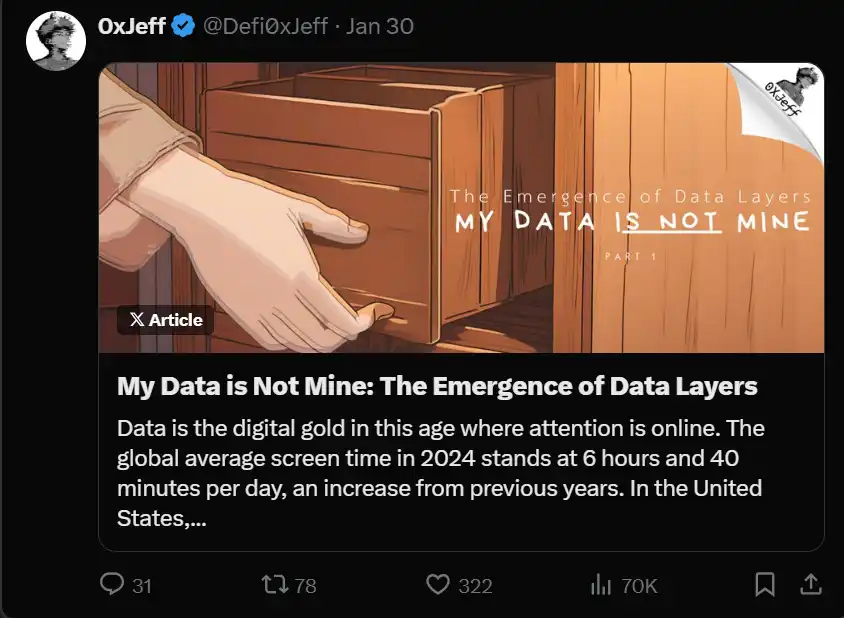
The GDPR in Europe, CCPA in California, and regulations in other regions worldwide have made data privacy not just an ethical issue but a legal requirement, urging companies to ensure data protection.
With the rapid advancement of artificial intelligence, AI has not only enhanced privacy protection but also further complicated the privacy and verifiability domain. For example, while AI can help detect fraudulent activities, it has also enabled the development of "deepfake" technology, making it more challenging to verify the authenticity of digital content.
Benefits
· Privacy-preserving Machine Learning: Federated Learning allows AI models to be trained directly on devices without centralizing sensitive data, thus protecting user privacy.
· AI can be used to anonymize or pseudonymize data, making data less traceable to individuals while still being usable for analysis.
·AI is crucial for developing tools to detect and reduce deepfake dissemination, thereby ensuring the verifiability of digital content (and detecting/verifying the authenticity of AI agents).
·AI can automatically ensure that data processing practices comply with legal standards, making the verification process more scalable.
Challenge
·AI systems typically require large datasets to function effectively, but the use, storage, and access of data may be opaque, raising privacy concerns.
·With sufficient data and advanced AI techniques, individuals may be re-identified from a dataset that should have been anonymous, compromising privacy protection.
·As AI can generate highly realistic text, images, or videos, distinguishing between real and AI-generated fake content becomes more difficult, challenging verifiability.
·AI models may be deceived or manipulated (adversarial attacks), compromising the verifiability of data or the integrity of the AI system itself (as seen in cases like Freysa, Jailbreak, etc.).
These challenges have driven the rapid development of AI, blockchain, verifiability, and privacy technologies, leveraging the strengths of each. We have seen the rise of the following technologies:
·Zero-Knowledge Proofs (ZKP)
·Zero-Knowledge Transport Layer Security (zkTLS)
·Trusted Execution Environments (TEE)
·Fully Homomorphic Encryption (FHE)
1. Zero-Knowledge Proofs (ZKP)
ZKP allows one party to prove to another that they know certain information or that a statement is correct without revealing any information beyond the proof itself. AI can leverage this to prove that data processing or decisions comply with certain standards without revealing the data itself. A good case study is getgrass io, where Grass uses idle internet bandwidth to collect and organize public web data for training AI models.

The Grass Network allows users to contribute their idle internet bandwidth through a browser extension or application, which is used to crawl public web data and then process it into a structured dataset suitable for AI training. The network performs this web crawling process through nodes operated by users.
The Grass Network emphasizes user privacy by only crawling public data, not personal information. It uses zero-knowledge proofs to verify and protect the integrity and source of data, preventing data tampering and ensuring transparency. All data collection to processing transactions is managed through sovereign data aggregation on the Solana blockchain.
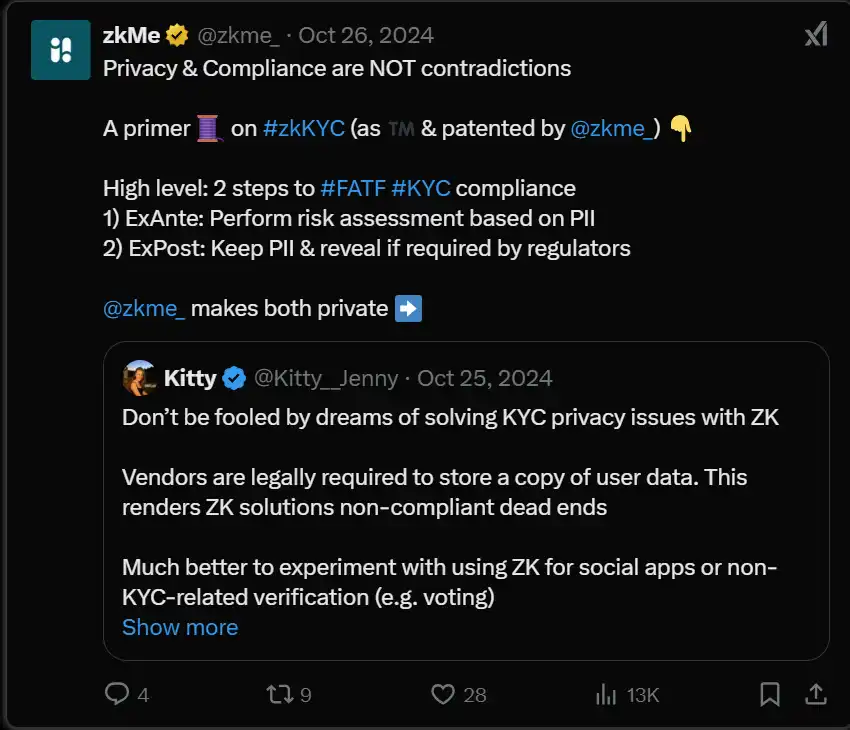
Another good case study is zkMe.
zkMe's zkKYC solution addressed the challenge of conducting KYC (Know Your Customer) processes in a privacy-preserving manner. By leveraging zero-knowledge proofs, zkKYC enables the platform to verify user identities without exposing sensitive personal information, thereby maintaining compliance while protecting user privacy.
2.zkTLS
TLS = Transport Layer Security, a standard security protocol that provides privacy and data integrity between two communicating applications (often associated with the "s" in HTTPS). zk + TLS = Enhanced privacy and security in data transmission.
A good case study is OpacityNetwork.
Opacity uses zkTLS to provide a secure and private data storage solution. By integrating zkTLS, Opacity ensures that data transfers between users and storage servers remain confidential and tamper-proof, addressing the inherent privacy issues in traditional cloud storage services.
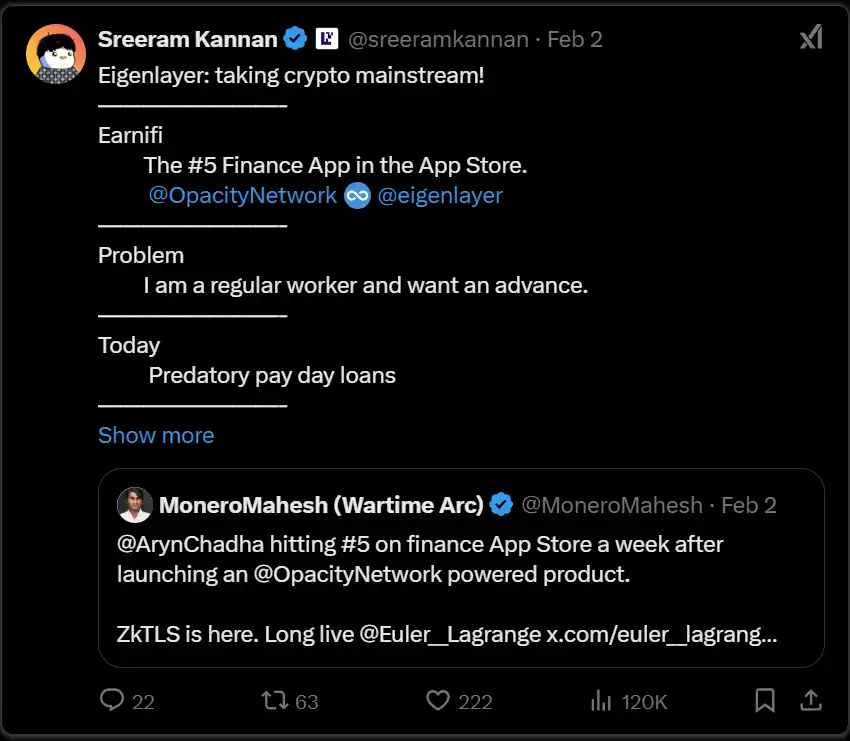
Use Case—Paycheck Advance
Earnifi is an app reportedly skyrocketing in app store rankings, particularly in the finance app category, leveraging OpacityNetwork's zkTLS.
· Privacy: Users can provide their income or employment status to a lender or other service without revealing sensitive banking information or personal details like bank statements.
· Security: The use of zkTLS ensures these transactions are secure, verified, and private, avoiding the need for users to entrust all financial data to a third party.
· Efficiency: The system reduces the costs and complexities associated with traditional paycheck advance platforms, as traditional platforms might require intricate verification processes or data sharing.
3.TEE
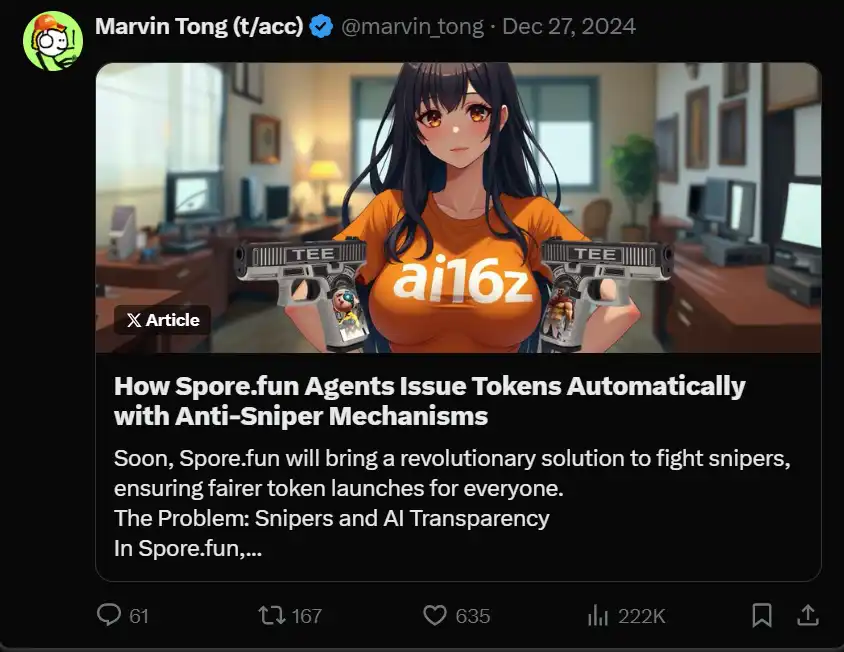
Trusted Execution Environment (TEE) provides hardware-enforced isolation between a normal execution environment and a secure execution environment. This is perhaps the most well-known secure implementation in AI agents currently to ensure they are fully autonomous agents. Promoted by 123skely's aipool tee experiment: a TEE pre-sale event where the community sends funds to the agent, and the agent autonomously issues tokens based on predefined rules.

marvin tong's PhalaNetwork: MEV Protection, integration of ai16zdao's ElizaOS, and Agent Kira as a verifiable autonomous AI agent.
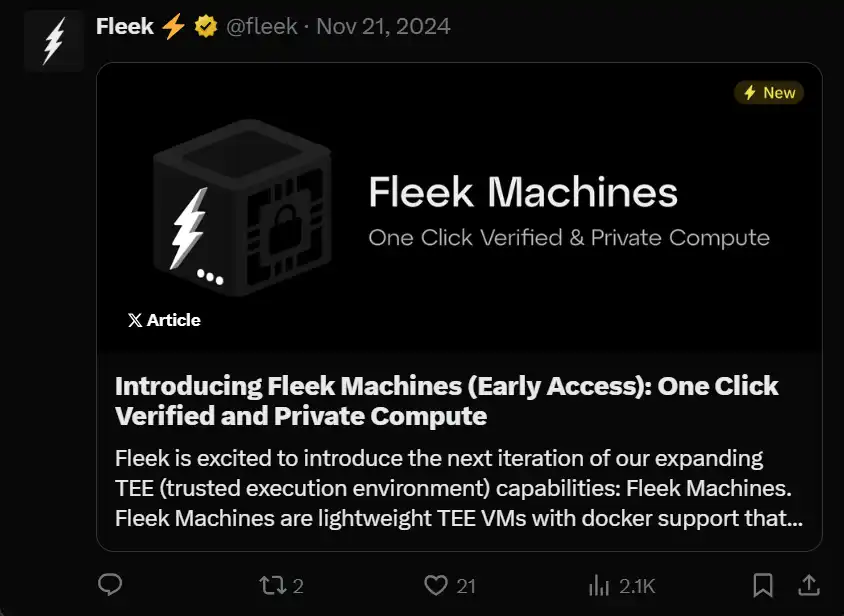
fleek's One-Click TEE Deployment: Focused on streamlining usage and enhancing developer accessibility.
4. FHE (Fully Homomorphic Encryption)
A form of encryption that allows computation to be performed directly on encrypted data without the need to decrypt it first.
A good case study is mindnetwork xyz and its proprietary FHE technology/use case.

Use Case — FHE Staking Layer with Risk-Free Voting
FHE Staking Layer
By using FHE, staked assets remain encrypted, meaning private keys are never exposed, significantly reducing security risks. This ensures privacy while also validating transactions.
Risk-Free Voting (MindV)
Governance voting takes place on encrypted data, ensuring that voting remains private and secure, reducing the risk of coercion or bribery. Users gain voting power (vFHE) by holding staked assets, thus decoupling governance from direct asset exposure.
FHE + TEE
By combining TEE and FHE, they create a robust security layer for AI processing:
· TEE protects operations in the computing environment from external threats.
· FHE ensures operations are always performed on encrypted data throughout the entire process.
For institutions handling transactions ranging from $100 million to $1 billion+, privacy and security are paramount to prevent front-running, hacking attempts, or exposure of trading strategies.
For an AI agent, this dual encryption enhances privacy and security, making it particularly useful in the following areas:
· Sensitive training data privacy
· Protecting internal model weights (preventing reverse engineering/IP theft)
· User data protection
The main challenge of FHE still lies in the high overhead due to its computational intensity, leading to increased energy consumption and latency. Current research is exploring methods such as hardware acceleration, hybrid encryption techniques, and algorithm optimization to reduce the computational burden and improve efficiency. Therefore, FHE is best suited for low-computation, high-latency applications.
Summary
· FHE = Operating on encrypted data without decryption (highest privacy protection, but most expensive)
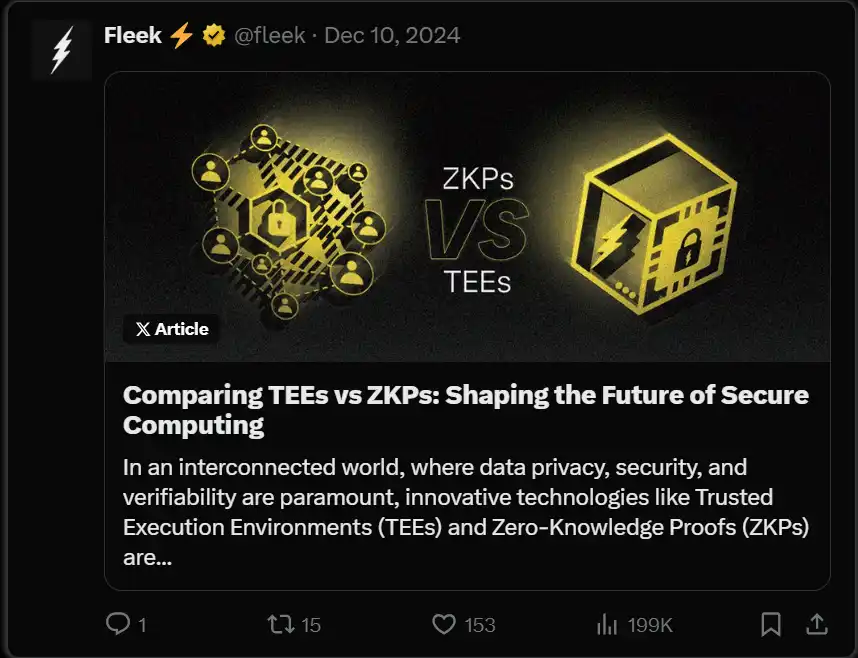
· TEE = Hardware, secure execution in an isolated environment (balancing security and performance)
· ZKP = Proof of statements or identity authentication without revealing underlying data (suitable for proving facts/credentials)
This is a broad topic, so this is not the end. One key question still remains: in an era of increasingly sophisticated deepfakes, how do we ensure that AI-driven verifiability mechanisms are truly trustworthy? In Part Three, we will delve into:
· Verifiability layer
· AI's role in validating data integrity
· The future development of privacy and security
You may also like

Trump Says He Was Unaware of $500M UAE Investment in World Liberty Financial
Key Takeaways: US President Donald Trump denied knowledge of a $500 million UAE investment in World Liberty Financial.…

Crypto Industry and Banks at a Stalemate Over Stablecoin Yield Deal
Key Takeaways The White House has urged a compromise on stablecoin yields to progress Senate crypto legislation. Crypto…

Why Vitalik Buterin Sold Over 700 Ethereum (ETH) Despite Market Recovery
Key Takeaways Vitalik Buterin sold over 700 Ethereum not for market reasons but to finance long-term projects. The…

Binance Withdrawals Restored Following Temporary Disruption
Key Takeaways Binance faced technical difficulties affecting withdrawals, but services were quickly restored within 20 minutes. The disruption…

Asian Markets Stabilize as Bitcoin Trades Around $78K
Key Takeaways Bitcoin steadies at approximately $78,000 as Asian markets recover from recent volatility. Regional equities, including Japan’s…

Bitcoin Price Prediction: The Warsh Shock & The Stablecoin Summit—Is the Bull Case Dead?
Key Takeaways Kevin Warsh’s nomination as Federal Reserve Chair has caused a drop in liquidity for riskier assets,…

White House Continues to Negotiate Over Crypto Market Structure Bill
Key Takeaways The White House is pushing for a compromise on the contentious issue of stablecoin yields in…
Billionaire Michael Saylor’s Strategy Acquires $75M More Bitcoin – Is This a Bullish Sign?
Key Takeaways Michael Saylor’s Strategy has expanded its Bitcoin holdings by purchasing an additional 855 BTC for $75.3…
Polymarket Bettors Assign Over 70% Probability of Bitcoin Dropping Below $65K — Are They Correct?
Key Takeaways Polymarket users predict Bitcoin has a 71% chance of falling below $65,000 in 2026, reflecting market…
CFTC Regulatory Shift Could Unlock New Growth for Coinbase Prediction Markets
Key Takeaways Newly appointed CFTC Chair, Michael Selig, aims for a unified federal oversight approach for crypto-linked prediction…

We Hacked Perplexity AI to Predict the Price of XRP, Bitcoin, and Ethereum By the End of 2026
Key Takeaways Perplexity AI predicts XRP may soar to $8 by 2026, fueled by legal victories and supportive…
Current Crypto Price Predictions: An In-Depth Analysis of XRP, Dogecoin, and Shiba Inu
Key Takeaways XRP, Dogecoin, and Shiba Inu are experiencing significant price declines amid geopolitical uncertainties and general market…

Pepe Coin Forecast: Price Appears Dismal, Yet Savvy Investors Rally Behind the Scenes
Key Takeaways Pepe Coin has experienced significant price drops, yet indicators suggest it may soon bottom out, with…

BitMine Reports 4.285M ETH Holdings, Expands Staked Position With Massive Reward Outlook
Key Takeaways BitMine Immersion Technologies has reported significant crypto holdings valued at $10.7 billion. The company’s Ethereum holdings…

Crypto Exchanges’ Stock Plunge 60% as Trading Volumes Dwindle – Is the Decline Ending or Just Beginning?
Key Takeaways Trading volumes on major crypto exchanges have drastically fallen, with a nearly 90% drop from October…

Best Crypto to Acquire Now February 2 – XRP, Solana, Ethereum
Key Takeaways Recent market turmoil saw Bitcoin plunge dramatically, affecting all major cryptocurrencies. XRP, Solana, and Ethereum are…

Ethereum Price Prediction: Top ETH Bulls Face $7.6 Billion in Paper Losses as Price Drops Below $2,400
Key Takeaways Ethereum has faced a downturn, dropping 19% below $2,400, resulting in significant paper losses for major…

Shiba Inu Price Prediction: SHIB Just Crashed to a 3-Year Low – Is SHIB Heading Towards Zero?
Key Takeaways Shiba Inu has recently hit a significant low, experiencing a 15% drop that places it at…
Trump Says He Was Unaware of $500M UAE Investment in World Liberty Financial
Key Takeaways: US President Donald Trump denied knowledge of a $500 million UAE investment in World Liberty Financial.…
Crypto Industry and Banks at a Stalemate Over Stablecoin Yield Deal
Key Takeaways The White House has urged a compromise on stablecoin yields to progress Senate crypto legislation. Crypto…
Why Vitalik Buterin Sold Over 700 Ethereum (ETH) Despite Market Recovery
Key Takeaways Vitalik Buterin sold over 700 Ethereum not for market reasons but to finance long-term projects. The…
Binance Withdrawals Restored Following Temporary Disruption
Key Takeaways Binance faced technical difficulties affecting withdrawals, but services were quickly restored within 20 minutes. The disruption…
Asian Markets Stabilize as Bitcoin Trades Around $78K
Key Takeaways Bitcoin steadies at approximately $78,000 as Asian markets recover from recent volatility. Regional equities, including Japan’s…
Bitcoin Price Prediction: The Warsh Shock & The Stablecoin Summit—Is the Bull Case Dead?
Key Takeaways Kevin Warsh’s nomination as Federal Reserve Chair has caused a drop in liquidity for riskier assets,…


 App
App