
- Buy Crypto
- Markets
 Futures
- Spot
- Copy Trade
 Earn
Earn- More
Solana's "Ecosystem Battle": Raydium and Pump.fun Begin Cake War

In the crypto world, competition has always been the main theme, and the recent internal strife in the Solana ecosystem has taken this "cake-grabbing" drama to a climax.
Last month, the popular Solana meme coin launchpad Pump.fun announced the development of its own AMM to reduce reliance on Raydium. Less than a month later today, Raydium announced the launch of a token launch platform LaunchLab similar to Pump.fun.
With this announcement, it basically signaled the end of the informal partnership between Pump.fun and Raydium. LaunchLab is said to provide linear, exponential, and logarithmic combination curves to match the token's demand and price. It will also allow third-party UIs to set their own fees. The market reacted swiftly to this news, with RAY surging by 16.2% in the past 24 hours at the time of writing, briefly touching $2.05.
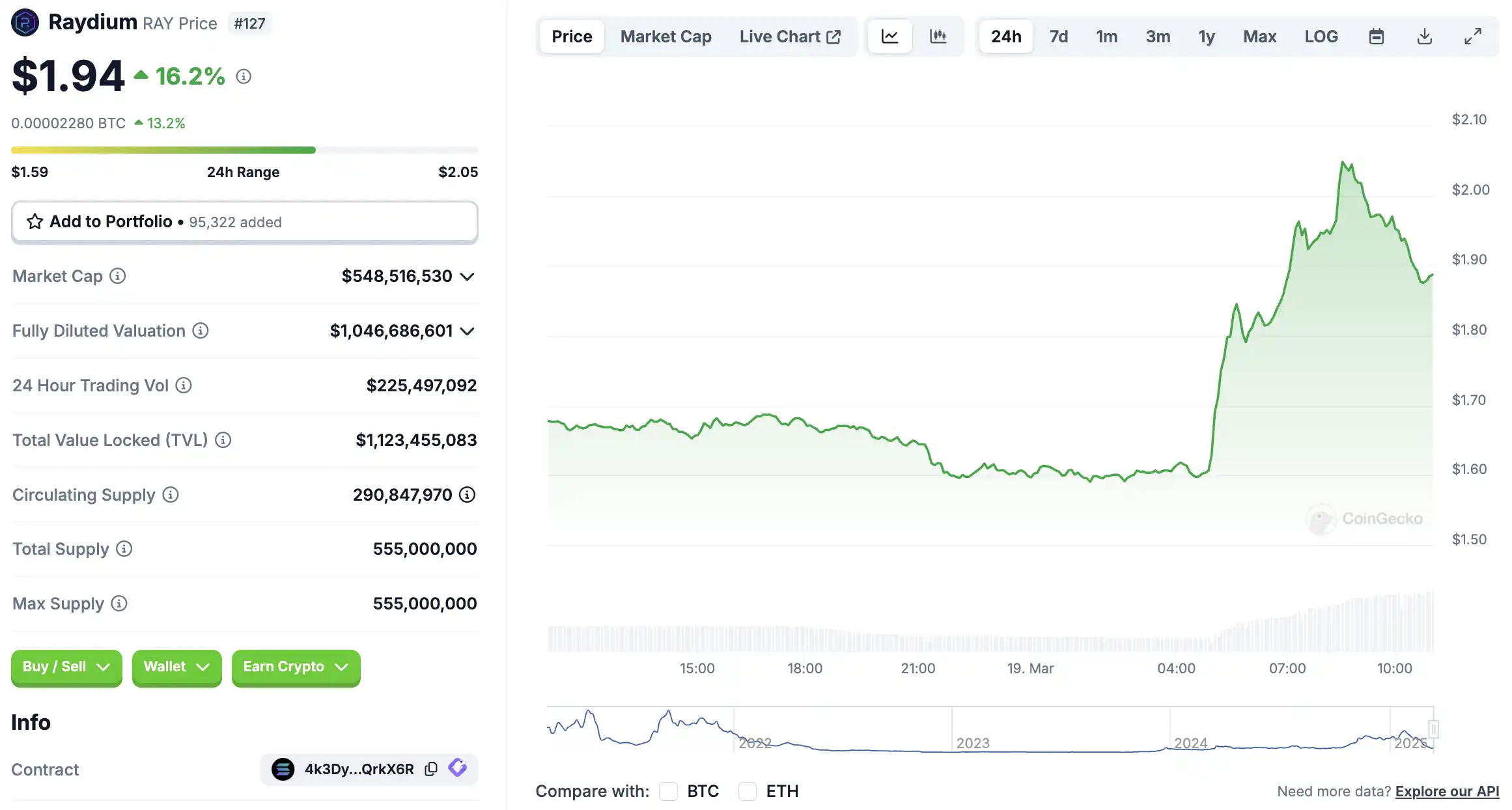
Pump.fun's "Betrayal" and Raydium's "Counterattack"
In fact, Raydium and Pump.fun originally had a mutually beneficial relationship. Pump.fun, as a hot meme coin launchpad on Solana, had its token issuance split into two phases: first in the "seed" phase, relying on its own Bonding Curve mechanism for trading matching. Once the trading volume reached $69,000, it would move to the "public" phase, migrating liquidity to Raydium to create pools and continue trading. Raydium, as Solana's mainstream DEX, charges a 0.25% fee per trade, with 0.22% going to LPs, and the remaining 0.03% used to buy back RAY tokens to support ecosystem development. This means Raydium's trading volume directly determines its fee income, thereby affecting RAY's value.
However, if Pump.fun builds its own AMM liquidity pool, the situation changes. Pump.fun's tokens may no longer flow to Raydium but be directly "intercepted" within its protocol. This is undoubtedly a severe blow to Raydium. According to Blockworks Research data, in the past 30 days, Pump.fun's meme coins accounted for 41% of Raydium's trading fee revenue. Raydium's native token plummeted by 25% in February as investors anticipated a significant drop in Raydium's revenue once Pump.fun started migrating tokens to its internal AMM.
Related Reading:《Pump.fun Flip the Table? Self-built AMM Pool Escapes Raydium's Restraints》
Raydium did not sit idly by, as it seemed to have anticipated Pump.fun's "betrayal." Data shows that Raydium still has about $168 million on its balance sheet, enough for some product upgrades and renovations. The advantage of having ample funds is that it allows the company to act quickly, such as suddenly developing a branch of Pump.fun. It was reported that Pump.fun's internal AMM had been circulating in Solana's rumor mill for some time before the leak. This LaunchLab was actually a big move that Raydium had been holding back for several months, indicating that it was not a sudden whim but a carefully planned counterattack. Relying on years of accumulated technical expertise and user base, Raydium aims to directly snatch Pump.fun's rice bowl from the source. This showdown is like a "battle of titans," with neither side willing to back down.
So why did Pump.fun and Raydium suddenly decide to end their mutual assistance and go their separate ways? Perhaps after this year's Memecoin market was harvested by meme coins and wife coins and then suffered repeated bloodbaths, with damage from whale insider trading, low-price chip accumulation, pump and rug-pull, there are no longer many retail investors willing to sit idly by for yet another PvP battle that shatters the dream of instant wealth.
The confrontation between Pump.fun and Raydium may be a desperate battle for remaining traffic and users. Pump.fun aims to "lock" users into its own ecosystem through DEX, while Raydium tries to snatch people from Pump.fun using a Meme launcher.
DeFi Old Playbook: A Reenactment of Vertical Integration
Overall, Pump.fun and Raydium's strategies are not only to improve their own tech stacks but also to engage in vertical integration, taking control of the entire token creation to trading pipeline.
In fact, this "end-to-end full-service" strategy was already common in the previous DeFi cycle. Back then, DeFi protocols were fond of playing the "three-piece set" - trading, lending, stablecoins, wanting to close the entire logic loop. From public chains like Near and Tron to protocols like Aave and Curve, they all entered the stablecoin race, some even making it an initial feature embedded in their own ecosystem. Public chains issued native stablecoins to "self-generate liquidity" or break free from external dependencies, while DeFi protocols built their AMM and lending platforms to solidify the moat of liquidity. The underlying logic is that whoever controls the "three-piece set" can strategically position themselves in the crypto financial ecosystem. Whether a new public chain attracts users with stablecoins or an old protocol embeds lending and trading components, the ultimate goal of vertical integration is scalability and independence.
Related Reading: "Crypto Mass War, The Defense Road to "De-USDC" Stablecoins"
Pump.fun and Raydium are now taking the same path. Pump.fun has a first-mover advantage in the token creation field, while Raydium has a strong foundation in AMM pools, with each side having its own unique strengths. On the bright side, this competition may stimulate the Solana ecosystem to reach new heights; on the other hand, it may lead to further fragmentation of attention and funds in the already illiquid Meme sector, and everyone might end up losing favor. Will this "civil war" in the Solana ecosystem result in each carving out their own territory, or will they fight to mutual destruction in the end? The ultimate success or failure will depend on whether the market and users buy into it.
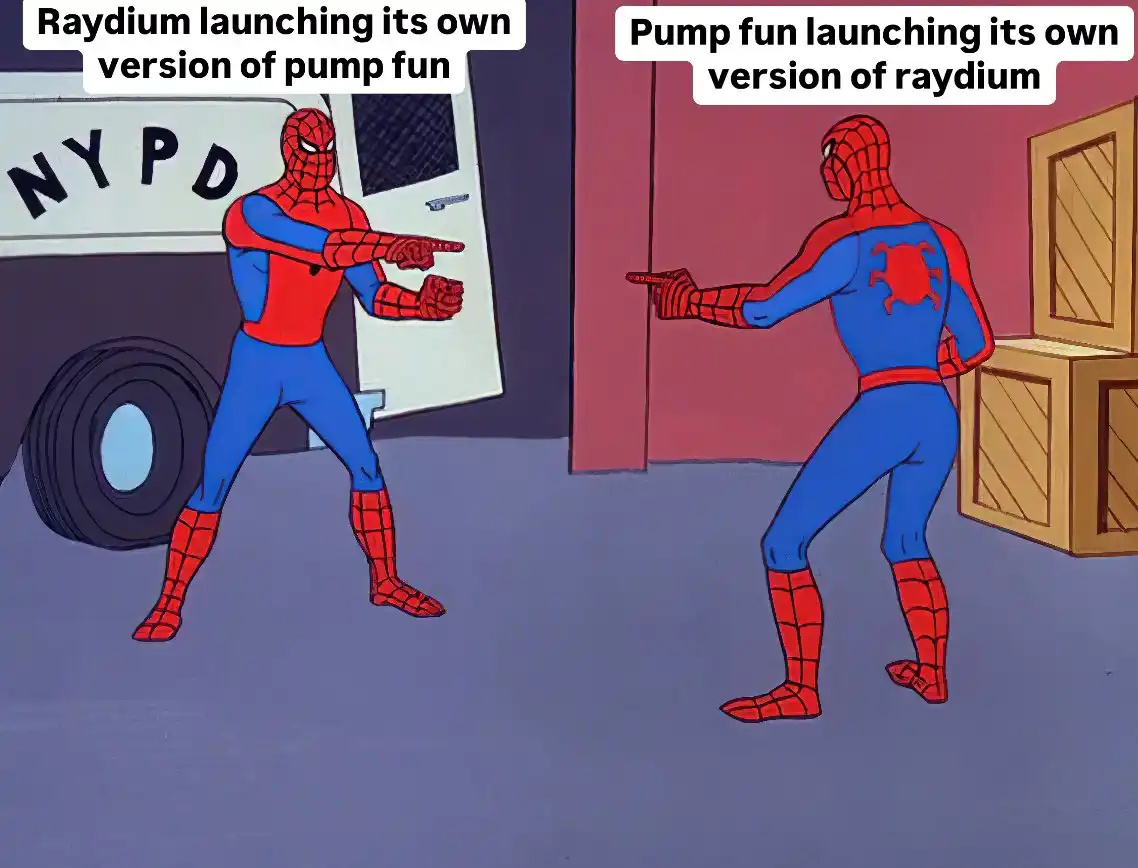
The "cake" battle between Pump.fun and Raydium may be a microcosm of the escalating competition in the Solana ecosystem. Will the future be separate portals or internal resource consumption? Who will have the last laugh? Let's grab our seats and watch the show.
You may also like

Key Market Intelligence for February 5th, how much did you miss out on?

Wintermute: By 2026, crypto had gradually become the settlement layer of the Internet economy

Tether Q4 2025 Report: USDT Market Cap Nears $190 Billion, Multiple Metrics Reach All-Time Highs

Kyle Samani's about-face, one of the biggest believers in web3, has also left the industry

Bhutan Quietly Sells Over $22M in Bitcoin, Drawing Speculation Over Possible Moves
Key Takeaways Bhutan has transferred over $22 million in Bitcoin from sovereign wallets in the past week. The…

BitMine Endures a $7B Unrealized Loss as Ethereum Dips Below $2,100
Key Takeaways BitMine is facing a significant financial challenge with an unrealized loss of over $7 billion in…

Trump-Linked World Liberty Financial Under Scrutiny Following $500 Million UAE Stake
Key Takeaways A U.S. House investigation is examining a $500 million UAE stake in Trump-related World Liberty Financial.…

Asia Market Open: Bitcoin Tumbles as Asian Equities Reflect Global Tech Retreat
Key Takeaways: Bitcoin’s price plunged by 6% to $72,000, reflecting the spillover effects from the global tech sector’s…

Crypto Firms Propose Concessions to Banks as Stablecoin Disputes Stall Key Crypto Bill
Key Takeaways: Crypto companies are attempting to navigate stablecoin disputes with banks but agreements remain elusive. Industry representatives…

CoolWallet Introduces TRON Energy Rental to Minimize TRX Transaction Costs
Key Takeaways CoolWallet has integrated TRON’s energy rental services, offering users lower transaction fees while maintaining asset security.…

CFTC Officially Withdraws Biden-Era Proposal to Ban Political and Sports Prediction Markets
Key Takeaways: The CFTC has rescinded a 2024 proposal and subsequent 2025 advisory that aimed to prohibit event…

Binance Says Assets Rose Amid Alleged Bank Run Attempt
Key Takeaways: Binance reported an unexpected increase in assets during a community-driven withdrawal campaign, challenging conventional expectations of…

Same Macro Tape, Different Bid – Gold Absorbs Flows as Bitcoin Swings
Key Takeaways: Gold is experiencing significant demand growth, especially via ETFs and central banks, projecting a robust performance…
Crypto Price Prediction Today, February 4 – Focus on XRP, Cardano, and Dogecoin
Key Takeaways Bitcoin is facing significant pressure, affecting the entire cryptocurrency market, including heavyweights like XRP, Cardano, and…

Vitalik Buterin Urges Ethereum Builders to Innovate Beyond Clone Chains
Key Takeaways Vitalik Buterin criticizes the trend of creating copy-paste EVM chains, encouraging developers to focus on truly…
Best Crypto to Buy Now February 4: XRP, Solana, Hyperliquid Picks
Key Takeaways XRP remains one of the top picks for cross-border transactions due to its high speed and…
XRP Price Prediction: Ripple Quietly Unlocks a Billion Tokens – Is a Price Shock Coming in the Next Few Hours?
Key Takeaways Ripple has released one billion XRP tokens into the market, potentially causing a shift in XRP…

Google’s Gemini AI Predicts the Price of XRP, Ethereum, and Solana By the End of 2026
Key Takeaways Google’s Gemini AI forecasts significant growth for XRP, anticipating a price of up to $8 by…
Key Market Intelligence for February 5th, how much did you miss out on?
Wintermute: By 2026, crypto had gradually become the settlement layer of the Internet economy
Tether Q4 2025 Report: USDT Market Cap Nears $190 Billion, Multiple Metrics Reach All-Time Highs
Kyle Samani's about-face, one of the biggest believers in web3, has also left the industry
Bhutan Quietly Sells Over $22M in Bitcoin, Drawing Speculation Over Possible Moves
Key Takeaways Bhutan has transferred over $22 million in Bitcoin from sovereign wallets in the past week. The…
BitMine Endures a $7B Unrealized Loss as Ethereum Dips Below $2,100
Key Takeaways BitMine is facing a significant financial challenge with an unrealized loss of over $7 billion in…


 App
App