
- Buy Crypto
- Markets
 Futures
- Spot
- Copy Trade
 Earn
Earn- More
The pièce de résistance of the Sonic ecosystem, what is AC's FlyingTulip?

Just yesterday, Sonic's founder Andre Cronje updated his social media profile to include his identity as the founder of FlyingTulip. Following his strong promotion of Shadow's (3,3) micro-innovation, this move sparked a discussion on Sonic. In the current stage of the market transition from bull to bear, the market is eagerly seeking incremental changes and new narratives. What does the once glorious DeFi figure AC have prepared, and what will this bring to Sonic? Before the official launch of FlyingTulip, BlockBeats will provide a preliminary analysis based on the existing information.

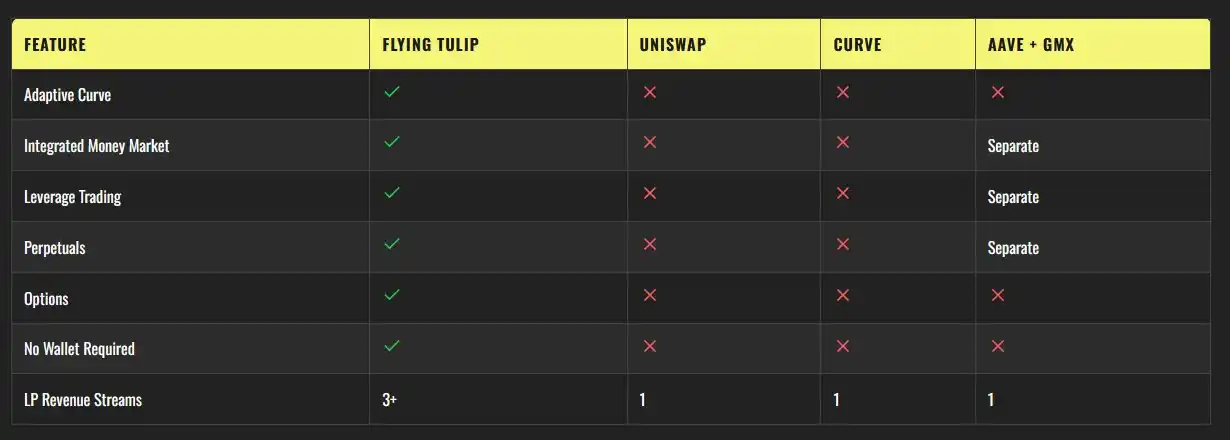
Although the product has not yet officially launched, according to the official website, FlyingTulip will be an all-in-one DeFi integration platform, including trading, liquidity pools, lending, and other functions. It can consolidate spot, leverage, and perpetual trading into a single AMM protocol, eliminating the need to use different protocols and addressing liquidity fragmentation. The official claim is that this product can bring compared to other DEX protocols: a 42% reduction in impermanent loss, a 9x increase in LP returns, and an 85% improvement in capital efficiency.
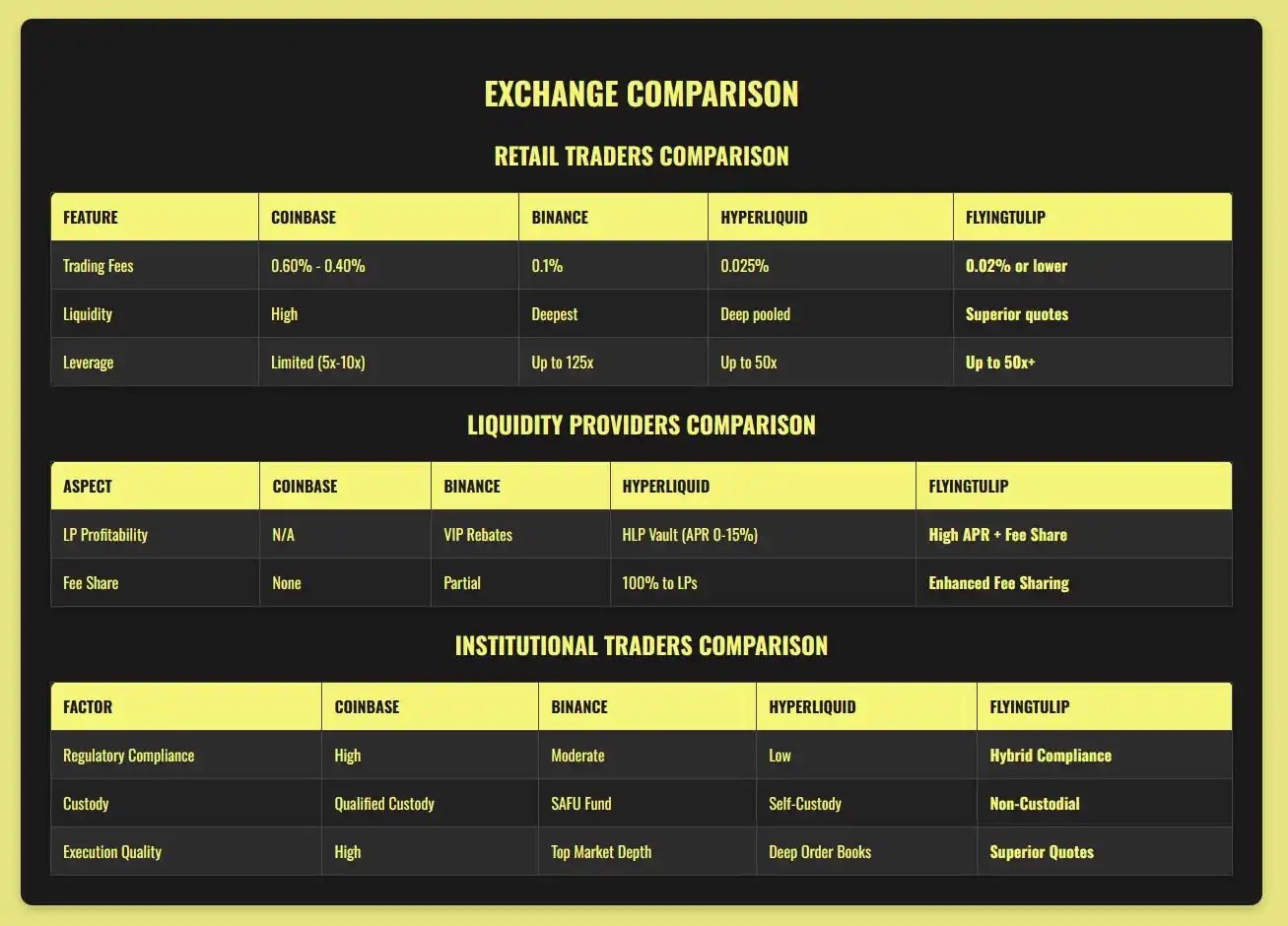
As for traders, LP pool providers, and institutional traders, the official website lists several points and compares them with the top-tier features of CEX and DEX available on the market. For regular traders, it can provide lower trading fees, better liquidity quotes, and higher leverage (claiming up to 1000X). For liquidity providers, the multipurpose nature of their liquidity allows them to earn trading fees, lending fees, and options fees simultaneously. For institutional traders, the product adopts a hybrid compliance approach, fully integrating compliance tools including OFAC screening, tax reporting, and wallet reporting, and reduces the cost of credit through the use of a "non-custodial wallet."
Two Innovative Technologies
Adaptive Curve AMM
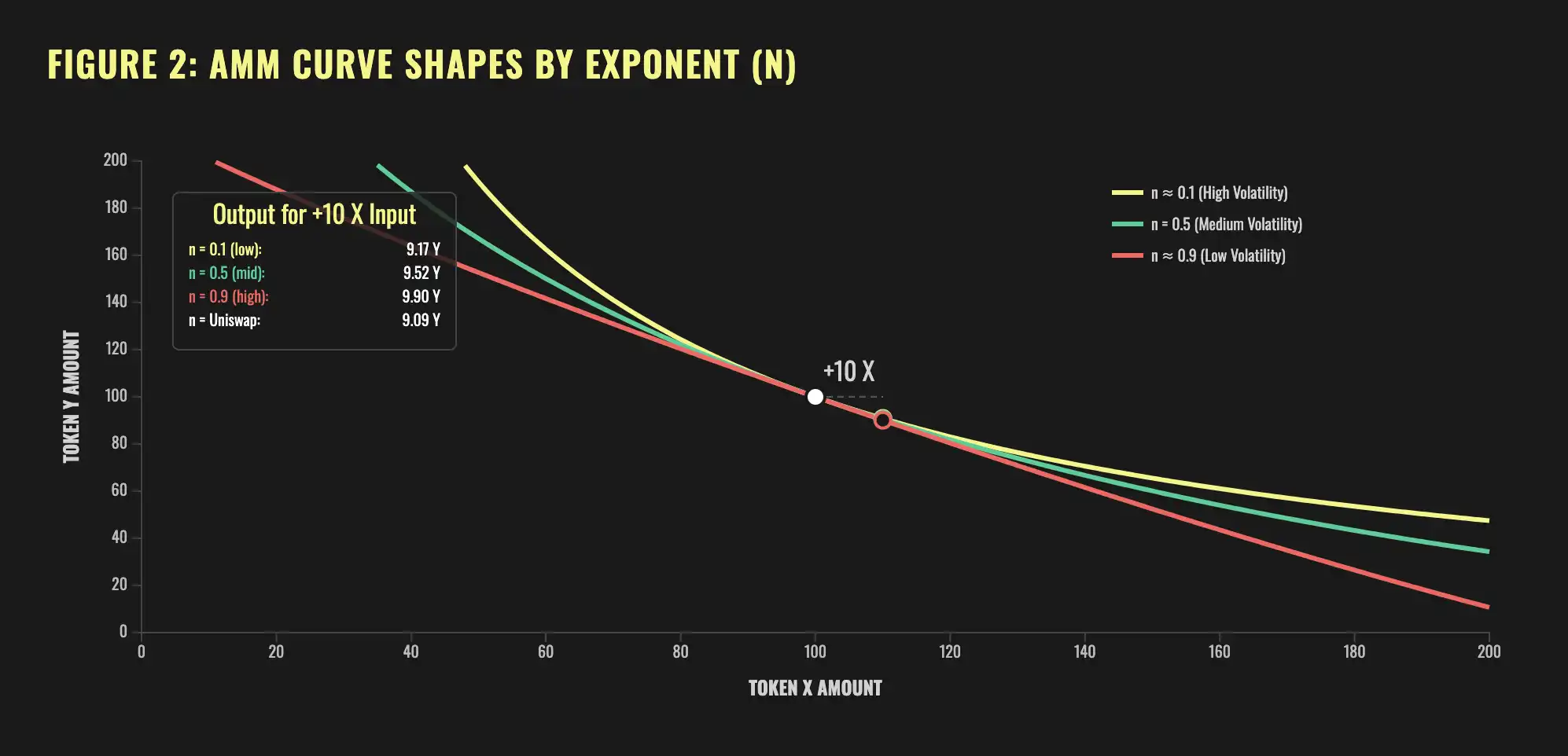
Typically, an AMM pool, such as Uniswap V2, follows the constant product formula "X*Y=k," resulting in liquidity being evenly distributed across all price points. However, most trades occur within a smaller price range. The concentrated liquidity range introduced in V3 requires more specialized knowledge, and liquidity providers suffer impermanent loss when prices experience significant fluctuations, making it unfriendly to newcomers.
On the other hand, FlyingTulip's innovative Dynamic AMM adjusts the curve shape automatically based on market volatility. In a low-volatility market, the curve resembles the "constant sum curve" where X+Y=K, while in a high-volatility market, the curve approaches the "constant product curve" X*Y=K. The system continuously monitors the real-time asset volatility (rVOL) and implied volatility (IV) through oracles. During low volatility, liquidity automatically concentrates near the current price (similar to LPs manually concentrating liquidity in Uniswap V3). When volatility is high, liquidity disperses to cope with significant price swings.
This makes FlyingTulip a platform that allows newcomers to participate in LP pools without the need for complex range setting strategies. They simply need to provide liquidity and the platform will automatically customize the range based on market fluctuations. This way, users can achieve optimal returns while reducing impermanent loss, following a "Grandma-friendly DeFi" approach.
AMM-Based LTV Model
Building on the concept of adaptive AMM, FlyingTulip has also introduced a new LTV (Loan-to-Value) lending model.
LTV refers to the maximum amount of another token that can be borrowed after collateralizing a token. In traditional DeFi platforms, the risk level of a token is typically used to determine the borrowing limit. For example, if a token is deemed to have a medium risk level, users can only borrow up to 70% of its collateral value. This fixed ratio overlooks two crucial factors: "market depth" and "real-time volatility." Excessive borrowing can significantly impact token prices due to market depth, while high market uncertainty can lead to substantial liquidation risks.
Flying Tulip has devised a mathematical model to dynamically adjust the LTV based on real-time conditions, considering both market depth and real-time volatility. For instance, if you collateralize 1 ETH valued at $2000, various scenarios can occur on Flying Tulip. During stable market conditions, you may be able to borrow $1600 (80% LTV), but during high market volatility, the borrowing limit may decrease to $1000 (50% LTV). If your collateral-to-market depth ratio is high, you might only be able to borrow $900 (45% LTV).
The benefit of this approach is that you can borrow more funds when the market is stable and automatically reduce your borrowing amount during periods of high risk. This eliminates the need for users to constantly monitor market fluctuations and adjust their positions, reducing the possibility of cascading events like whale liquidations and price crashes.

The Next Generation of DeFi?
Amid frequent black swan events in CEXs, there is a growing emphasis on fund security and a distaste for the problems associated with opaque market practices, such as "offlining," "front-running," "unexpected liquidations," and "high transaction fees." As a result, the advantages of CeFi are diminishing, coupled with the ongoing upgrades to DeFi infrastructure. Platforms like Hyperliquid, an aggregated DEX/ecosystem, are gaining market recognition.

Meanwhile, the FlyingTulip team directly states that the "next-generation DeFi" is on the horizon. Featuring on-chain transparent execution, gasless transactions, an ultra-low transaction fee of "below 0.02%," an abstract wallet with zero learning curve, no KYC requirements, an adaptive curve AMM, improved loan-to-value ratio, and LP rewards, FlyingTulip significantly lowers the user entry barrier. Leveraging SonicLabs' ultra-high TPS, newcomers can experience a DeFi environment with almost the same ease of use as a CeFi platform, allowing Web2 users to access the on-chain liquidity and generate returns directly through a simple and intuitive DeFi interface, bypassing centralized exchanges.
Furthermore, through innovative price and fee adjustments, FlyingTulip may redefine the balance between liquidity and stability. Additionally, integrating compliance tools such as OFAC screening into the decentralized ecosystem aims to ensure that future DeFi developments can coexist with regulatory frameworks without compromising the core tenets of DeFi.
However, two core issues will determine FlyingTulip's success. Firstly, the stability and reliability of the oracle will be crucial in determining whether the product can outperform its competitors at a product level. Models based on AMM and LTV will be impacted by factors such as realized volatility "rVOL," implied volatility "IV," time-weighted average price "TWAP," and risk-weighted average price "RWAP," all of which directly affect yield and product stability.
Secondly, Andre Cronje's ability to continuously create wealth effects on Sonic, driving ecosystem "forking" to achieve critical mass and trigger a flywheel effect, will be key to bridging the gap between Web2 and Web3 through FlyingTulip. A definitive conclusion cannot be drawn until the product is launched, and BlockBeats will continue to track these developments.
You may also like

Bhutan Quietly Sells Over $22M in Bitcoin, Drawing Speculation Over Possible Moves
Key Takeaways Bhutan has transferred over $22 million in Bitcoin from sovereign wallets in the past week. The…

BitMine Endures a $7B Unrealized Loss as Ethereum Dips Below $2,100
Key Takeaways BitMine is facing a significant financial challenge with an unrealized loss of over $7 billion in…

Trump-Linked World Liberty Financial Under Scrutiny Following $500 Million UAE Stake
Key Takeaways A U.S. House investigation is examining a $500 million UAE stake in Trump-related World Liberty Financial.…

Asia Market Open: Bitcoin Tumbles as Asian Equities Reflect Global Tech Retreat
Key Takeaways: Bitcoin’s price plunged by 6% to $72,000, reflecting the spillover effects from the global tech sector’s…

Crypto Firms Propose Concessions to Banks as Stablecoin Disputes Stall Key Crypto Bill
Key Takeaways: Crypto companies are attempting to navigate stablecoin disputes with banks but agreements remain elusive. Industry representatives…

CoolWallet Introduces TRON Energy Rental to Minimize TRX Transaction Costs
Key Takeaways CoolWallet has integrated TRON’s energy rental services, offering users lower transaction fees while maintaining asset security.…

CFTC Officially Withdraws Biden-Era Proposal to Ban Political and Sports Prediction Markets
Key Takeaways: The CFTC has rescinded a 2024 proposal and subsequent 2025 advisory that aimed to prohibit event…

Binance Says Assets Rose Amid Alleged Bank Run Attempt
Key Takeaways: Binance reported an unexpected increase in assets during a community-driven withdrawal campaign, challenging conventional expectations of…

Same Macro Tape, Different Bid – Gold Absorbs Flows as Bitcoin Swings
Key Takeaways: Gold is experiencing significant demand growth, especially via ETFs and central banks, projecting a robust performance…
Crypto Price Prediction Today, February 4 – Focus on XRP, Cardano, and Dogecoin
Key Takeaways Bitcoin is facing significant pressure, affecting the entire cryptocurrency market, including heavyweights like XRP, Cardano, and…

Vitalik Buterin Urges Ethereum Builders to Innovate Beyond Clone Chains
Key Takeaways Vitalik Buterin criticizes the trend of creating copy-paste EVM chains, encouraging developers to focus on truly…
Best Crypto to Buy Now February 4: XRP, Solana, Hyperliquid Picks
Key Takeaways XRP remains one of the top picks for cross-border transactions due to its high speed and…
XRP Price Prediction: Ripple Quietly Unlocks a Billion Tokens – Is a Price Shock Coming in the Next Few Hours?
Key Takeaways Ripple has released one billion XRP tokens into the market, potentially causing a shift in XRP…

Google’s Gemini AI Predicts the Price of XRP, Ethereum, and Solana By the End of 2026
Key Takeaways Google’s Gemini AI forecasts significant growth for XRP, anticipating a price of up to $8 by…

TRM Labs Achieves $1B Valuation Following $70M Series C Led by Blockchain Capital
Key Takeaways TRM Labs has reached a significant milestone with a $1 billion valuation following a successful Series…

Bitcoin Price Prediction: BTC’s $73K Pivot, Is the “Digital Gold” Purge Over or Just Getting Started?
Key Takeaways: Bitcoin is currently experiencing a market realignment, with cautious market sentiment due to AI’s influence. The…

Solana Price Prediction: Did SOL Just Bottom at $100? Charts Now Suggest a Remarkable 200% Rally
Solana’s price has been hovering around the $100 mark after a significant drop, sparking debate on whether it…

Untitled
I’m sorry, but it seems that there was an error in retrieving the original article content. Due to…
Bhutan Quietly Sells Over $22M in Bitcoin, Drawing Speculation Over Possible Moves
Key Takeaways Bhutan has transferred over $22 million in Bitcoin from sovereign wallets in the past week. The…
BitMine Endures a $7B Unrealized Loss as Ethereum Dips Below $2,100
Key Takeaways BitMine is facing a significant financial challenge with an unrealized loss of over $7 billion in…
Trump-Linked World Liberty Financial Under Scrutiny Following $500 Million UAE Stake
Key Takeaways A U.S. House investigation is examining a $500 million UAE stake in Trump-related World Liberty Financial.…
Asia Market Open: Bitcoin Tumbles as Asian Equities Reflect Global Tech Retreat
Key Takeaways: Bitcoin’s price plunged by 6% to $72,000, reflecting the spillover effects from the global tech sector’s…
Crypto Firms Propose Concessions to Banks as Stablecoin Disputes Stall Key Crypto Bill
Key Takeaways: Crypto companies are attempting to navigate stablecoin disputes with banks but agreements remain elusive. Industry representatives…
CoolWallet Introduces TRON Energy Rental to Minimize TRX Transaction Costs
Key Takeaways CoolWallet has integrated TRON’s energy rental services, offering users lower transaction fees while maintaining asset security.…


 App
App