
- Buy Crypto
- Markets
- Futures
- Spot
- Copy Trade
 Earn
Earn- More
XMR Surges Over 50% in One Week: Who's Buying?

Original Title: "The More It Gets Restricted, the Higher It Goes? Decrypting the Black-and-White Truth Behind XMR's Soaring Price"
Original Author: Frank, PANews
The privacy-focused player XMR (Monero) hit a new all-time high on January 13th, with the spot price breaking above $690, once again sparking discussions about privacy coins in the market.
From January 2025 to the present, XMR has surged from around $200 to its current price, marking a maximum increase of 262% over the past year. At a time when most mainstream altcoins are generally weak, this surge is exceptionally rare. What's even more intriguing is that this rally occurred against the backdrop of unprecedented global regulatory tightening.
Due to compliance pressures, major centralized exchanges such as Binance have long delisted XMR's spot trading. Just on January 12th, the Dubai Virtual Asset Regulatory Authority (VARA) officially announced a ban on the trading and custody of privacy coins throughout Dubai and its free zones. However, this ban not only failed to cast a shadow on XMR but also defied the odds by reaching a new high, serving as a derision to the Dubai government.
Amidst liquidity drought on trading platforms and the swinging regulatory hammer, who is the real driving force behind XMR's surge? PANews delves beneath the surface to find the genuine demand behind this round of market movement.
Trading Platforms Are Not the Core Pricing Venue
Despite the hot market, it is not dominated by funds within trading platforms.
On the spot side, although XMR's recent trading volume has seen some increase as the market rises, it has mostly remained in the range of tens of millions to $200 million, without any particularly exaggerated increments. Looking back, the real and significant peak of spot trading volume was created on November 10th, reaching $4.1 billion. This means that in this recent doubling market cycle, spot trading (or spot buying within centralized exchanges) is not the primary driver.
On the futures side, the situation is similar. The peak in trading volume also occurred on November 10th. Subsequently, up until just a week ago, there was no significant surge in futures trading volume, and there were even signs of a slight decline. Looking at the open interest data, the curve of its USD-denominated changes almost completely overlaps with the price trend. The amount of XMR held in the market has not seen a massive surge, and the rise in the open interest is merely due to the price increase, rather than the entry of large-scale new funds for opening positions.
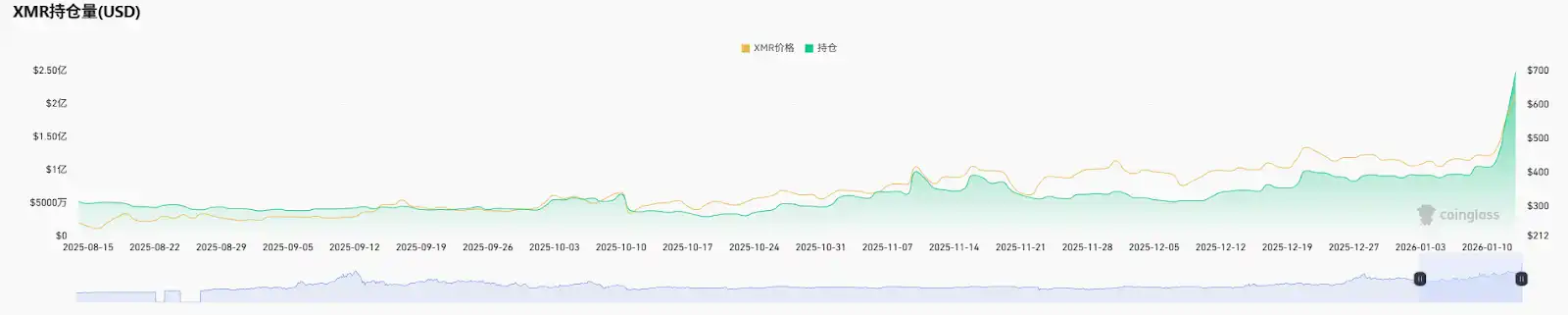
Evidently, mainstream trading platforms are not the core venue for pricing XMR at the moment.
Supply Side Undercurrent, Miner Shuffling, and Early Deployment
Since the "surface-level" funding is unremarkable, we need to turn to the "dark side" of the on-chain world. XMR, as the most privacy-centric network with minimal information leakage, yet with fluctuating mining difficulty and rewards, allows us to glimpse into capital deployment on the supply side.
Mining historical difficulty typically represents capital's enthusiasm for participating in the network ecosystem. Data shows that XMR's mining difficulty started to rise rapidly at the end of 2024 and remained in a rapid growth state throughout the first half of 2025. Although there were fluctuations from September to November, a new round of difficulty escalation has recently begun.
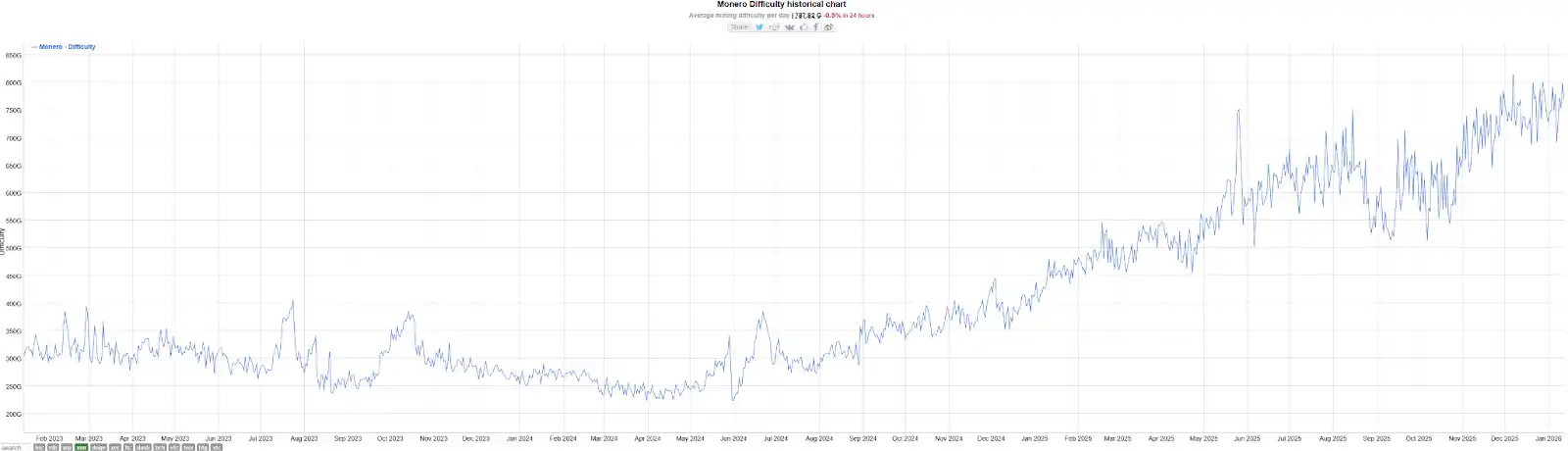
Here we have to mention an episode: In September, the Qubic project team claimed to control over 51% of XMR's total network hashrate and conducted a "demonstration attack," causing an 18-block chain reorganization on the XMR network. This event sounded the alarm for the community, and subsequently, a large number of miners migrated their hashrate to the established mining pool SupportXMR. This turmoil was the main reason for the dramatic fluctuations in mining difficulty at the end of 2025, but it also indirectly confirmed the vitality and resilience of the hashrate market.
More noteworthy is the linkage between mining rewards and difficulty.
Prior to April 2025, Monero network's mining rewards experienced a significant decline. Looking at the difficulty chart at that time, there was a sharp increase in hashrate while the coin price remained volatile. This deviation led to diluted rewards, possibly forcing some high-cost small miners out of the market. Data shows that the mining difficulty briefly dropped in April, confirming this speculation.
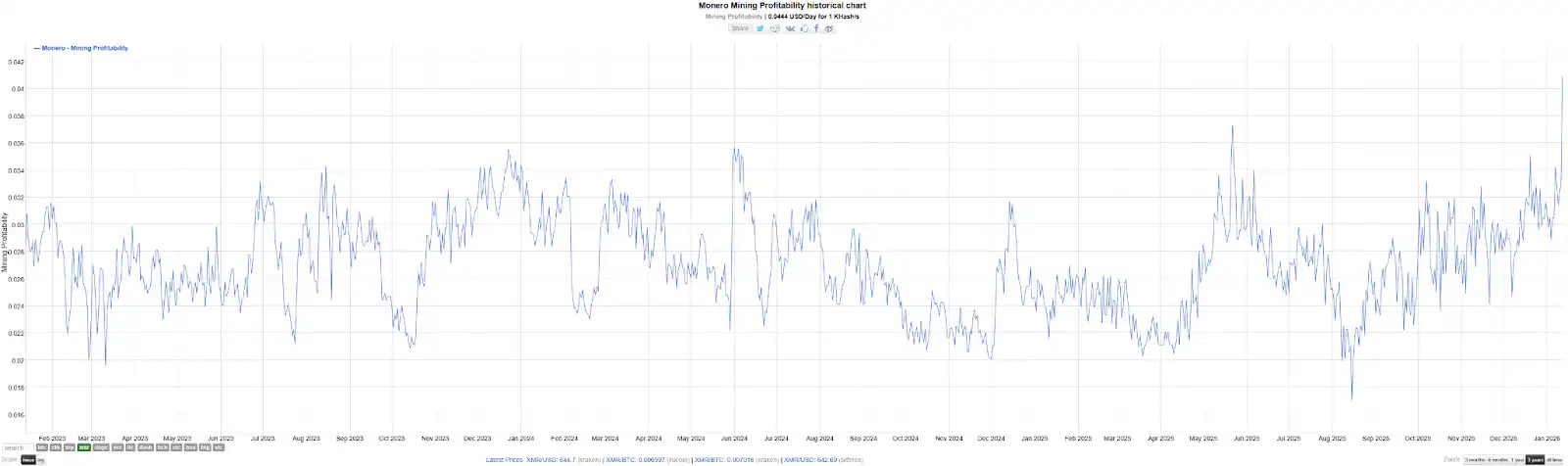
This was a typical case of "miner surrender" and "chip exchange." Subsequently, with a significant price surge, mining rewards and difficulty once again synchronously increased. From the data changes in this phase, it can be seen that as early as the beginning of 2025, some large mining companies or capital with strong risk resistance may have already started early deployment in Monero token mining despite the low returns.
Demand Side Validation, Premium for Privacy Payments
If miners represent the confidence on the supply side, then the average transaction fee most truthfully reflects the demand on the user side.
From the chart, Monero's average transaction fee remained relatively stable at below $0.1 until the first half of 2025. However, an upward trend began to emerge in June; by December 11, the highest average fee reached above $0.3, more than triple the amount from six months ago.
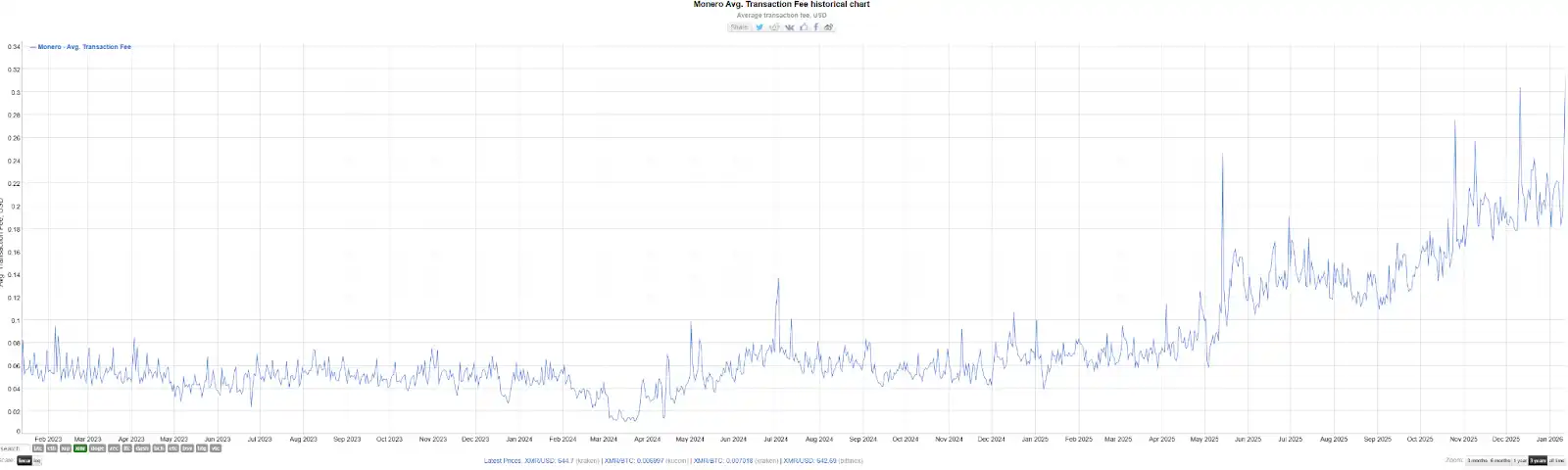
Due to Monero's dynamic block size mechanism, the surge in fees means that a large number of users are attempting to rapidly send transactions and are willing to pay high fees to compensate miners for the block size expansion cost. This indirectly proves that starting from the second half of 2025, the real transaction demand on the Monero chain began to increase significantly.
However, we have also discovered an interesting pattern: The surge in on-chain fees often occurs in sync with price surges.
For example, on April 28th, XMR suddenly rose by 14%, with the average transaction fee spiking to $0.125 on that day; whereas during the subsequent slow price climb period, the fees plummeted back to a low (bottoming at $0.058 on May 4th). This indicates that while market fluctuations can drive on-chain demand in the short term, when the volatility subsides, on-chain demand also returns to normal. Although sometimes the two are not always in sync (such as the fee increase on May 14th without a price movement), overall, over this year and a half period, price increases have temporarily driven on-chain demand, and the real on-chain demand growth has in turn sparked market optimism for XMR, with the two acting as cause and effect.
The Dual Nature of the Truth
From the above data, the surge in XMR may have a dual-natured truth.
The so-called "white" side is a "anti-fragile" rebound of privacy demand under high regulatory pressure.
The reverse thrust of regulation is becoming increasingly apparent. The ban by Dubai VARA not only failed to crush XMR but instead made market participants realize that regulatory agencies can ban trading platforms, but cannot ban the protocol itself. When major exchanges exited the XMR trading scene, relying on market makers and derivative pricing logic was rewritten, XMR returned to a pattern controlled by real users or some heavyweight players. After breaking away from the exchange system, privacy coins adopted an independent rhythm completely different from the mainstream market.
The "black" side is a capital game of information asymmetry.
Behind this opacity, there may be a "whale" lurking beneath the surface. The "not-so-impressive" transaction data (even on January 13, at an all-time high, the total contract holdings were only $240 million, with liquidation only a little over $1 million) indicates that mainstream institutions hardly predicted and participated in this rally in advance, only following suit.

This information asymmetry held by a few individuals leads to extreme price volatility. Particularly when the market starts to pay attention to this surge, it often indicates a short-term overheating of sentiment. Taking the example of the privacy coin ZEC in November, it experienced a retracement of over 50% after a surge. Ultimately, in the privacy coin market, there is a significant amount of "information asymmetry," putting retail investors at an absolute disadvantage.
In the midst of a privacy coin's violent volatility, on-chain data may be our only trusted guide. But in the opaqueness of the deep sea, free premium always comes with unknown risks.
You may also like

Russia’s Largest Bitcoin Miner BitRiver Faces Bankruptcy Crisis – What Went Wrong?
Key Takeaways BitRiver, the largest Bitcoin mining operator in Russia, faces a bankruptcy crisis due to unresolved debts…

Polymarket Predicts Over 70% Chance Bitcoin Will Drop Below $65K
Key Takeaways Polymarket bettors forecast a 71% chance for Bitcoin to fall below $65,000 by 2026. Strong bearish…

BitMine Reports 4.285M ETH Holdings, Expands Staked Position With Massive Reward Outlook
Key Takeaways BitMine Immersion Technologies holds 4,285,125 ETH, which is approximately 3.55% of Ethereum’s total supply. The company…

US Liquidity Crisis Sparked $250B Crash, Not a ‘Broken’ Crypto Market: Analyst
Key Takeaways: A massive $250 billion crash shook the cryptocurrency markets, attributed largely to liquidity issues in the…

Vitalik Advocates for Anonymous Voting in Ethereum’s Governance — A Solution to Attacks?
Key Takeaways Vitalik Buterin proposes a two-layer governance framework utilizing anonymous voting to address collusion and capture attacks,…

South Korea Utilizes AI to Pursue Unfair Crypto Trading: Offenders Face Severe Penalties
Key Takeaways South Korea is intensifying its use of AI to crack down on unfair cryptocurrency trading practices.…

Average Bitcoin ETF Investor Turns Underwater After Major Outflows
Key Takeaways: U.S. spot Bitcoin ETFs hold approximately $113 billion in assets, equivalent to around 1.28 million BTC.…

Japan’s Biggest Wealth Manager Adjusts Crypto Strategy After Q3 Setbacks
Key Takeaways Nomura Holdings, Japan’s leading wealth management firm, scales back its crypto involvement following significant third-quarter losses.…
CFTC Regulatory Shift Could Unlock New Opportunities for Coinbase Prediction Markets
Key Takeaways: The U.S. Commodity Futures Trading Commission (CFTC) is focusing on clearer regulations for crypto-linked prediction markets,…
Hong Kong Set to Approve First Stablecoin Licenses in March — Who’s In?
Key Takeaways Hong Kong’s financial regulator, the Hong Kong Monetary Authority (HKMA), is on the verge of approving…

BitRiver Founder and CEO Igor Runets Detained Over Tax Evasion Charges
Key Takeaways: Russian authorities have detained Igor Runets, CEO of BitRiver, on allegations of tax evasion. Runets is…

Crypto Investment Products Struggle with $1.7B Outflows Amid Market Turmoil
Key Takeaways: The recent $1.7 billion outflow in the crypto investment sector represents a second consecutive week of…

Why Is Crypto Down Today? – February 2, 2026
Key Takeaways: The crypto market has seen a downturn today, with a significant decrease of 2.9% in the…

Nevada Court Temporarily Bars Polymarket From Offering Contracts in the State
Key Takeaways A Nevada state court has temporarily restrained Polymarket from offering event contracts in the state, citing…

Bitcoin Falls Below $80K As Warsh Named Fed Chair, Triggers $2.5B Liquidation
Key Takeaways Bitcoin’s price tumbled below the crucial $80,000 mark following the announcement of Kevin Warsh as the…

Strategy’s Bitcoin Holdings Face $900M in Losses as BTC Slips Below $76K
Key Takeaways Strategy Inc., led by Michael Saylor, faces over $900 million in unrealized losses as Bitcoin price…
Trump-Linked Crypto Company Secures $500M UAE Investment, Sparking Conflict Concerns
Key Takeaways A Trump-affiliated crypto company, World Liberty Financial, has garnered $500 million from UAE investors, igniting conflict…

Billionaire Michael Saylor’s Strategy Buys $75M of More Bitcoin – Bullish Signal?
Key Takeaways Michael Saylor’s firm, Strategy, has significantly increased its Bitcoin holdings by acquiring an additional 855 BTC…
Russia’s Largest Bitcoin Miner BitRiver Faces Bankruptcy Crisis – What Went Wrong?
Key Takeaways BitRiver, the largest Bitcoin mining operator in Russia, faces a bankruptcy crisis due to unresolved debts…
Polymarket Predicts Over 70% Chance Bitcoin Will Drop Below $65K
Key Takeaways Polymarket bettors forecast a 71% chance for Bitcoin to fall below $65,000 by 2026. Strong bearish…
BitMine Reports 4.285M ETH Holdings, Expands Staked Position With Massive Reward Outlook
Key Takeaways BitMine Immersion Technologies holds 4,285,125 ETH, which is approximately 3.55% of Ethereum’s total supply. The company…
US Liquidity Crisis Sparked $250B Crash, Not a ‘Broken’ Crypto Market: Analyst
Key Takeaways: A massive $250 billion crash shook the cryptocurrency markets, attributed largely to liquidity issues in the…
Vitalik Advocates for Anonymous Voting in Ethereum’s Governance — A Solution to Attacks?
Key Takeaways Vitalik Buterin proposes a two-layer governance framework utilizing anonymous voting to address collusion and capture attacks,…
South Korea Utilizes AI to Pursue Unfair Crypto Trading: Offenders Face Severe Penalties
Key Takeaways South Korea is intensifying its use of AI to crack down on unfair cryptocurrency trading practices.…


 App
App