
- Buy Crypto
- Markets
- Futures
- Spot
- Copy Trade
 Earn
Earn- More
Yield Farming at 86% APY? How to Use Bots to "Earn While You Sleep" on Polymarket

Original Title: I built a Polymarket bot and tested multiple parameter setups, here are the results.
Original Author: @the_smart_ape, Crypto Researcher
Original Translation: Bitpush News
A few weeks ago, I decided to build my own Polymarket bot. The full version took me several weeks to complete.
I was willing to put in this effort because there is indeed an efficiency gap on Polymarket. Although some bots in the market are already taking advantage of these inefficiencies, it is still far from enough, and the opportunities in this market are still far greater than the number of bots.
Bot Building Logic
The bot's logic is based on a set of strategies I have manually executed in the past, which I automated to improve efficiency. The bot runs on the "BTC 15-minute UP/DOWN" market.
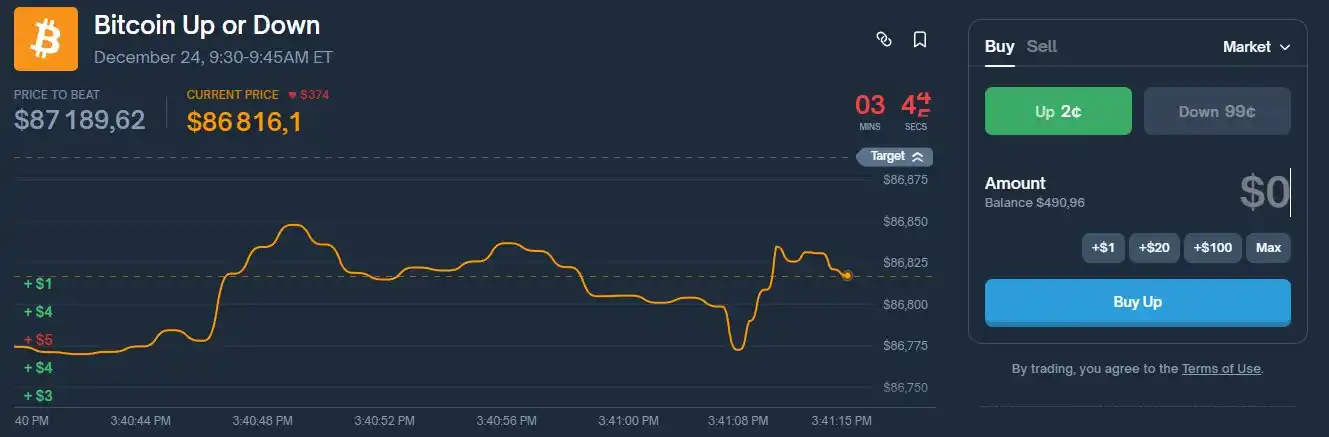
The bot runs a real-time monitoring program that can automatically switch to the current BTC 15-minute round, streamlining the best bid/ask through a WebSocket, displaying a fixed terminal UI, and allowing comprehensive control through text commands.
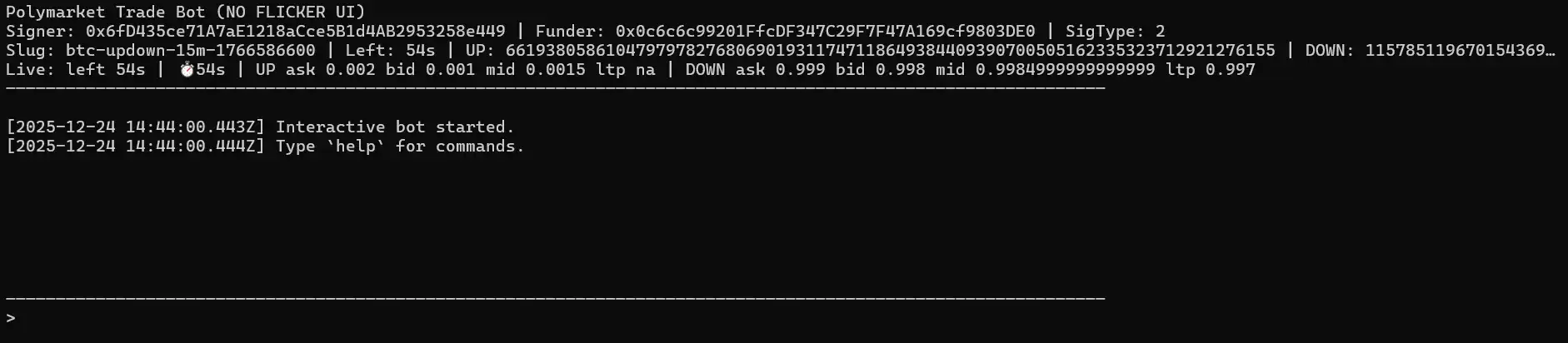
In manual mode, you can place orders directly.
buy up <usd> / buy down <usd>: Buy a specific amount in USD.
buyshares up <shares> / buyshares down <shares>: Purchase an exact amount of shares, using a user-friendly LIMIT + GTC (Good 'Til Canceled) order, executed at the current best ask price.
Automatic mode runs a recurring two-leg loop.
First, it only observes price movements within the windowMin minutes at the start of each round. If either side drops fast enough (reaching a drop percentage of at least movePct in about 3 seconds), it triggers "Leg 1," buying the side that experienced the sharp decline.
After completing Leg 1, the bot will never again buy the same side. It will wait for the "Second Leg (Leg 2, i.e., hedge)" and only trigger if the following condition is met: leg1EntryPrice + oppositeAsk <= sumTarget.
When this condition is met, it buys the opposite side. After Leg 2 is completed, the cycle ends, the bot returns to watching mode, waiting for the next flash crash signal using the same parameters.
If there is a change in the round during the cycle, the bot abandons the open cycle and restarts with the same settings in the next round.
The parameter settings for auto mode are as follows: auto on <shares> [sum=0.95] [move=0.15] [windowMin=2]
· shares: Position size for the two-stage trade.
· sum: Threshold for allowed hedging.
· move (movePct): Flash crash threshold (e.g., 0.15 = 15%).
· windowMin: Time from the start of each round to allow the execution of Leg 1.
Backtesting
The bot's logic is simple: wait for a violent flash crash, buy the side that just dropped, then wait for the price to stabilize and hedge by buying the opposite side, ensuring that priceUP + priceDOWN < 1.
But this logic needs to be tested. Is it really effective in the long run? More importantly, the bot has many parameters (shares, sum, move percentage, window minutes, etc.). Which parameter set is optimal and maximizes profit?
My first thought is to have the bot run live for a week and observe the results. The issue is that this takes too long and can only test one set of parameters, whereas I need to test many.
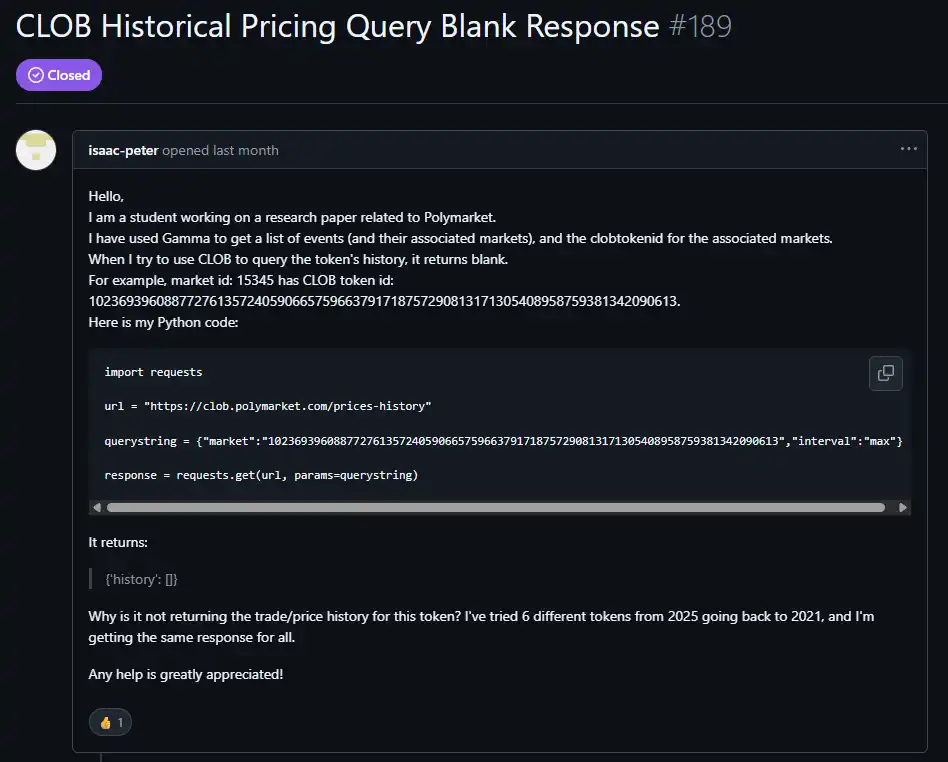
My second thought is to backtest using online historical data from the Polymarket CLOB API. Unfortunately, for the BTC 15-minute up/down market, the historical data endpoint consistently returns empty datasets. Without historical price ticks, the backtest cannot detect an "approximately 3-second flash crash," cannot trigger Leg 1, and regardless of the parameters used, results in 0 cycles and 0% return on investment (ROI).

Upon further investigation, I found that other users also encountered the same issue when retrieving historical data for certain markets. I tested other markets that did indeed return historical data and concluded that for this particular market, historical data simply was not preserved.
Due to this limitation, the only reliable way to backtest this strategy is to create my own historical dataset by recording real-time best-ask prices while the bot is running.
The recorder will write snapshots to disk, including the following:
· Timestamp
· Round Slug
· Remaining Seconds
· UP/DOWN Token ID
· UP/DOWN Best Ask Price
Subsequently, the "recorded backtest" will replay these snapshots and deterministically apply the same automated logic. This ensures the ability to obtain the high-frequency data needed to detect flash crashes and hedge conditions.
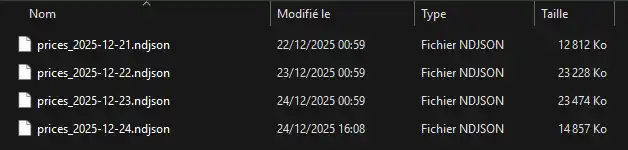
Over 4 days, I collected a total of 6 GB of data. I could have recorded more, but I deemed this sufficient to test different parameter sets.
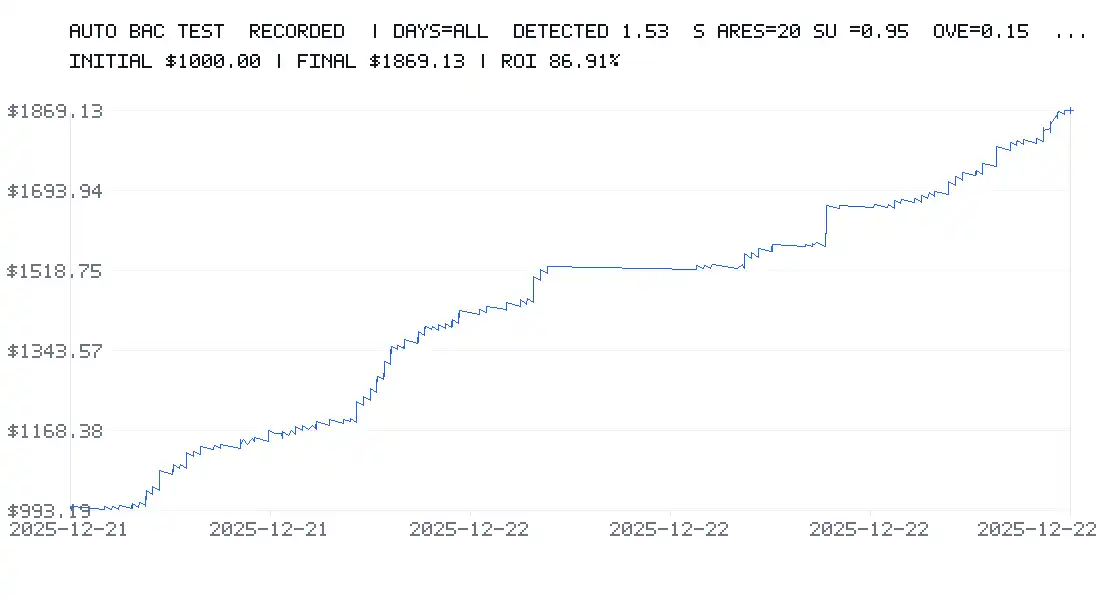
I began testing this set of parameters:
· Initial Balance: $1,000
· 20 Shares per Trade
· sumTarget = 0.95
· Flash Crash Threshold = 15%
· windowMin = 2 minutes
I also applied a constant 0.5% fee and 2% spread to stay in a conservative scenario.
The backtest showed an 86% ROI, turning $1,000 into $1,869 in just a few days.
Next, I tested a more aggressive set of parameters:
· Initial Balance: $1,000
· 20 Shares per Trade
· sumTarget = 0.6
· Flash Crash Threshold = 1%
· windowMin = 15 minutes
Outcome: After 2 days, the investment had a return rate of -50%.
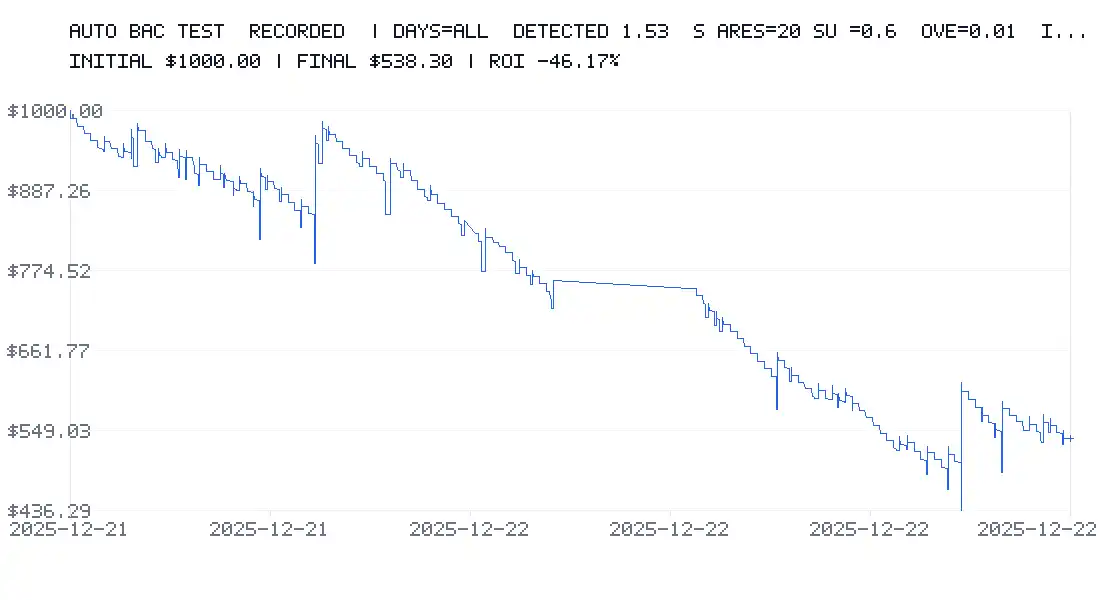
This clearly demonstrates that parameter selection is the most critical factor. It can make you a lot of money or lead to significant losses.
Limitations of Backtesting
Even with costs and spreads included, backtesting has its limitations.
· Firstly, it only uses a few days' worth of data, which may not be sufficient to gain a comprehensive market perspective.
· It relies on recorded optimal sell price snapshots; in reality, orders may partially fill or fill at different prices. Additionally, order book depth and available volume are not modeled.
· Sub-second micro-fluctuations are not captured (data sampled every second). While backtesting has timestamps at a 1-second level, a lot can happen between each second.
· Slippage is constant in backtesting, without simulating variable delays (e.g., 200–1500 milliseconds) or network congestion peaks.
· Each trade segment is assumed to be executed “instantaneously” (no order queueing, no resting orders).
· Costs are uniformly charged, whereas in reality, costs may depend on: Market/Token, Maker-Taker, Fee Tiers, or Conditions.
To maintain a pessimistic (cautious) approach, I applied a rule: if Leg 2 fails to execute before the market close, Leg 1 is considered a total loss.
While intentionally conservative, this doesn’t always align with reality:
· Sometimes Leg 1 can close early,
· Sometimes it ends up in-the-money (ITM) and wins,
· Sometimes the loss can be partial rather than total.
While the loss may be overestimated, this provides a practical “worst-case” scenario.
Most importantly, backtesting cannot simulate the impact of your large orders on the order book or attract predatory behavior from other traders. In reality, your order can:
· Disrupt the order book,
· Attract or repel other traders,
· Cause non-linear slippage.
Backtesting assumes you are a pure liquidity extractor (price taker) with no influence.
Lastly, it does not simulate rate limits, API errors, order rejections, halts, timeouts, reconnects, or situations where the bot is busy and misses signals.
Backtesting is extremely valuable for identifying a good range of parameters, but it is not a 100% guarantee as some real-world effects cannot be modeled.
Infrastructure
I plan to run this bot on a Raspberry Pi to avoid consuming resources on my main machine and keep it running 24/7.
However, there is still significant room for improvement:
· Using Rust instead of JavaScript will provide much better performance and processing time.
· Running a dedicated Polygon RPC node will further reduce latency.
· Deploying on a VPS close to the Polymarket server will also significantly reduce latency.
I'm sure there are other optimization methods that I have not yet discovered. Currently, I am learning Rust as it is becoming an essential language in Web3 development.
You may also like

What Happened in Crypto Today? Solana-Native Rails Launch on Digitap ($TAP) as the Best Crypto to Buy
Key Takeaways Digitap ($TAP) spearheads the transition toward real-world utility in cryptocurrency, offering a seamless financial ecosystem through…

Here’s Why Fed Contender Kevin Warsh is Seen as Bearish for Bitcoin
Key Takeaways Kevin Warsh is a potential nominee for the U.S. Federal Reserve chair, causing concerns due to…

XRP Price Breakdown Intensifies — Can Support Mitigate the Shock?
Key Takeaways XRP has dipped below the significant $1.80 mark, continuing its downtrend. The asset is trading beneath…

Kevin Warsh Associated with Crypto Project Basis and Electric Capital
Key Takeaways Kevin Warsh, former U.S. Federal Reserve Board Governor, is associated with crypto initiatives Basis and Electric…

Why is Trump’s Fed Chair Pick Kevin Warsh Seen as Bad News for Precious Metals, Commodities, Bitcoin, and Equities?
Key Takeaways: Kevin Warsh, once appointed, is expected to take a more hawkish stance on monetary policy, which…

Who Is Kevin Warsh? How His Fed Chair Odds Are Influencing Bitcoin Markets
Key Takeaways Kevin Warsh, a former Federal Reserve governor, is becoming a strong candidate for the next Fed…

Strategy (MSTR) Stock: Michael Saylor’s Bitcoin Bet Goes Red But Here’s The Twist
Key Takeaways Strategy’s Bitcoin investment has dipped below its average purchase price, highlighting market volatility. No immediate financial…

Gov-Backed Asset or Solana Meme? Uncovering the Reality Behind the USOR Crypto Frenzy
Key Takeaways USOR, a Solana token, sparked a debate over its legitimacy by claiming associations with U.S. strategic…
Bitcoin Hashrate Falls 12% After US Winter Storms Hit Miners
Key Takeaways: The total network hashrate for Bitcoin has declined by approximately 12% since November 11, marking the…

Gold’s Six-Month Rally Against Bitcoin Shows Parallels to 2019 Cycle
Key Takeaways Gold has consistently outperformed bitcoin over the last six months, despite being typically considered the haven…

Mantle’s Cross-Chain Era on Solana: Onboarding the Bybit Express to Mantle Super Portal
Key Takeaways Bybit joins forces with Mantle to enhance cross-chain asset flows through the Mantle Super Portal. Mantle…

XRP Price Outlook for 2026: Is Bitcoin Hyper Part of Long Term Themes?
Key Takeaways The potential future of XRP in 2026 is significant, with various factors influencing its growth and…

Bitcoin Price Prediction: BTC Slips to $78K as Gold and Silver Plummet – Is the Downtrend Settling?
Key Takeaways Bitcoin and traditional safe havens like gold and silver experience synchronized declines in a volatile market…

Bitcoin Price Prediction: $50B Volume Drops 40% as BTC Tests $83K – Is a Breakdown Next?
Key Takeaways: Bitcoin’s trading volume has seen a significant decline, indicating cautious trader behavior. Bitcoin prices remain under…
Bitcoin’s 7% Drop to $77K Might Indicate Cycle Low, Analyst Suggests
Key Takeaways: Bitcoin has experienced a significant drop from $77,000 to around $78,600 after a modest rebound. Analyst…
US Court Sentences Chinese National to Nearly Four Years for $37M Crypto Fraud
Key Takeaways Jingliang Su, a Chinese national, received a nearly four-year prison sentence for laundering over $36.9 million…
Tom Lee–Linked Bitmine Faces Over $6B in Unrealized Losses on ETH Reserve
Key Takeaways: Bitmine Immersion Technologies reports significant unrealized losses exceeding $6 billion from its Ether reserves. The firm…

Silver Suffers Record 36% Drop as Precious Metals Crash – Is Bitcoin Primed for a Rally?
Key Takeaways Silver and gold undergo a historic collapse due to geopolitical and technical influences, culminating in significant…
What Happened in Crypto Today? Solana-Native Rails Launch on Digitap ($TAP) as the Best Crypto to Buy
Key Takeaways Digitap ($TAP) spearheads the transition toward real-world utility in cryptocurrency, offering a seamless financial ecosystem through…
Here’s Why Fed Contender Kevin Warsh is Seen as Bearish for Bitcoin
Key Takeaways Kevin Warsh is a potential nominee for the U.S. Federal Reserve chair, causing concerns due to…
XRP Price Breakdown Intensifies — Can Support Mitigate the Shock?
Key Takeaways XRP has dipped below the significant $1.80 mark, continuing its downtrend. The asset is trading beneath…
Kevin Warsh Associated with Crypto Project Basis and Electric Capital
Key Takeaways Kevin Warsh, former U.S. Federal Reserve Board Governor, is associated with crypto initiatives Basis and Electric…
Why is Trump’s Fed Chair Pick Kevin Warsh Seen as Bad News for Precious Metals, Commodities, Bitcoin, and Equities?
Key Takeaways: Kevin Warsh, once appointed, is expected to take a more hawkish stance on monetary policy, which…
Who Is Kevin Warsh? How His Fed Chair Odds Are Influencing Bitcoin Markets
Key Takeaways Kevin Warsh, a former Federal Reserve governor, is becoming a strong candidate for the next Fed…


 App
App